
You've decided to outsource your email support. Now comes the hard part: figuring out which provider actually fits your business.
Most RFP templates you'll find online are built for enterprise companies with procurement teams and six-figure budgets. They'll have you asking about "omnichannel integration roadmaps" and "AI-driven sentiment analysis capabilities" when all you really need is someone to answer your customers' emails without making you look bad.
This customer support outsourcing RFP template is different. It's built for small SaaS and e-commerce businesses that need practical answers, not corporate fluff. You'll get the complete document structure, the 20 questions that actually matter, and copy-paste sections you can customize in minutes.
What Makes an RFP Different from a List of Questions
Before diving in, let's clear something up: an RFP (Request for Proposal) isn't just questions you fire at vendors. It's a structured document that tells providers who you are, what you need, and how to respond.
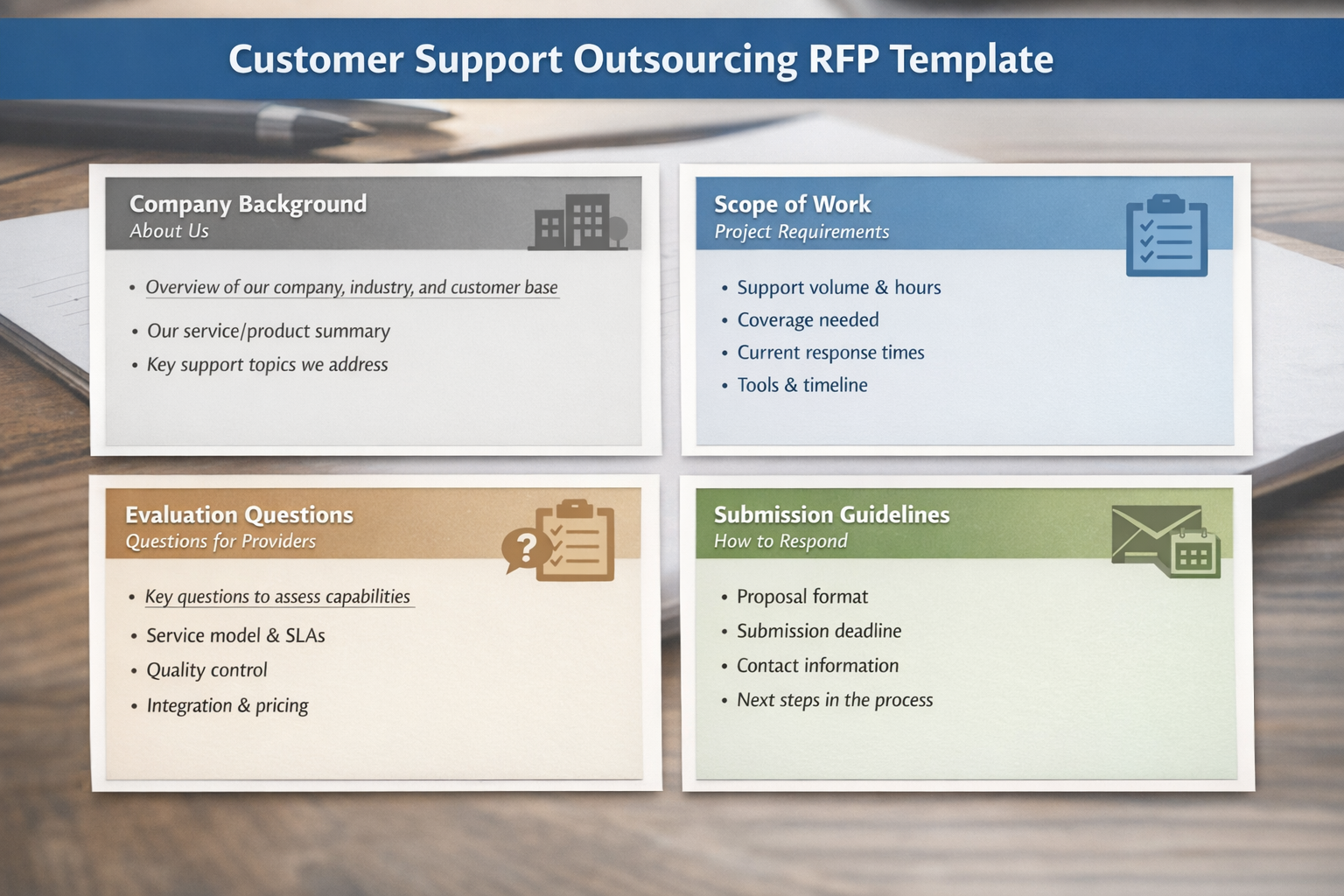
A complete RFP includes four essential parts:
Company Background – A brief introduction to your business so providers understand context
Scope of Work – Your specific requirements, volumes, and expectations
Evaluation Questions – The 20 questions we'll cover in detail below
Submission Guidelines – How and when providers should respond
Skip any of these, and you'll get inconsistent responses that are impossible to compare. Include all four, and providers will take you seriously—even if you're a five-person team.
How to Structure Your RFP Document
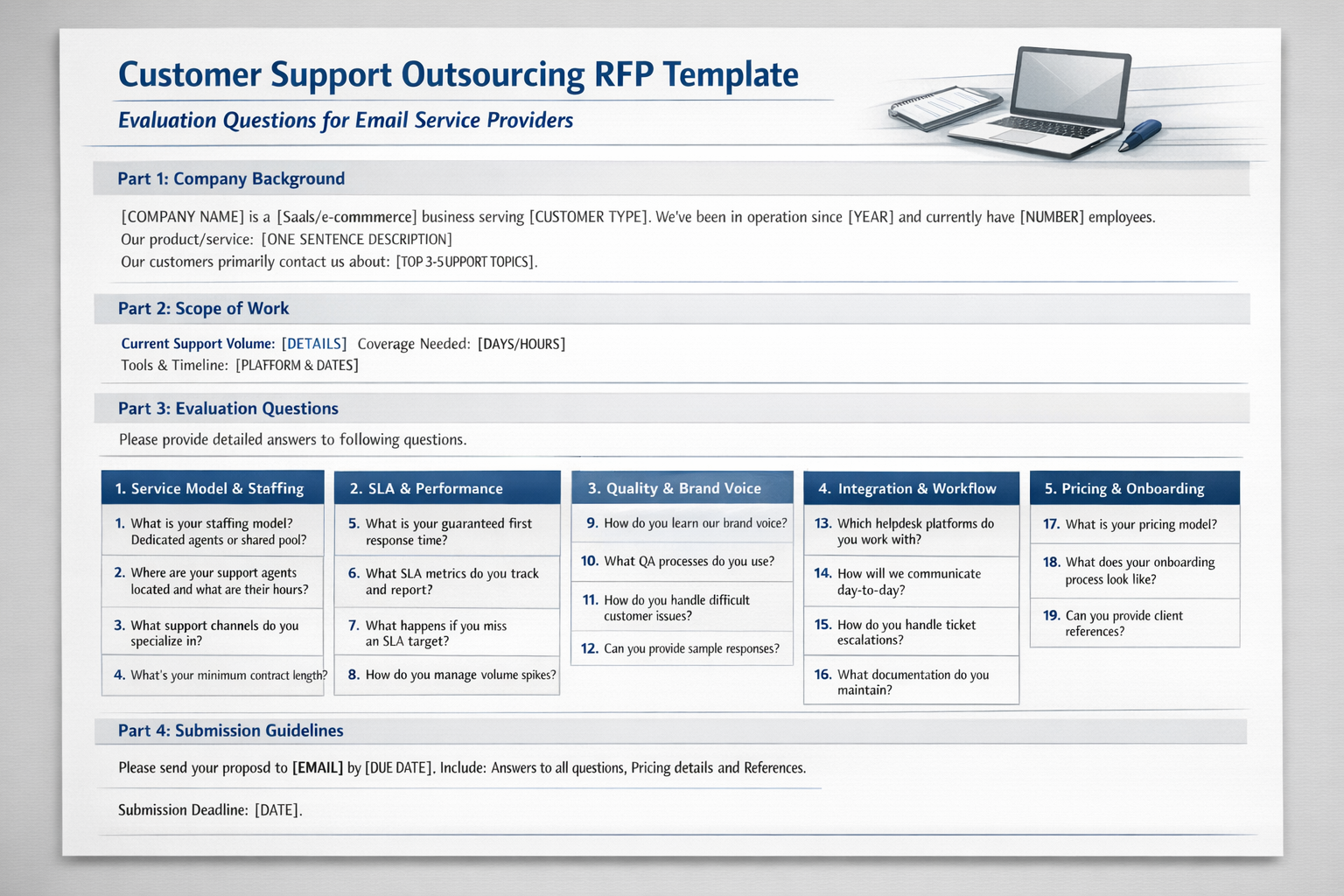
Here's a copy-paste framework you can customize for your business. Fill in the brackets with your specifics.
Part 1: Company Background (Keep It Short)
[COMPANY NAME] is a [SaaS/e-commerce] business serving [CUSTOMER TYPE]. We've been in operation since [YEAR] and currently have [NUMBER] employees.Our product/service: [ONE SENTENCE DESCRIPTION]Our customers primarily contact us about: [TOP 3-5 SUPPORT TOPICS]
Don't write a novel about your company history—just tell them what you sell and who buys it. Providers need context, not your origin story.
Part 2: Scope of Work
CURRENT SUPPORT VOLUME:- Approximately [NUMBER] support tickets per month- Peak periods: [SEASONALITY OR LAUNCH CYCLES]- Current average response time: [HOURS/DAYS]COVERAGE NEEDED:- Days: [Monday-Friday / 7 days]- Hours: [Business hours / Extended / 24-7]- Holidays: [Coverage needed? Y/N]CHANNELS:- Primary: Email/ticket support- Secondary: [If applicable]TOOLS WE USE:- Helpdesk: [Zendesk/HelpScout/Freshdesk/Other]- Communication: [Slack/Teams/Other]TIMELINE:- RFP responses due: [DATE]- Decision target: [DATE]- Desired go-live: [DATE]
Being specific here saves everyone time. A provider who can't meet your volume or coverage needs should self-select out early.
Part 3: Evaluation Questions
This is where the 20 questions below come in. Include them exactly as written, or customize based on your priorities.
Part 4: Submission Guidelines
Please submit your proposal to [EMAIL] by [DATE].Your response should include:- Answers to all 20 evaluation questions- Proposed pricing based on our stated volume- Two references from similar businesses- Sample response to this scenario: [INCLUDE A REAL TICKET FROM YOUR QUEUE]We will schedule calls with finalists during [DATE RANGE].
Now let's get to those questions.
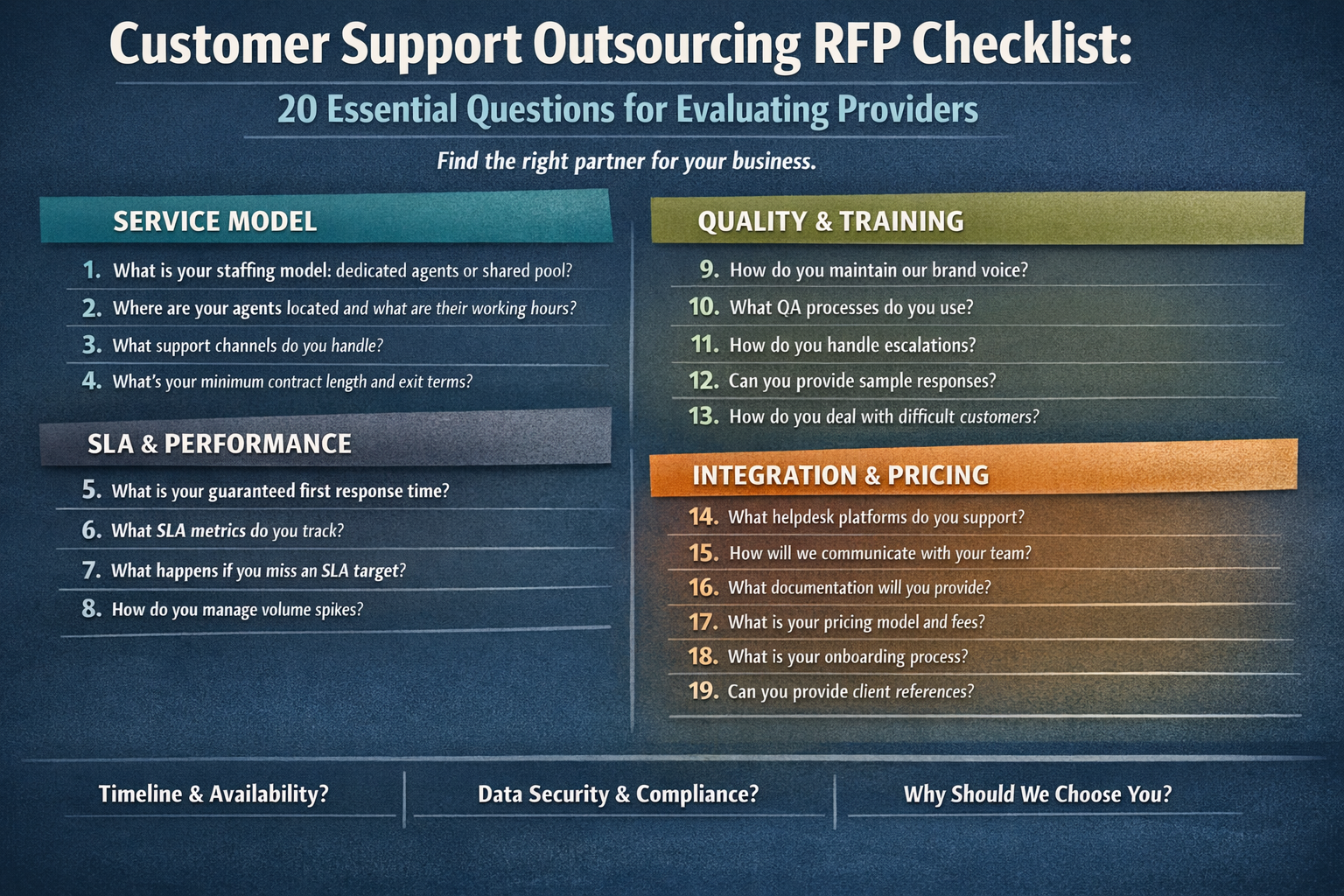
Section 1: Understanding Their Service Model (Questions 1–4)
These questions establish whether the provider's basic structure matches your needs.
Question 1: What is your staffing model, and will we have dedicated agents or a shared pool?
Why this matters: Dedicated agents learn your product, your voice, and your customers' quirks. Shared pools might offer lower costs but often deliver inconsistent service quality.
What to look for: Clarity on exactly who will be handling your tickets. The best providers can name specific people or describe a small, consistent team.
Red flag: Vague answers about "our team of specialists" without specifics on how work gets assigned.
Question 2: Where are your support agents located, and what are their working hours?
Why this matters: Location affects cultural fluency, language quality, and availability during your customers' peak hours.
What to look for: Specifics on location, time zones covered, and how their hours align with your customer base. Teams with native-level English fluency and time zone overlap with your customers typically deliver smoother interactions [1].
Red flag: Reluctance to specify locations or claims of "global coverage" without details.
Question 3: What support channels do you handle, and what's your core specialty?
Why this matters: Providers who try to do everything often excel at nothing. Those who specialize in email support typically deliver higher quality for that channel.
What to look for: Honest acknowledgment of their strengths. A provider focused on email will likely outperform one spreading attention across phone, chat, SMS, and social simultaneously.
Red flag: Claims of equal excellence across every possible channel.
Question 4: What's your minimum contract length, and what happens if the partnership isn't working?
Why this matters: Long-term contracts protect the provider, not you. Flexibility indicates confidence in their service quality.
What to look for: Month-to-month options or short trial periods. Clear exit terms without punitive fees.
Red flag: Pressure to sign annual contracts before you've seen results.
Section 2: Evaluating SLA Criteria and Performance Standards (Questions 5–8)
Service Level Agreements (SLAs) define what you're actually paying for. These questions help you understand what guarantees you'll receive—and what happens when they're missed.
Question 5: What is your guaranteed first response time, and how do you measure it?
Why this matters: "Fast response times" means nothing without specifics. Email customers generally expect replies within a few hours, with many anticipating responses in under four hours during business hours [2].
What to look for: Concrete commitments (e.g., "all emails answered within 24 hours, Monday through Friday") with clear measurement methodology.
Red flag: Hedged language like "typically" or "on average" instead of guarantees.
Question 6: What SLA metrics do you track, and how will you report them to us?
Why this matters: You can't improve what you don't measure. Common metrics include first response time, resolution time, customer satisfaction scores, and ticket volume trends.
What to look for: Regular reporting (weekly or monthly) with clear explanations of each metric. Bonus points for proactive insights, not just data dumps.
Red flag: No standard reporting or charges for "custom analytics."
Question 7: What happens when you miss an SLA target?
Why this matters: Every provider misses targets occasionally. How they respond reveals their accountability standards.
What to look for: Clear remediation processes, service credits, or other accountability measures. Genuine acknowledgment that misses happen and concrete steps they take when they do.
Red flag: Dismissive attitudes about SLA misses or buried fine print that makes guarantees essentially meaningless.
Question 8: How do you handle unexpected ticket volume spikes?
Why this matters: Product launches, viral moments, or seasonal peaks can overwhelm undersized teams. Your customers shouldn't suffer because you had a good sales day.
What to look for: Concrete plans for scaling up quickly—whether that's backup staff, cross-trained team members, or clear escalation protocols.
Red flag: Rigid staffing with no surge capacity or extra charges that kick in exactly when you need help most.
Section 3: Quality Control and Brand Voice Alignment (Questions 9–13)
Quality is what separates outsourcing that feels like an extension of your team from outsourcing that feels like a call center reading from a script.
Question 9: How do you learn and maintain our brand voice in customer communications?
Why this matters: Your support responses represent your brand. A mismatch in tone—too formal, too casual, or just off—erodes customer trust.
What to look for: A structured onboarding process that includes reviewing past tickets, creating style guides, and getting your approval on sample responses before going live.
Red flag: Claims they can "start immediately" without any learning period.
Question 10: What quality assurance processes do you have in place?
Why this matters: Without QA, quality degrades over time. Someone needs to be reviewing responses, catching mistakes, and ensuring consistency.
What to look for: Regular ticket reviews, quality scoring systems, and feedback loops that actually improve performance.
Red flag: Quality assurance that's entirely reactive (only triggered by complaints).
Question 11: How do you handle situations where an agent doesn't have the answer?
Why this matters: Your customers shouldn't get wrong information just because an agent felt pressure to respond quickly.
What to look for: Clear escalation paths, willingness to say "let me find out," and processes for updating knowledge bases when gaps appear.
Red flag: Pressure on agents to resolve everything in one response regardless of accuracy.
Question 12: Can you share examples of responses you've written for similar businesses?
Why this matters: Past work reveals more than promises. Writing samples show their actual communication quality and adaptability.
What to look for: Examples that demonstrate range, empathy, and clear problem-solving. Even better: examples that required adapting to different brand voices.
Red flag: Refusal to share any samples or only providing overly polished "showcase" examples.
Question 13: How do you handle sensitive situations like angry customers or refund requests?
Why this matters: Anyone can answer easy questions. Difficult situations reveal true capability.
What to look for: Thoughtful approaches that balance customer satisfaction with your business policies. Understanding that empathy matters but so do your bottom-line boundaries.
Red flag: Rigid scripts or inability to discuss nuanced scenarios.
Section 4: Integration, Communication, and Workflow (Questions 14–17)
The practical mechanics of working together determine whether outsourcing feels seamless or creates additional management burden.
Question 14: What helpdesk platforms do you work with, and will you use our existing system?
Why this matters: Switching platforms creates friction, data migration headaches, and learning curves for your team.
What to look for: Flexibility to work within your current tools (Zendesk, HelpScout, Freshdesk, Intercom, etc.) rather than forcing you onto their preferred system.
Red flag: Requiring you to adopt their proprietary platform.
Question 15: How will day-to-day communication work between your team and ours?
Why this matters: You need quick answers when policies change, promotions launch, or issues arise. Email chains with 24-hour turnarounds won't cut it.
What to look for: Real-time communication channels (like Slack) alongside scheduled check-ins. Clear escalation paths for urgent issues.
Red flag: Communication limited to weekly status meetings or email only.
Question 16: How do you handle ticket escalations that require our input?
Why this matters: Some issues legitimately need your involvement—technical bugs, unusual requests, VIP customers. The handoff process matters.
What to look for: Clear criteria for what gets escalated, how escalations are flagged, and expected turnaround times on your side.
Red flag: Either escalating everything (defeating the purpose of outsourcing) or escalating nothing (risking mishandled situations).
Question 17: What documentation do you create and maintain about our support processes?
Why this matters: Good documentation means consistent answers and easier training for new agents. It also protects you if the relationship ends—you should own that knowledge.
What to look for: Proactive documentation of FAQs, common issues, and response templates. Clear agreement that you own all documentation created.
Red flag: No systematic documentation or claims that documentation is proprietary.
Section 5: Pricing, Onboarding, and Partnership Terms (Questions 18–20)
Money questions deserve straight answers. These final questions ensure you understand exactly what you're paying for.
Question 18: What is your pricing model, and what's included versus extra?
Why this matters: Hidden fees erode trust and blow budgets. You need to understand the total cost, not just the headline number.
What to look for: Transparent pricing based on clear metrics (ticket volume, hours, etc.). Comprehensive explanations of what's standard versus what incurs additional charges.
What to ask about specifically:
Onboarding fees
Reporting and analytics
Weekend or holiday coverage
Quality assurance
Documentation creation
Platform or tool costs
Red flag: Pricing that seems too good to be true (it usually is) or complexity designed to obscure actual costs.
Question 19: What does your onboarding process look like, and how long until you're handling tickets independently?
Why this matters: Onboarding determines how quickly you'll see value and how much of your time will be consumed in the transition.
What to look for: A structured timeline with clear milestones. Typical onboarding periods range from one to three weeks depending on complexity [3]. Should include knowledge transfer, sample responses for your approval, and gradual handoff.
Red flag: No structured process or promises of "day one readiness" without adequate preparation.
Question 20: What references can you provide from similar businesses?
Why this matters: Current clients tell you what sales conversations won't.
What to look for: References from businesses similar in size, industry, and support complexity. Willingness to connect you directly.
Red flag: No references available or only references from vastly different business types.
Quick Reference: All 20 Questions at a Glance
For easy copying into your RFP document:
| # | Question |
| 1 | What is your staffing model, and will we have dedicated agents or a shared pool? |
| 2 | Where are your support agents located, and what are their working hours? |
| 3 | What support channels do you handle, and what's your core specialty? |
| 4 | What's your minimum contract length, and what happens if the partnership isn't working? |
| 5 | What is your guaranteed first response time, and how do you measure it? |
| 6 | What SLA metrics do you track, and how will you report them to us? |
| 7 | What happens when you miss an SLA target? |
| 8 | How do you handle unexpected ticket volume spikes? |
| 9 | How do you learn and maintain our brand voice in customer communications? |
| 10 | What quality assurance processes do you have in place? |
| 11 | How do you handle situations where an agent doesn't have the answer? |
| 12 | Can you share examples of responses you've written for similar businesses? |
| 13 | How do you handle sensitive situations like angry customers or refund requests? |
| 14 | What helpdesk platforms do you work with, and will you use our existing system? |
| 15 | How will day-to-day communication work between your team and ours? |
| 16 | How do you handle ticket escalations that require our input? |
| 17 | What documentation do you create and maintain about our support processes? |
| 18 | What is your pricing model, and what's included versus extra? |
| 19 | What does your onboarding process look like, and how long until you're handling tickets independently? |
| 20 | What references can you provide from similar businesses? |
How to Score and Compare Provider Responses
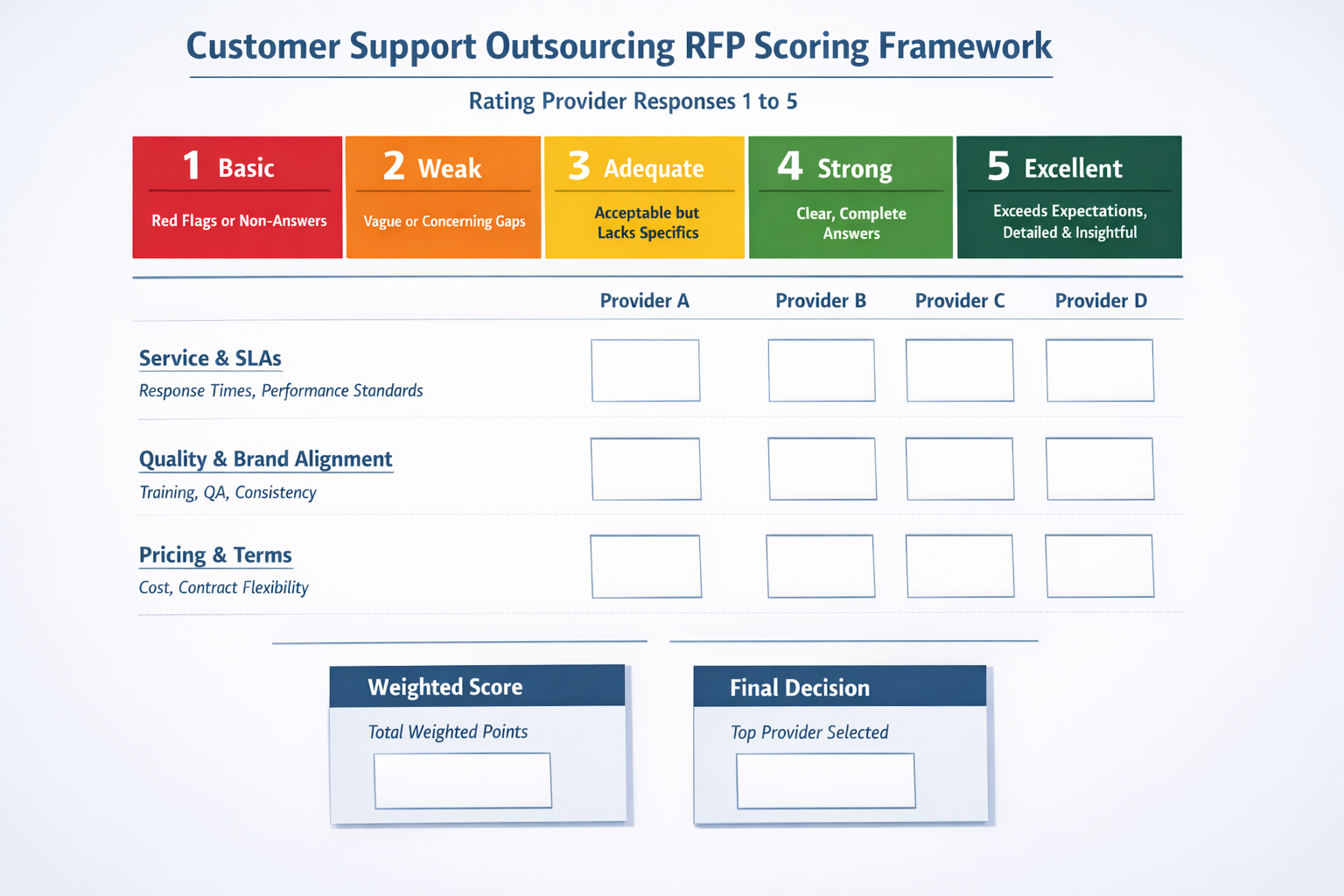
Numbers help prevent decisions based on who had the best sales presentation. Use this scoring framework:
For each question, rate responses 1–5:
5: Exceeds expectations with specific, confidence-inspiring detail
4: Meets expectations with clear, complete answers
3: Adequate but lacking specifics
2: Vague or concerning gaps
1: Red flags or non-answers
Weight categories based on your priorities:
If brand voice consistency is your top concern, weight Section 3 higher. If you've been burned by hidden costs before, weight Section 5 more heavily.
Calculate weighted scores:
Multiply each section's average by its weight, then total for each provider.
Beyond the numbers:
Scores help structure comparison, but trust your gut too. How did communication feel during the RFP process? Were they responsive? Did they ask good questions about your business? The RFP process itself previews what working together will be like.
Red Flags That Should Disqualify a Provider
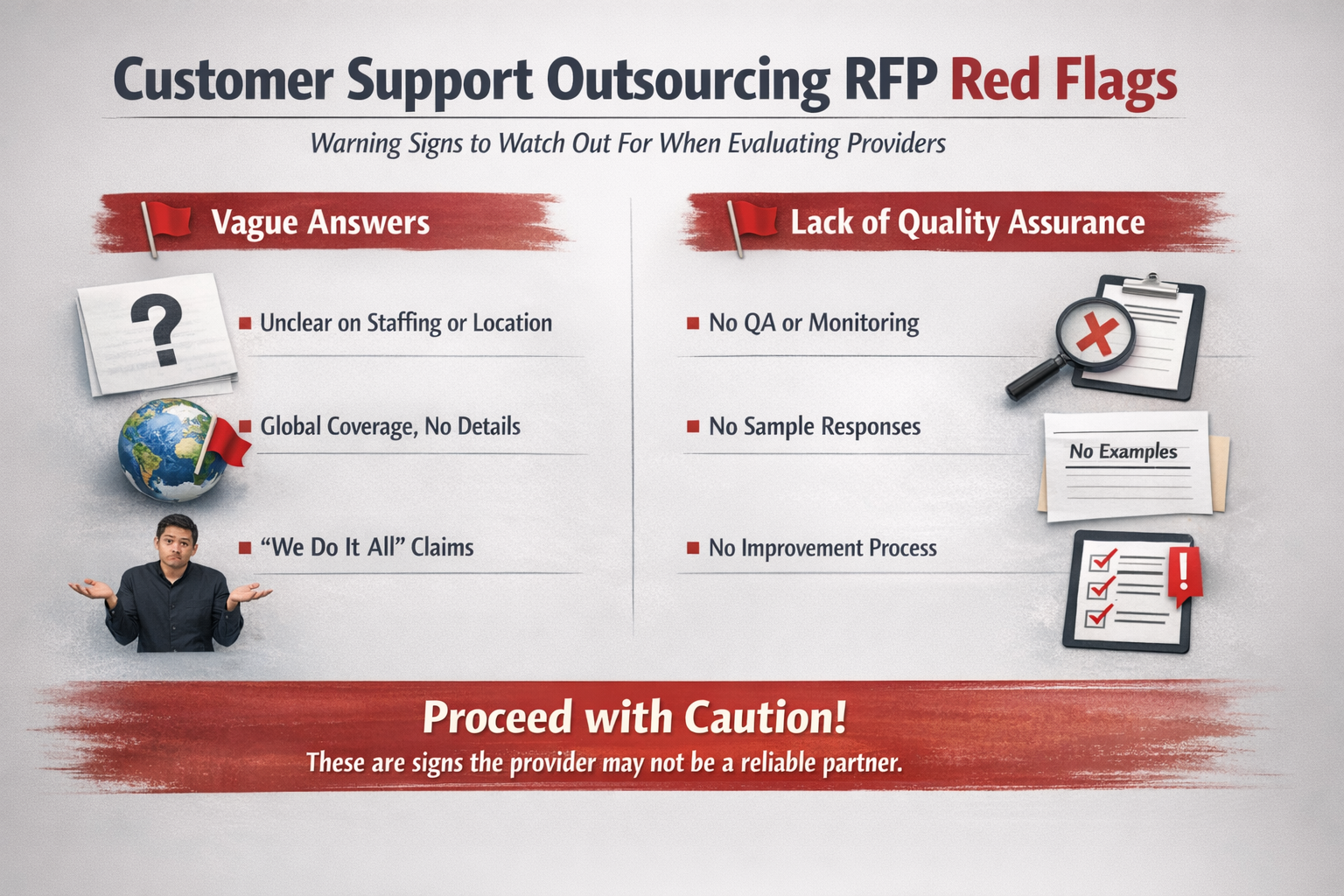
Some issues warrant immediate removal from consideration:
Inability to specify who handles your tickets. If they can't tell you, they probably don't know.
No quality assurance process. Quality without measurement declines.
Pressure for long contracts before proving value. Confident providers don't need to trap you.
Vague answers about location or staffing. Transparency is baseline professional behavior.
Claims of excellence in everything. Specialization beats jack-of-all-trades for quality.
No references or only enterprise references when you're a small business. Experience with your type of business matters.
Your Next Step
This template gives you the questions and the structure. Now you need the answers.
Download the complete RFP template as a document you can customize and send to prospective providers. It includes all 20 questions, the copy-paste framework sections, scoring matrices, and space for notes.
If you're evaluating outsourced email support options and want to talk through what matters most for your specific situation, schedule a call with Evergreen Support. We're happy to discuss your needs—even if we're not the right fit, we can help you figure out what questions matter most for your business.
Frequently Asked Questions
How many providers should I send this RFP to?
Three to five is usually ideal. Fewer limits your comparison options; more creates evaluation fatigue. Focus on providers whose basic model (pricing tier, specialization, location) already matches your needs before investing time in detailed RFPs.
Should I share this template with providers in advance?
Yes. Giving providers the questions ahead of time leads to more thoughtful, complete responses. You're not trying to trick anyone—you're trying to find a genuine match. Providers who perform worse with preparation time were never going to perform well anyway.
What if a provider's answers are great but their pricing is highest?
The cheapest option rarely delivers the best value in customer support outsourcing. Calculate the cost of poor support: lost customers, damaged reputation, and your time fixing problems. That said, "highest price equals highest quality" isn't automatically true either. Use scoring to assess whether premium pricing reflects premium capability.
How long should I give providers to respond?
One to two weeks is reasonable for a thorough response. Shorter timelines might rush incomplete answers; longer ones suggest the RFP isn't their priority. Note how they communicate during this period—it previews future collaboration.
What if I need help evaluating responses?
If you're unsure how to interpret technical answers or spot concerning patterns, consider asking a peer who's been through this process or seeking an expert consultation. Many support agencies offer free consultations that can help you understand what good answers look like.
E-E-A-T: Why Trust This Template
This RFP template was developed based on real-world experience helping small SaaS and e-commerce businesses evaluate support partners. It reflects lessons learned from founders who've navigated this process—what worked, what they wished they'd asked, and what red flags they learned to recognize too late. The goal isn't to sell you on any particular solution but to help you make an informed decision that serves your customers and your business.
Cited Works
[1] Bureau of Labor Statistics — "Customer Service Representatives: Occupational Outlook." https://www.bls.gov/ooh/office-and-administrative-support/customer-service-representatives.htm
[2] HubSpot Research — "State of Service Report."
https://www.hubspot.com/state-of-service
[3] Help Scout — "The Complete Guide to Outsourcing Customer Support." https://www.helpscout.com/blog/outsourcing-customer-support/


