

You've built something people actually want. Customers are signing up, orders are coming in, and your inbox is exploding. That's the good news.
The bad news? You're spending three hours a day answering "Where's my order?" and "How do I reset my password?" instead of building your product, closing deals, or—wild idea—sleeping.
Outsourcing customer support crosses your mind. But then the questions hit. Will they actually understand my product? What happens to my customer data? Will my customers notice the difference?
These aren't paranoid concerns. They're smart ones. Most founders considering outsourced customer support have been burned before—by AI chatbots that frustrated their users, by overseas teams that didn't quite get their brand voice, or by services that seemed great until something went wrong.
Let's address the real questions founders ask about outsourcing support. No spin, no sales pitch—just honest answers.
1. Will an Outsourced Team Actually Understand My Product?
This is the big one. You've spent years building something you know inside and out. How can anyone else possibly explain it to your customers?
Here's the truth: a good outsourced support team won't know your product as well as you do on day one. That's not the goal. The goal is getting them to the point where they can handle 80-90% of incoming questions competently—and know exactly when to escalate the rest to you.
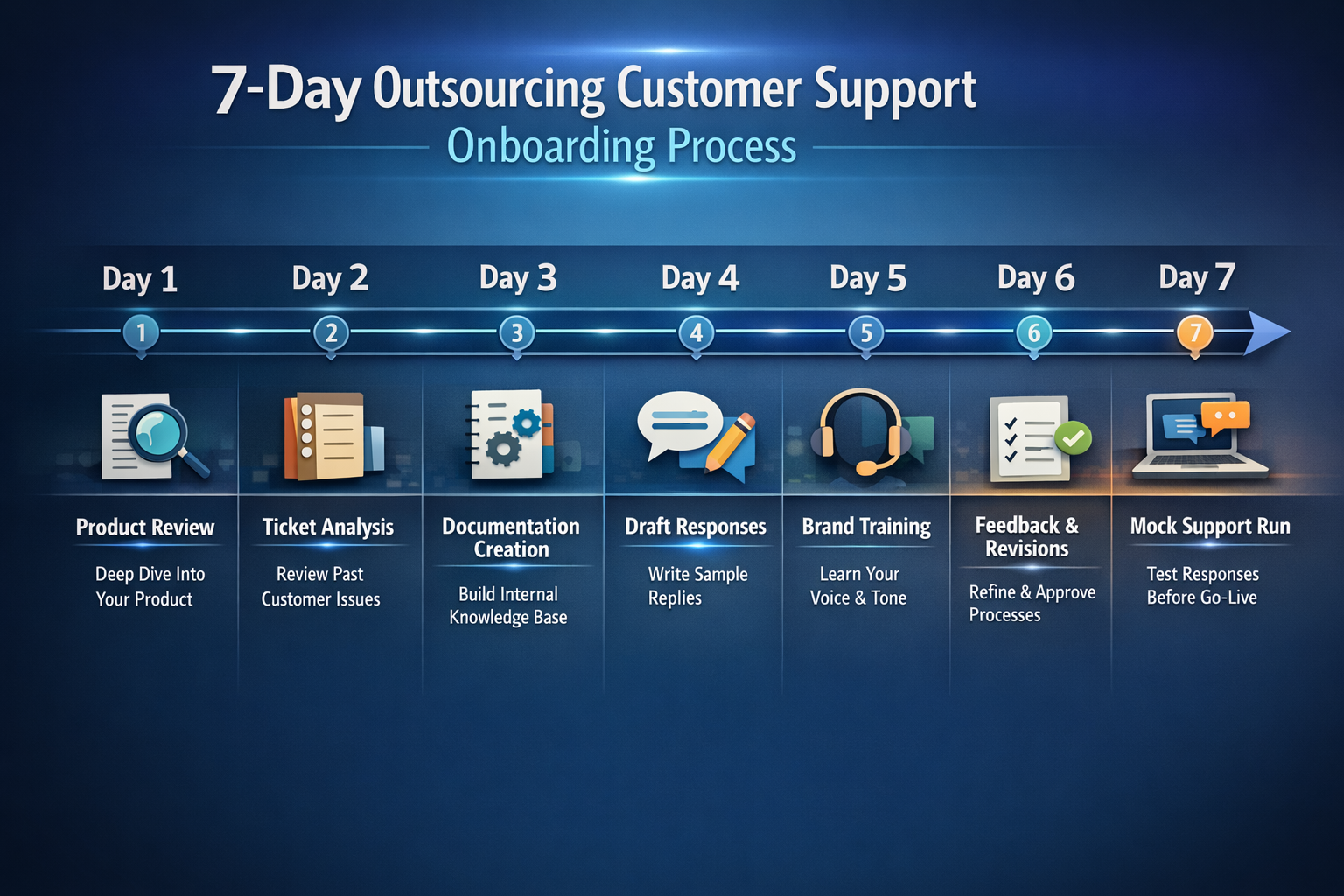
The onboarding process matters enormously here. Quality support agencies spend significant time learning your product, reviewing past tickets, and understanding common issues before they ever touch a customer email. They draft responses for your review. They build documentation from your existing knowledge.
At Evergreen Support, we typically spend seven days doing nothing but learning your business before we answer a single customer inquiry [1]. We review your past tickets, create internal documentation, and write sample responses for you to approve or edit.
The key question to ask any potential partner: "What does your onboarding process look like, and how do you ensure quality before going live?"
If they can't give you specifics, that's a red flag.
2. How Do I Know My Customers Won't Notice the Difference?
Your customers love your brand because it feels personal. You worry that outsourcing will turn that warm, human experience into something generic and corporate.
This concern is completely valid—and it's why the right partner invests heavily in learning your brand voice before they start.
The practical reality: your customers don't care who types the email. They care that their problem gets solved quickly, accurately, and with empathy. A response that arrives in four hours and genuinely helps them beats a founder-written response that takes three days.
The brand voice piece takes work, though. A good agency will:
Study your existing communications
Draft responses in your voice for approval
Refine based on your feedback
Continue adapting as they learn
You should be able to review responses during onboarding and feel confident they sound like you—not like a call center script [2].
One practical tip: have your support partner use your existing helpdesk and email systems. Whether you're on Zendesk, Help Scout, Intercom, or Gorgias, your customers see the same interface, the same email address, the same experience. The only difference is faster responses.
3. What About Data Security and Customer Privacy?
You're giving an outside team access to customer information, purchase history, and potentially sensitive account details. This should make you nervous. It means you're thinking carefully.
Here's what responsible outsourcing looks like from a security standpoint:
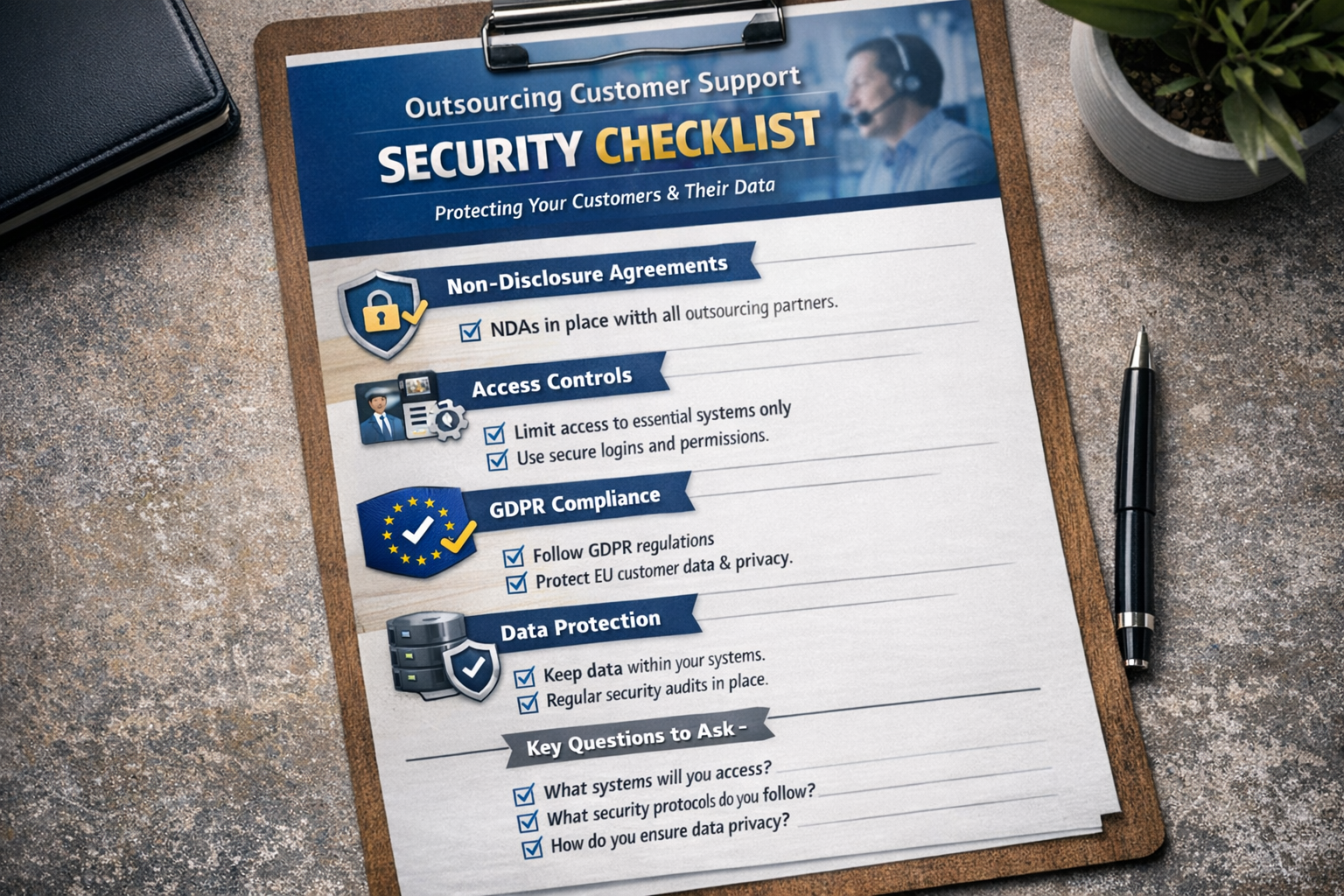
Access controls matter. Your support partner should only access the systems they need. They shouldn't have admin rights to your entire infrastructure. If you use Help Scout, they get Help Scout access. If you use Zendesk, they get Zendesk access. Nothing more.
NDAs are standard. Any reputable agency will sign a non-disclosure agreement before seeing any customer data. If they hesitate, walk away.
Your systems, their access. The safest model involves the support team working within your existing helpdesk software rather than exporting data to their own systems. Your data stays where it is—they just log in to help.
GDPR and compliance. If you serve European customers, ask specifically how your partner handles GDPR requirements. They should be able to give clear answers about data handling, retention, and customer rights requests.
The honest answer is that outsourcing does introduce some additional risk compared to handling everything yourself. But so does hiring employees—and those employees have the same access. The question isn't whether risk exists but whether appropriate safeguards are in place.
When evaluating partners, ask: "Walk me through exactly what systems you'll need access to and what security protocols you follow."
4. What Happens When Something Goes Wrong?
This question usually comes from founders who've been burned before. Maybe an overseas team sent incorrect information. Maybe an AI chatbot made promises you couldn't keep. Maybe a contractor went rogue during a crisis.
First, understand that mistakes will happen. Anyone handling your support—including you—will occasionally mess up. The question is what happens next.
A few things to look for:
Clear escalation paths. Your support partner should know exactly which issues to escalate to you immediately versus handle themselves. A quality agency works with you to define these boundaries upfront. Technical bugs, VIP customers, complex refund requests—whatever matters most to your business should have a clear protocol [3].
Real-time communication channels. You should be able to reach your support team quickly when something urgent comes up. A shared Slack channel is common and works well for this.
Quality oversight. Ask how the agency monitors response quality. Do they have peer review? Management spot-checks? Customer satisfaction tracking? Internal processes matter more than promises.
Accountability structures. Ideally, you'll have dedicated agents assigned to your account who become genuinely familiar with your business over time—not a rotating cast of strangers.
The month-to-month model also matters here. If you're locked into a long-term contract, you have less recourse when things go sideways. Flexible arrangements keep everyone incentivized to perform.
5. How Much Does Outsourcing Actually Cost Compared to Hiring?
This is where the math gets interesting.
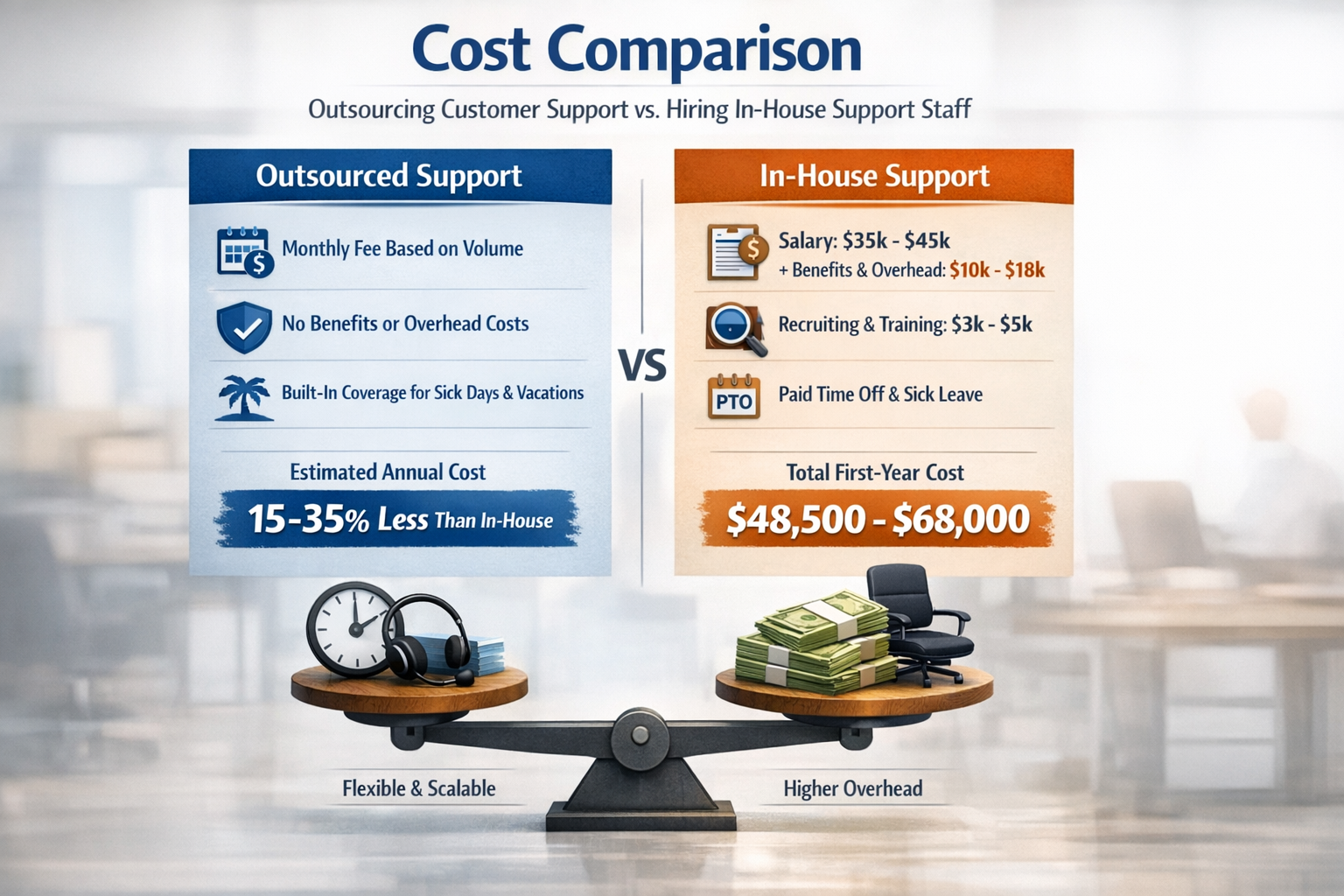
Hiring a full-time, in-house customer support representative costs significantly more than their base salary. According to the Bureau of Labor Statistics, benefits and overhead typically add 30-40% on top of wages [4]. Factor in recruiting costs, training time, management overhead, and the risk of turnover, and a single support hire can easily run $45,000-$65,000 per year fully loaded for an entry-level position.
And that's just one person. If they get sick, take vacation, or quit suddenly, you're back to answering emails yourself.
Here's a simplified comparison:
In-House Hire (Entry-Level)
Base salary: $35,000-$45,000
Benefits & overhead (30-40%): $10,500-$18,000
Recruiting & training: $3,000-$5,000
Total first-year cost: $48,500-$68,000
Outsourced Support (Volume-Based)
Monthly fee based on ticket volume
No benefits, recruiting, or training costs
Built-in coverage for sick days and vacations
Annual cost varies by volume, typically 15-35% less than in-house [5]
The break-even calculation depends on your specific situation:
Under 30-40 hours per week of support work: Outsourcing usually wins on cost and flexibility
40+ hours of consistent work: In-house might make sense, but factor in redundancy needs
Highly variable volume: Outsourcing handles spikes better
The real question isn't just "which is cheaper?" but "which gives me back more time to focus on what actually grows the business?"
6. What If My Business Is Too Small (or Too Unique) to Outsource?
Many founders assume outsourcing only makes sense for larger companies with dedicated support budgets and straightforward products.
Actually, small businesses with complex products are often the best candidates—because the founder or key team member spending hours on support has enormously high opportunity cost.
Think about it this way: if you're the person who can close deals, build features, or make strategic decisions, every hour you spend answering "Did my order ship?" is an hour of your highest-value work lost.
The "we're too unique" objection usually stems from legitimate complexity in your product or customer base. But uniqueness doesn't mean outsourcing is impossible—it means onboarding takes more care.
A few questions to honestly assess your situation:
Can most of your support questions be answered with access to documentation and basic product knowledge?
Are you willing to invest time upfront to train a partner thoroughly?
Do you have clear processes (or the willingness to create them) for handling common issues?
If you answered yes to those, you're probably a good candidate regardless of size.
The businesses that genuinely struggle with outsourcing are those where almost every ticket requires deep technical expertise or C-suite decision-making. If 90% of your tickets need to be escalated, outsourcing doesn't help much.
But that's rare. Most founders find that the majority of their support volume is routine stuff they've answered dozens of times before—the exact kind of work that outsources well.
7. How Do I Make Sure the Transition Doesn't Hurt My Customer Experience?
You've worked hard to build trust with your customers. The idea of handing off communication to someone else feels risky.
The good news: a well-managed transition often improves customer experience rather than hurting it.
Here's why. Your customers probably aren't getting responses as quickly as they'd like right now. Research from Help Scout shows that 90% of customers rate an "immediate" response as important when they have a support question—and "immediate" typically means under 10 minutes for many contexts [6]. If you're currently taking 24-48 hours to reply while juggling everything else, a dedicated support team responding in under 12 hours is a significant upgrade—regardless of who writes the email.
That said, transitions require care. Some practical approaches:
Soft launches work. Start with your support partner handling a subset of tickets while you monitor quality closely. Expand gradually as confidence builds.
Approval periods make sense. During onboarding, review responses before they go out. It takes more time upfront but catches issues before they reach customers.
Feedback loops are essential. Stay close to customer sentiment during the transition. Watch satisfaction scores, read a sample of responses weekly, and maintain open communication with your partner about what's working.
Be ready to course-correct. No transition is perfect. The goal isn't flawless execution from day one—it's a partner who responds constructively to feedback and improves over time.
One often-overlooked benefit: an outsourced team with fresh eyes frequently spots patterns and improvement opportunities you've missed. They'll notice that the same question keeps coming up and suggest a documentation fix. They'll identify confusing product areas that generate tickets. That outside perspective has real value.
8. What Types of Support Issues Should I Still Handle Myself?
Not everything should be outsourced. Even with the best partner, some issues genuinely require your direct involvement.
Keep these in-house:
Complex technical bugs requiring developer input. If the fix requires access to your codebase or deep engineering knowledge, your support partner can gather initial information and acknowledge the issue, but resolution stays with your team.
High-stakes financial decisions. Enterprise contract negotiations, unusual refund situations involving significant amounts, or billing disputes that require executive judgment.
Crisis communications. Major outages, security incidents, or PR-sensitive situations need your direct voice and decision-making authority.
VIP or strategic accounts. If losing a particular customer would materially hurt your business, you may want personal involvement in their support experience.
Your support partner handles:
Routine questions (shipping, password resets, how-to guidance)
Standard troubleshooting within documented procedures
Tier-1 billing inquiries
Initial response and information gathering for complex issues before escalation
A good support partner helps you define these boundaries during onboarding and follows them consistently [3]. The goal is clear protocols so your team knows exactly when to loop you in—and when they're empowered to resolve things independently.
9. Will Outsourcing Help If My Support Volume Is Inconsistent?
Variable volume is actually one of the strongest arguments for outsourcing.
With in-house hires, you either overstaff during slow periods (wasting money) or scramble during busy ones (disappointing customers). There's no winning. You're paying the same salary whether you get 20 tickets or 200.
Volume-based pricing models adjust to your actual needs. You pay for what you use rather than maintaining capacity for peak demand that rarely materializes.
This is particularly valuable for:
Seasonal businesses (ecommerce with holiday spikes, tax software with April rushes)
Launch-driven companies (major feature releases that temporarily spike support needs)
Growing startups (where volume might double in three months and you can't predict exactly when)
The flexibility runs both ways. If your volume drops—maybe you fixed a bug that was generating tickets, or seasonality works in your favor—your costs drop too. Try getting that flexibility with a full-time employee.
10. How Do Outsourced Teams Maintain Quality Over Time?
Quality maintenance requires ongoing effort from both sides. The honeymoon period always looks great—the real question is what happens six months in.
On the agency side, look for:
Peer review of responses
Regular training updates as your product evolves
Management oversight and spot-checks
Customer satisfaction tracking tied to individual agents
On your side, commit to:
Providing feedback when something misses the mark
Updating your partner on product changes, policy updates, and new features
Staying engaged enough to catch drift early
Regular check-ins to review trends and continuously improve
The best partnerships involve recurring communication—whether that's a weekly Slack check-in or a monthly call to review what's working and what needs adjustment.
One warning sign: if your support partner disappears after onboarding and you only hear from them when there's a problem, that's a red flag. Proactive communication about trends, suggestions for improvement, and regular quality updates indicate a partner invested in long-term success.

The Question Behind the Questions
Every FAQ above points to the same underlying concern: "Can I trust someone else with something this important?"
That's the real question. And there's no universal answer—only the answer for your specific situation with your specific partner.
What we can say is this: the founders who successfully outsource support approach it as a partnership, not a transaction. They invest in onboarding. They stay engaged during the early weeks. They provide feedback and expect it in return. They choose partners who align with their values and communication style.
The founders who struggle tend to approach outsourcing as a "set and forget" solution—hand it off and hope for the best. That rarely works with anything important.
If you're considering outsourcing, the most useful thing you can do is talk honestly with a potential partner about your specific concerns. Ask hard questions. See how they respond.
Ready to Have That Conversation?
We built Evergreen Support specifically for small online businesses—founders and small teams who need reliable, human-powered support without the complexity of managing it themselves.
We're not the right fit for everyone. We focus on email support (not phone or chat). We cover business hours Monday through Friday (not 24/7). We work with SaaS and ecommerce companies (not every industry).
But if those parameters match your needs, we'd genuinely like to hear what questions you have that we haven't answered here.
Book a call with Evergreen Support to discuss your specific situation—no pressure, no pitch, just an honest conversation about whether outsourcing makes sense for you.
Frequently Asked Questions
How long does it take to onboard an outsourced support team?
A thorough onboarding process typically takes about seven days from signup to going live. This includes initial discovery calls, reviewing your past support tickets, building internal documentation, and having you approve draft responses before the team handles real customer inquiries. Rushing this process usually leads to problems, so quality agencies won't skip steps even if you're eager to start.
Can I try outsourced support before committing long-term?
Reputable agencies offer month-to-month arrangements specifically because forcing long-term commitments creates misaligned incentives. Some providers, including Evergreen Support, offer low-cost trial onboarding so you can evaluate the fit before full monthly billing begins [1]. If a provider requires annual contracts upfront, ask why—and whether they're confident enough in their service to let you leave.
How do outsourced teams maintain quality over time?
Quality maintenance requires ongoing effort from both sides. On the agency side, this typically includes peer review of responses, regular training updates, and management oversight. On your side, it means providing feedback when something misses the mark and staying engaged enough to catch drift early. The best partnerships involve regular check-ins to review trends and continuously improve.
Will outsourcing help if my support volume is inconsistent?
Variable volume is actually one of the strongest arguments for outsourcing. With in-house hires, you either overstaff during slow periods or scramble during busy ones. Volume-based pricing models adjust to your actual needs—you pay for what you use rather than maintaining capacity for peak demand that rarely materializes.
Why Trust This Information
Evergreen Support was founded by Emma Fletcher and Ellis Annichine after working together at a startup where they experienced the challenges of small-business customer support firsthand. Since 2021, they've built a team of US-based support specialists focused exclusively on helping small online businesses maintain high-quality customer communication. This FAQ reflects real questions from founders they've spoken with and genuine answers based on operational experience in the outsourced support space.
Works Cited
[1] Evergreen Support — "Pricing." https://www.evergreensupport.co/pricing
[2] Evergreen Support — "Keeping Outsourced Customer Support On-Brand." https://www.evergreensupport.co/blog/keeping-outsourced-customer-support-on-brand
[3] Evergreen Support — "Fractional Customer Support Teams: A Startup's Complete Guide." https://www.evergreensupport.co/blog/fractional-customer-support-teams-startups-guide
[4] U.S. Bureau of Labor Statistics — "Employer Costs for Employee Compensation." https://www.bls.gov/news.release/ecec.nr0.htm
[5] Evergreen Support — "Outsource Customer Support Costs vs In-House: 2025 Guide." https://www.evergreensupport.co/blog/outsource-customer-support-cost-comparison
[6] Help Scout — "Customer Service Statistics."
https://www.helpscout.com/75-customer-service-facts-quotes-statistics/


