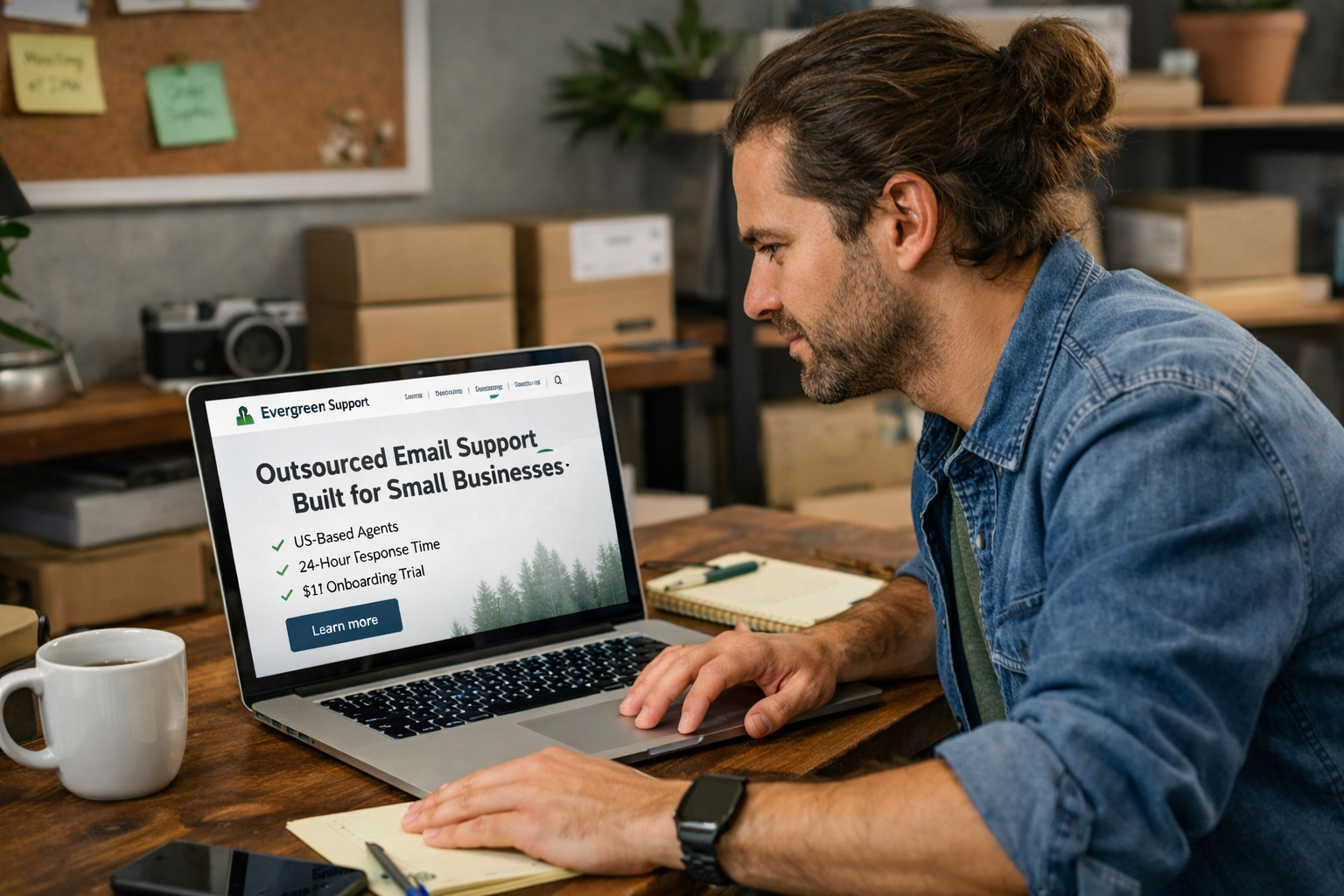

Finding the right outsourced customer support partner for your e-commerce brand feels a bit like dating. There are plenty of options out there, but most of them aren't quite right for your business. And the wrong match? That can cost you customers, revenue, and a whole lot of headaches.
Here's what we've learned from talking to dozens of e-commerce founders: most "best outsourced support" lists are either stuffed with enterprise-level call centers (totally wrong fit for a 5-person Shopify store) or they skip the actual comparison entirely. Neither helps you make a decision.
So let's do something different. This guide breaks down specific outsourced customer support providers for e-commerce brands—who they're best for, what they actually cost, and how to evaluate whether outsourcing even makes sense for your situation.
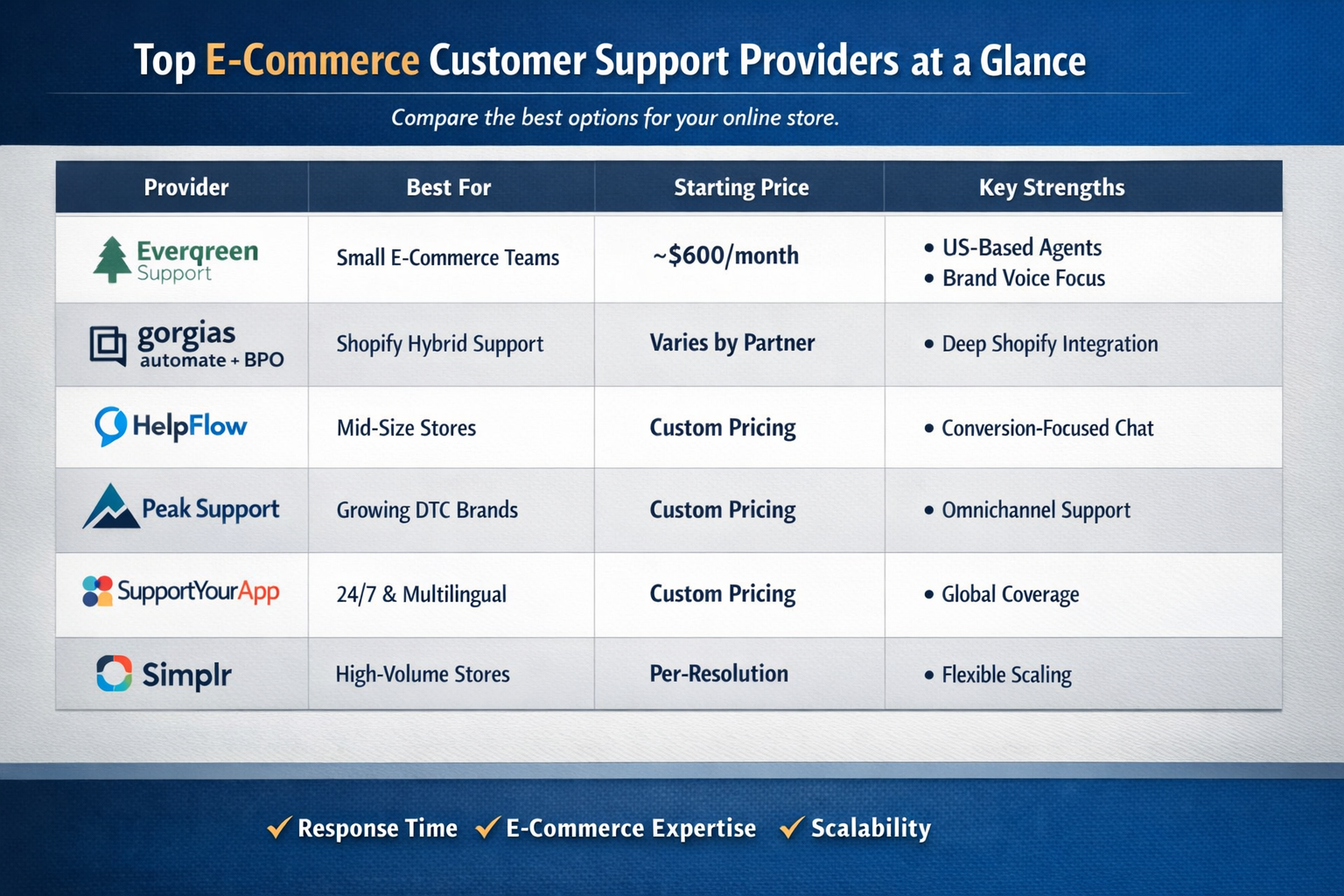
Quick Comparison: Top E-Commerce Support Partners at a Glance
Before diving deep, here's a snapshot of the providers we'll cover:
| Provider | Best For | Starting Price | Key Strength |
| Evergreen Support | Small e-commerce brands (1-5 person teams) | ~$600/month | US-based humans, brand voice focus |
| Gorgias Automate + BPO Partners | Shopify brands wanting tech + human hybrid | Varies by partner | Deep Shopify integration |
| HelpFlow | Mid-size stores needing live chat + email | Custom pricing | Conversion-focused chat |
| Peak Support | Growing DTC brands with higher volume | Custom pricing | Omnichannel coverage |
| SupportYourApp | Brands needing multilingual or 24/7 | Custom pricing | Global coverage options |
| Simplr | High-volume stores during peak seasons | Per-resolution pricing | Flexible scaling |
Now let's break each one down.
Detailed Provider Reviews
Evergreen Support
Best for: Small e-commerce businesses (typically 1-5 person teams) who want human-powered email support without losing their brand's personal touch.
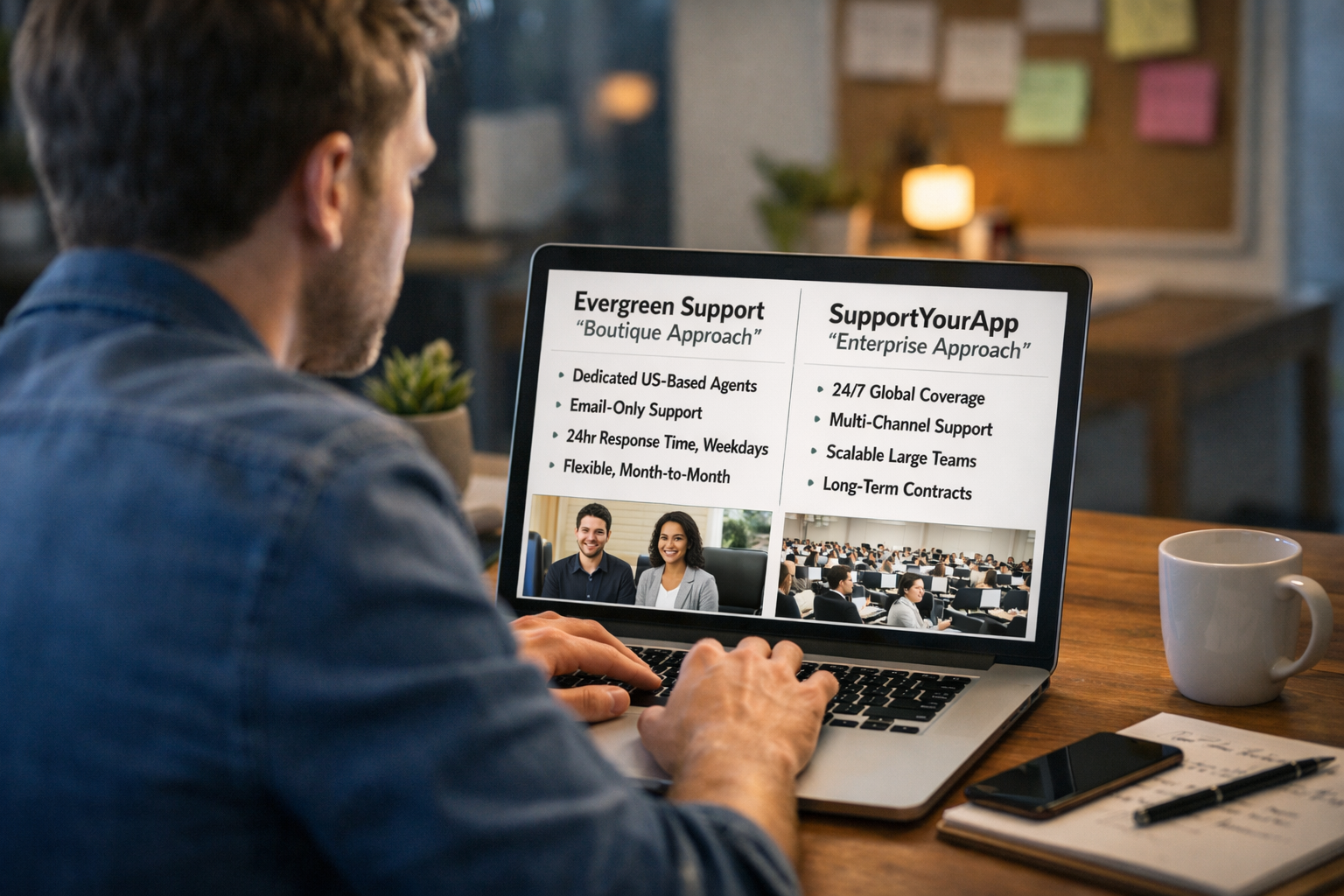
What they do: Evergreen Support is a US-based agency that specializes in email support for small online businesses. They assign two dedicated agents to each account—meaning you get consistent coverage even when one person is out sick or on vacation. Their focus is exclusively on email/ticket support (no phone or live chat), which allows them to specialize rather than spread thin.
Pricing: Volume-based monthly subscription starting around $600/month for up to 100 tickets. Month-to-month contracts with a $1 trial onboarding period.
Standout features:
24-hour response time guarantee (Monday-Friday)
Two dedicated agents who learn your brand voice
They build and maintain your support documentation as they go
No long-term contracts required
Potential limitations:
Email only—no phone or live chat coverage
Business hours Monday-Friday (not 24/7)
Best suited for lower-to-moderate ticket volumes
Best fit if: You're a founder or small team drowning in support emails, you value quality over rock-bottom pricing, and you want someone who sounds like you when replying to customers.
Gorgias Automate + BPO Partners
Best for: Shopify-native brands who want tight integration between their helpdesk and support team.
What they do: Gorgias is primarily a helpdesk platform built for e-commerce, but they've developed an ecosystem of vetted BPO partners who staff support using the Gorgias interface. This means your outsourced team works within the same system you'd use if handling support yourself—complete with order data, customer history, and macros.
Pricing: Gorgias platform pricing is separate from BPO partner fees. Partner pricing varies widely based on scope and volume.
Standout features:
Native Shopify, BigCommerce, and Magento integrations
Support agents see order info without switching systems
Automation handles simple tickets; humans handle complex ones
Choose from multiple vetted partners
Potential limitations:
Requires Gorgias subscription plus partner fees
Quality varies by which partner you select
Can feel complex to evaluate multiple vendors
Best fit if: You're already using (or planning to use) Gorgias and want a support team that lives inside that ecosystem.
HelpFlow
Best for: Mid-size e-commerce stores that see live chat as a conversion tool, not just a support channel.
What they do: HelpFlow positions itself as a "conversion-focused" support provider. Their agents are trained to not just answer questions but to guide shoppers toward purchasing. They handle both live chat and email support, with particular expertise in proactive chat engagement.
Pricing: Custom pricing based on volume and channels. Generally positioned for brands with meaningful traffic and support volume.
Standout features:
Agents trained on sales psychology, not just support scripts
Proactive chat triggers to catch abandoning visitors
Handles both pre-sale and post-sale inquiries
Performance tracking tied to revenue metrics
Potential limitations:
Higher price point than basic support options
Sales-focused approach may not fit every brand voice
Requires sufficient site traffic to justify proactive chat
Best fit if: You have real traffic volume, you believe live chat can drive sales, and you want agents who think like salespeople.
Peak Support
Best for: Growing DTC brands that need professional omnichannel support and have outgrown scrappy solutions.
What they do: Peak Support offers dedicated support teams across email, chat, phone, and social media. They work with a range of e-commerce clients and have developed specific expertise in DTC brand support. Their model typically involves dedicated agents rather than shared pools.
Pricing: Custom pricing based on team size and channels. Generally suited for brands with established support needs.
Standout features:
True omnichannel coverage (email, chat, phone, social)
Dedicated team model builds product knowledge over time
Quality assurance and regular performance reporting
Experience with complex DTC operations (subscriptions, returns, etc.)
Potential limitations:
Pricing may be high for very small brands
Longer ramp-up time for dedicated teams
Better suited for consistent volume than sporadic spikes
Best fit if: You've grown past the "founder handling support" stage and need a professional team across multiple channels.
SupportYourApp
Best for: E-commerce brands needing multilingual support or true 24/7 coverage.
What they do: SupportYourApp provides outsourced support teams with global coverage. They can staff support in multiple languages and time zones, making them suitable for brands selling internationally or needing round-the-clock availability.
Pricing: Custom pricing based on languages, hours, and volume.
Standout features:
Support available in 30+ languages
24/7/365 coverage options
Can handle phone, chat, email, and social
Experience with international e-commerce logistics questions
Potential limitations:
Larger operation may feel less personalized
Pricing for premium coverage (multilingual, 24/7) adds up
May be overkill for US-only, business-hours brands
Best fit if: You sell internationally, have customers in multiple time zones, or genuinely need 24/7 support availability.
Simplr
Best for: High-volume e-commerce stores that need flexible scaling, especially during peak seasons.
What they do: Simplr uses a distributed network of support specialists combined with AI routing to handle customer inquiries. Their model is designed to scale up and down quickly—helpful for brands with significant seasonal swings (think Black Friday, holiday rushes).
Pricing: Per-resolution pricing model, which can be cost-effective for variable volume.
Standout features:
Rapid scaling without long-term commitments
AI-assisted routing to match inquiries with qualified specialists
Pay-per-resolution aligns cost with actual work done
Handles email and chat
Potential limitations:
Less emphasis on dedicated agents who deeply know your brand
Per-resolution pricing requires careful monitoring
AI routing may not suit brands wanting purely human interactions
Best fit if: Your volume fluctuates dramatically and you need a partner who can scale with demand without locking you into fixed costs.
Why E-Commerce Brands Need Specialized Support Partners
Not all customer support is created equal. E-commerce support comes with its own quirks: order tracking questions, shipping delays, returns and exchanges, payment issues, product inquiries. Your support partner needs to understand these workflows inside and out.
Generic call centers that also handle insurance claims and utility complaints? They're not built for the speed and tone your online customers expect.
Research consistently shows that e-commerce customers have high expectations for response times. According to HubSpot, 90% of customers rate an "immediate" response as important when they have a customer service question [1]. For e-commerce specifically, slow responses can directly impact whether someone completes a purchase or abandons their cart entirely.
The stakes are real. A customer waiting 48 hours for a reply about whether an item ships to their address probably isn't waiting around. They've already bought from your competitor.

What to Look for in an E-Commerce Support Partner
Before signing with any provider, here's what actually matters when evaluating outsourced support for your online store.
Response Time Guarantees
Look for partners who commit to specific response time SLAs (service level agreements). Vague promises like "fast responses" don't cut it. You want something concrete—24 hours or less for email, for example.
E-Commerce Platform Experience
Your support team should know their way around Shopify, WooCommerce, BigCommerce, or whatever platform you're running. They should understand how to check order status, process returns, and navigate your backend without needing to escalate every question back to you.
Ask specific questions: "Have you worked with [your platform] before? Can you walk me through how you'd handle a 'where's my order' inquiry?"
Brand Voice Alignment
This matters more than most people realize. Your customers have built a relationship with your brand. If your support suddenly sounds like it's coming from a corporate call center, that disconnect erodes trust.
The best partners invest time learning your tone and style during onboarding. They should create response templates in your voice and have you approve sample replies before going live.
Scalability for Peak Seasons
E-commerce is seasonal. Black Friday, holiday rushes, product launches—your support volume might triple overnight. Your partner should be able to scale up without dropping quality.
Transparent Pricing
Watch out for hidden fees, per-ticket charges that balloon unexpectedly, or contracts that lock you in for years. The best partners offer predictable pricing you can actually budget for.
Human vs. AI Clarity
Some providers quietly use AI to handle tickets while charging human-support rates. If you want human support—and for most e-commerce brands dealing with frustrated customers, you should—confirm you're actually getting it.
Types of Outsourced Support Options
Beyond specific providers, it helps to understand the categories you'll encounter.
Full-Service Support Agencies
These are dedicated customer service agencies that provide trained support professionals to handle your inbox. They typically offer:
Dedicated agents who learn your brand
Process documentation and knowledge base development
Quality assurance and training
Coverage during business hours (some offer extended hours)
Full-service agencies work best for brands that want a true partnership—someone who operates as an extension of your team rather than just a ticket-clearing service.
Virtual Assistant Services
Individual VAs or VA agencies can handle support among other tasks. This option tends to be cheaper but comes with tradeoffs:
Less specialized training in support best practices
Often a single point of failure (if your VA gets sick, you're on your own)
Variable quality depending on who you hire
For very early-stage brands doing minimal volume, a VA might work. But as you scale, the limitations become apparent.
Offshore Call Centers
Traditional BPO (business process outsourcing) companies offer lower prices by staffing overseas call centers. The trade-off is usually quality:
Language and cultural barriers can frustrate customers
High agent turnover means constant retraining
Often optimized for volume, not customer satisfaction
Some e-commerce brands have made offshore work, but it requires heavy oversight and typically suits high-volume, low-complexity interactions.
Tech-Enabled Hybrid Solutions
A growing category combines AI/automation with human agents. These solutions use technology to handle simple inquiries automatically while routing complex issues to humans. The quality varies significantly based on how the AI is implemented and how well the human backup is trained.

Key Questions to Ask Any Potential Partner
Before signing anything, get clear answers to these questions:
What's your onboarding process?A thorough onboarding should include discovery calls, documentation review, draft response approval, and a trial period before going fully live. If they promise to "start tomorrow," that's a red flag.
How do you ensure brand voice consistency?The best partners create response templates in your voice, have you approve sample replies, and provide ongoing quality checks.
What happens when my agent is sick or on vacation?Single-agent setups are risky. Look for partners that assign backup coverage so your inbox never goes dark.
What's included in the price?Get specifics. Does the fee cover documentation work? Slack communication? Training? Some partners nickel-and-dime you for extras.
Can I see sample responses or references?Any reputable partner should be willing to share examples of their work or connect you with current clients.
What's your escalation process?You don't want a partner that tries to handle everything (including complex issues they shouldn't touch) or one that escalates every minor question back to you. Look for clear escalation criteria.
What e-commerce platforms have you worked with?Experience with your specific platform (Shopify, WooCommerce, etc.) significantly reduces ramp-up time.
Red Flags to Watch For
Years of talking to e-commerce founders who've tried (and sometimes failed with) outsourced support reveals some common warning signs:
Promises that sound too good to be true. "We'll cut your support costs by 80% while improving CSAT!" Maybe. But probably not.
No trial period or money-back guarantee. Reputable partners let you test the relationship before committing.
Vague or hidden pricing. If you can't get a straight answer about what you'll pay, walk away.
AI chatbots disguised as human support. Some providers quietly use AI to handle tickets while charging human-support rates. If you want human support, confirm you're getting it.
Long-term contracts with no exit clause. Month-to-month arrangements (or short initial terms) protect you if the partnership isn't working.
High agent turnover. If they can't keep their own people, how will they maintain consistency for your customers?
No e-commerce experience. A partner who's never dealt with "where's my order" emails will take months to get up to speed.
When Outsourcing Makes Sense (And When It Doesn't)
Outsourcing isn't right for every e-commerce brand. Here's a quick sanity check:
Outsourcing probably makes sense if:
You or your team spends hours daily on support instead of growth activities
Support volume is consistent enough to justify a monthly fee
You've tried to hire in-house and struggled with turnover or coverage gaps
You need coverage during times you can't provide it yourself
Your support needs are primarily email/ticket based (versus highly technical)
You might want to hold off if:
Your volume is so low that a few minutes a day handles it
Your product requires extremely deep technical knowledge that's hard to transfer
You're not ready to invest time in proper onboarding and documentation
You're looking for rock-bottom pricing at any cost to quality
The honest truth? Outsourcing requires some upfront effort. You'll need to document your processes, approve response templates, and be available during onboarding. But once that foundation is built, the time savings compound.
Evaluating the True Cost of Support Options
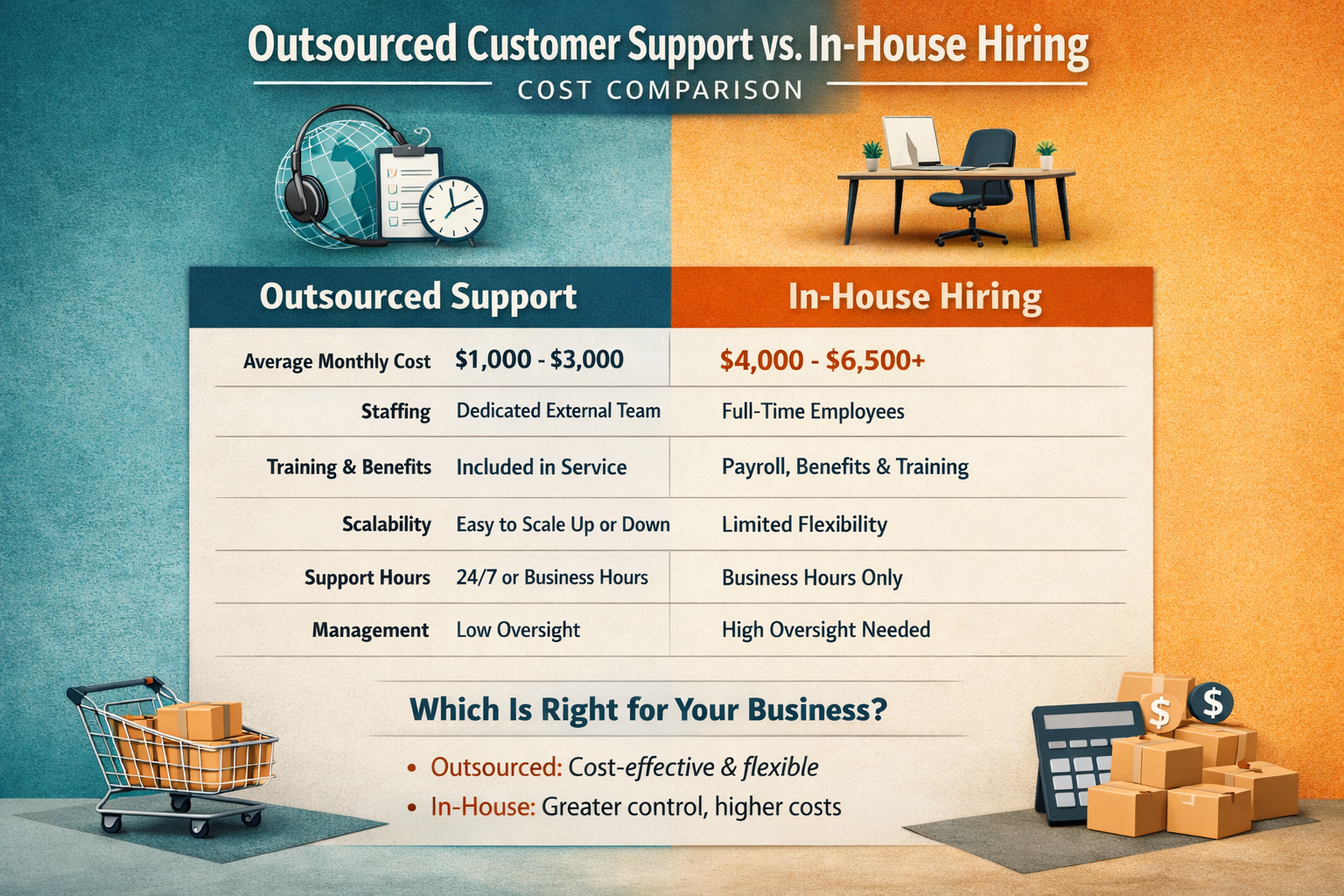
Let's talk numbers, because this is where decisions get made.
Hiring an in-house support rep involves more than just salary. According to the Bureau of Labor Statistics, employer costs for employee compensation average about 30% above base wages when you factor in benefits, taxes, and insurance [2]. Add recruiting costs, training time, and the coverage gaps when your one person is sick or on vacation.
Outsourcing costs vary widely based on provider type and volume:
| Option | Typical Monthly Cost | Coverage | Best For |
| Individual VA | $500–$1,500 | Variable, often part-time | Very early stage, low volume |
| Offshore BPO | $1,000–$3,000 | Full-time, often 24/7 | High volume, simple queries |
| US-Based Agency | $600–$3,000+ | Business hours, volume-based | Small-to-mid brands wanting quality |
| Enterprise Solutions | $5,000+ | Full coverage, multiple channels | Established brands with high volume |
For most small-to-mid e-commerce brands, the sweet spot is a specialized US-based agency charging $600–$2,000/month based on volume. That typically buys you:
Dedicated agents who know your brand
Business hours coverage (Monday–Friday)
Documentation and process improvement
Built-in backup coverage
The math often works out in outsourcing's favor when you factor in all the hidden costs of hiring and managing someone yourself.
Making the Final Decision
Once you've narrowed your options, the final choice often comes down to fit. Which partner:
Communicates in a way that feels natural to you?
Asks thoughtful questions about your business during sales conversations?
Shows genuine curiosity about your customers and brand?
Has relevant experience with your type of products or platform?
The best support partnerships feel like collaborations, not vendor relationships. Your partner should care about your customers almost as much as you do.
That's a high bar. But it's the right one.
Ready to Evaluate Your Options?
If your inbox is eating your days, your customers are waiting too long for replies, or you're just ready to focus on growing instead of firefighting support tickets—it's worth exploring what outsourced support could look like for your brand.
A good next step: schedule a call with a few potential partners from this list. Come prepared with questions about their onboarding process, pricing, and how they handle brand voice. Pay attention to how they communicate during the sales process—it's a preview of how they'll communicate with your customers.
And if you want to see what working with a human-powered, e-commerce-focused support team looks like, book a call with Evergreen Support to discuss whether we're the right fit for your brand. No pressure, no long contracts—just a conversation about your situation.
Frequently Asked Questions
How much does outsourced e-commerce customer support typically cost?
Costs range widely based on provider type and your volume. Individual VAs might run $500–$1,500 monthly, while specialized US-based agencies typically charge $600–$3,000+ depending on ticket volume. Enterprise solutions with 24/7 multi-channel coverage start around $5,000 monthly. Most small e-commerce brands find the best value in volume-based pricing from specialized agencies rather than hourly billing or rock-bottom offshore options.
Will outsourced agents really understand my products and brand voice?
The good ones will—but it requires investment during onboarding. Quality partners spend time learning your products, reviewing past tickets, creating response templates in your voice, and getting your approval before going live. This process typically takes one to two weeks. Partners who skip thorough onboarding often deliver generic-sounding support that frustrates customers.
What response time should I expect from an outsourced support partner?
Reputable partners offer concrete SLAs. For email support, 24-hour response times during business days is a common standard for quality providers. Some offer faster turnaround. Be wary of vague promises like "quick responses" without specific commitments. Also clarify coverage hours—most don't include weekends or holidays by default.
How do I know if outsourcing is better than hiring an in-house support rep?
Consider total cost, coverage, and reliability. In-house hires involve salary plus roughly 30% for benefits and taxes, plus recruiting and training costs. You also face coverage gaps during sick days, vacations, and turnover. Outsourced partners often cost less per hour of productive support time and provide built-in backup coverage. Outsourcing typically wins for small teams until you have enough volume to justify multiple full-time employees.
What if the outsourced support doesn't work out?
Look for partners offering month-to-month contracts, trial periods, or money-back guarantees. Avoid long-term lock-ins, especially with a new partner. Quality providers are confident enough in their service to let you test the relationship before committing. If things aren't working, you should be able to transition out without penalty.
About Evergreen Support
Evergreen Support is a US-based customer support agency built specifically for small online businesses. Founded by Emma Fletcher and Ellis Annichine—who experienced the challenges of providing excellent support at a small startup firsthand—Evergreen provides human-powered email support that lets founders focus on growing their businesses instead of drowning in their inboxes. The team specializes in e-commerce and SaaS support, with dedicated agents who learn each client's brand voice and operate as a true extension of their team.
Works Cited
[1] HubSpot — "The Hard Truth About Acquisition Costs (and How Your Customers Can Save You)."
https://blog.hubspot.com/service/customer-acquisition-study
[2] Bureau of Labor Statistics — "Employer Costs for Employee Compensation." https://www.bls.gov/news.release/ecec.nr0.htm