
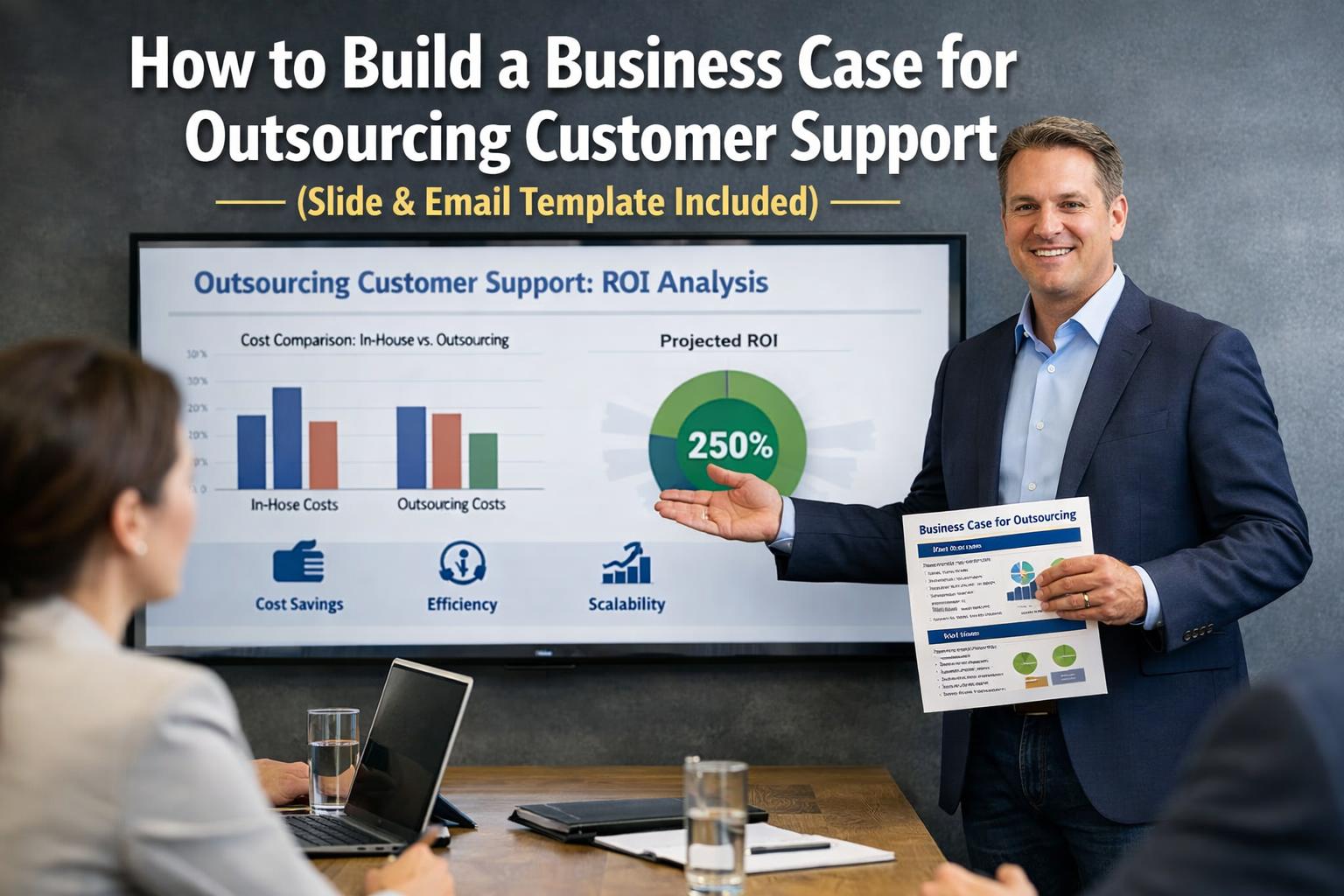
You know outsourcing your support inbox would change everything. Fewer late nights. Faster replies. Actual time to do your job.
But here's the problem: you're not the final decision-maker.
Maybe you're the COO who inherited support tickets alongside operations. Maybe you're the marketing lead who somehow became the default help desk. Either way, you need to convince your founder, your leadership team, or your board that outsourcing customer support is worth the investment.
That's a different challenge than just wanting relief. You need a business case that speaks their language—numbers, risks, and a clear path forward.
This guide gives you exactly that. We'll walk through the financial math, the stakeholder objections you'll face, and the frameworks that actually get budgets approved. Plus, you'll find ready-to-use templates for the pitch deck and email that lands on the right desks.
Let's build your case.
Why Internal Buy-In Requires a Different Approach
Most content about outsourcing customer support speaks directly to founders who control the budget. The message is simple: "You're overwhelmed. Here's the solution. Sign up."
But if you're pitching internally, you face a fundamentally different challenge.
Your leadership team isn't feeling the daily pain of a flooded inbox. They see support as something that's "handled"—until customers start complaining publicly or churn spikes without explanation. The gap between your lived experience and their awareness is where business cases go to die.
Internal stakeholders typically evaluate outsourcing through three lenses:
Financial impact. Does this save money or cost money? What's the ROI timeline?
Operational risk. What could go wrong? How do we maintain quality control?
Strategic alignment. Does this support our growth goals or distract from them?
Your business case needs to address all three—with specifics, not generalities.
The Real Cost of Doing Nothing
Before you can justify spending money on outsourced support, you need to quantify what the current approach actually costs. Most teams dramatically underestimate this number.
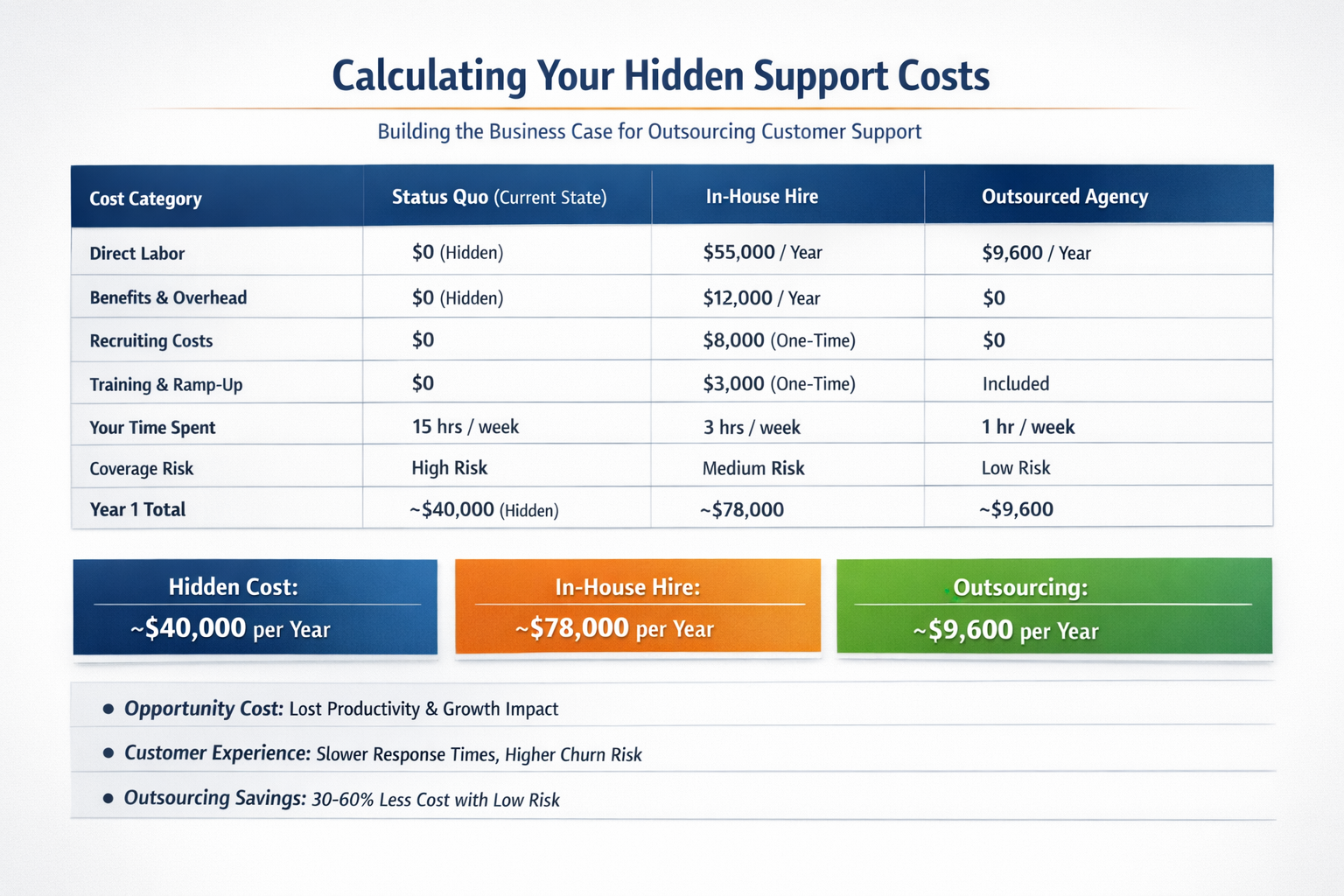
Calculating Your Hidden Support Costs
Start with the obvious: who handles support today, and what's their hourly rate?
If you're the one answering tickets alongside your "real" job, calculate your effective hourly cost to the company. A marketing director earning $90,000 annually costs roughly $43 per hour in salary alone. Add benefits and overhead, and you're closer to $55-60 per hour [1].
Now track how many hours per week you spend on support. Be honest. Include the context-switching time, the mental load, and the emails you answer at 10 PM.
Sample calculation:
Hours spent on support weekly: 15
Fully loaded hourly cost: $55
Weekly support cost: $825
Monthly support cost: $3,300
Annual support cost: $39,600
That's nearly $40,000 annually in buried support costs—before you account for the opportunity cost of what you're not doing with those 15 hours.
The Opportunity Cost Multiplier
Here's where the math gets uncomfortable for leadership.
If you're a marketing lead spending 15 hours weekly on support, you're not spending 15 hours on campaigns, partnerships, or growth initiatives. What's that worth?
For most growth-stage companies, a marketing leader's strategic output is worth significantly more than their hourly rate suggests. One campaign that improves conversion by 2% might generate tens of thousands in revenue. One partnership you didn't have time to pursue represents unmeasured upside.
This is harder to quantify precisely, but it's often the most compelling argument. Frame it this way:
"Every hour I spend on password resets is an hour I'm not spending on [specific high-value initiative leadership cares about]."
Customer Experience Degradation
Slow response times cost real money. Research consistently shows that customers expect replies within hours, not days [2]. When responses lag, several things happen:
Cart abandonment increases (for ecommerce)
Churn risk rises (for SaaS)
Negative reviews appear (for everyone)
Referrals decrease
If you can tie response time to any of these metrics in your business, include that data. Even directional evidence helps—something like "Our average response time has increased from 4 hours to 18 hours over the past six months, correlating with a 15% increase in refund requests."
Building the Financial Model
Leadership teams respond to spreadsheets. Here's how to build one that makes your case.
The Comparison Framework
Create a side-by-side analysis of three scenarios:
Scenario A: Current State (Status Quo)
Hidden labor costs (your time, anyone else's time)
Estimated opportunity cost
Any measurable CX degradation costs
Scenario B: Hire In-House
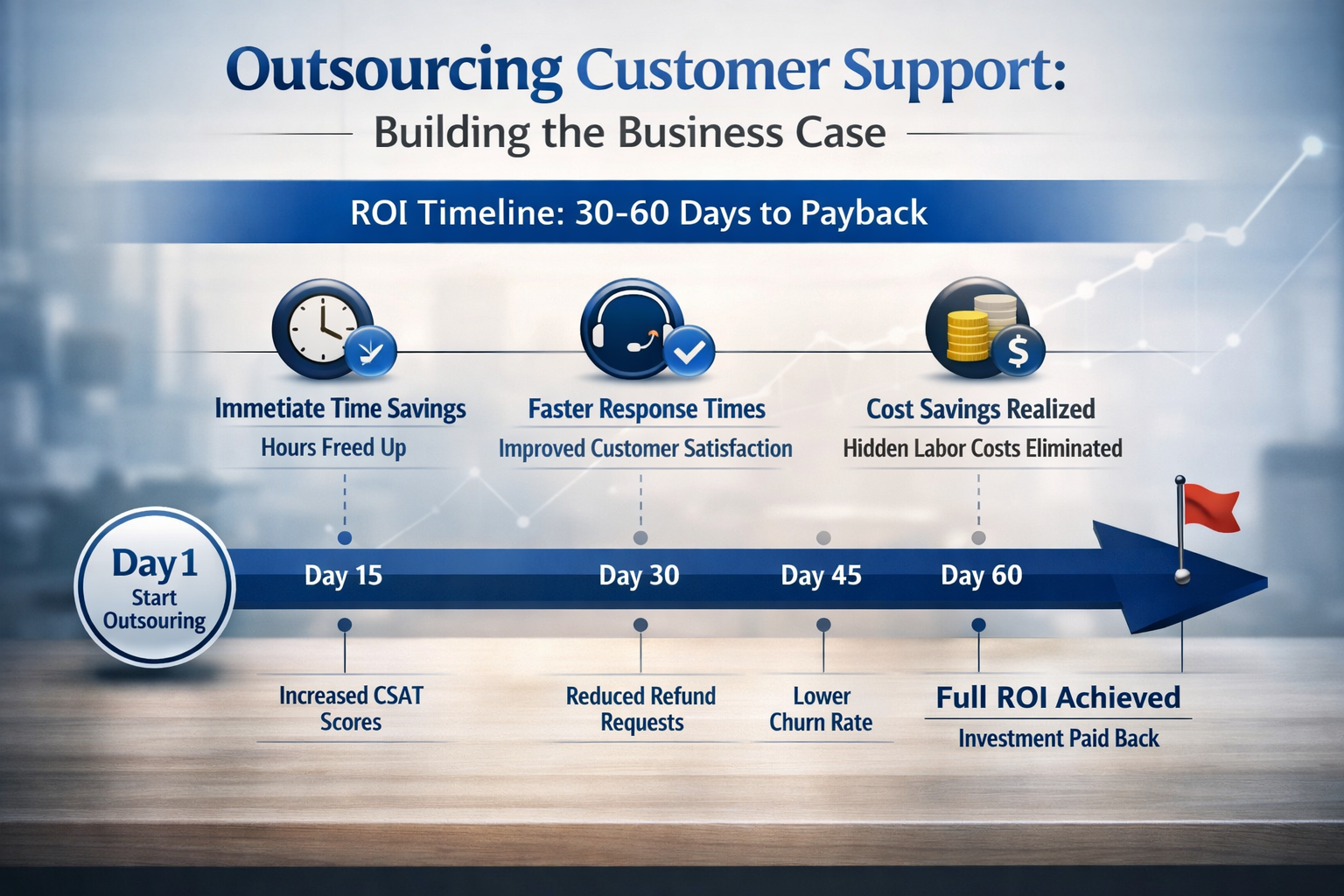
Fully loaded salary for a customer support specialist (typically $45,000-$60,000 annually including benefits) [3]
Recruiting costs (often 15-20% of first-year salary)
Training and ramp time (usually 4-8 weeks of reduced productivity)
Management overhead (your time supervising)
Coverage gaps (vacation, sick days, turnover risk)
Scenario C: Outsource to Specialized Agency
Monthly service fee based on ticket volume
Typical range: $600-$1,500/month for small businesses handling 100-300 tickets monthly [4]
No recruiting, benefits, or turnover costs
Built-in coverage redundancy
Sample Numbers (Adjust for Your Business)
Let's say your company handles approximately 150 support tickets monthly.
| Cost Category | Status Quo | In-House Hire | Outsourced Agency |
| Direct Labor | $0 (hidden) | $55,000/year | $9,600/year |
| Benefits/Overhead | $0 (hidden) | $12,000/year | $0 |
| Recruiting | $0 | $8,000 (one-time) | $0 |
| Training | $0 | $3,000 (one-time) | Included |
| Your Time (ongoing) | 15 hrs/week | 3 hrs/week | 1 hr/week |
| Coverage Gaps | High risk | Medium risk | Low risk |
| Year 1 Total | ~$40,000 (hidden) | ~$78,000 | ~$9,600 |
These numbers will vary based on your actual volume, location, and specific provider—but the structure holds. Outsourcing typically costs 30-60% less than hiring in-house while eliminating the coverage and turnover risks [5].
ROI Timeline
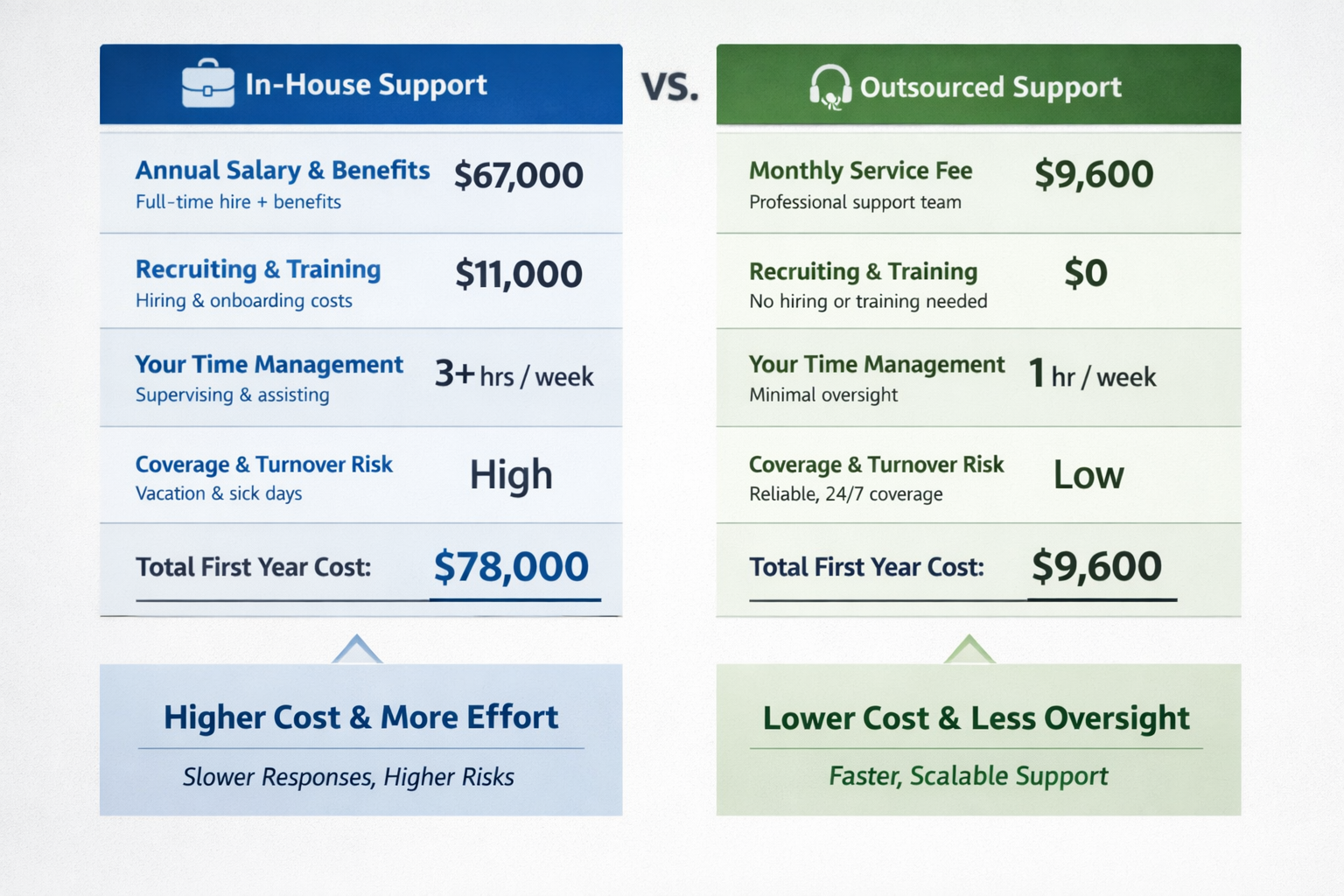
Most outsourcing arrangements show positive ROI within 30-60 days through:
Immediate time recovery (you get hours back starting week one)
Faster response times improving customer satisfaction
Elimination of hidden labor costs
Frame the investment in terms of payback period, not just annual cost. "We recover the full quarterly cost in reclaimed productivity within the first month" is more compelling than abstract annual savings.
Addressing Stakeholder Objections
You're going to face pushback. Here are the most common objections and how to handle them.
"Will They Really Understand Our Product?"
This is the biggest concern, and it's legitimate. An outsourced team that sends generic responses will damage customer relationships.
Your response: Quality providers invest heavily in onboarding. They review past tickets, build internal documentation, draft sample responses for your approval, and don't go live until you're confident in their approach. The best agencies assign dedicated agents to your account—the same people, every day—so they develop genuine product knowledge over time.
Proof point: Ask potential providers about their onboarding process and whether they assign dedicated agents versus rotating staff.
"What About Brand Voice?"
Leadership may worry that outsourced support will feel impersonal or off-brand.
Your response: This is solvable through process. During onboarding, you review and approve sample responses before anything goes to customers. You provide tone guidelines and feedback. The outsourced team writes as your company, not alongside it.
Proof point: Request sample responses from providers during evaluation. If they can't match your voice in samples, they won't match it live.
"What If Something Goes Wrong?"
The fear of an outsourced agent making a major mistake is real.
Your response: Build in escalation protocols. Define which issues get handled directly (password resets, shipping questions, basic troubleshooting) and which get escalated to your internal team (enterprise account issues, technical bugs requiring engineering, refund requests above a threshold). Quality providers expect and embrace this structure.
Proof point: Include escalation criteria in your vendor requirements and confirm providers have experience with tiered support models.
"Isn't This Too Expensive for Our Stage?"
Early-stage companies often assume outsourcing is an enterprise luxury.
Your response: The math actually favors outsourcing at smaller volumes. Hiring a full-time support person for 150 tickets/month is wildly inefficient—they'll be underutilized, which means overpaying for capacity you don't need. Volume-based outsourcing pricing scales with your actual demand.
Proof point: Show the cost-per-ticket math. If in-house costs $55,000/year for 150 tickets/month (1,800 tickets annually), that's roughly $30 per ticket. Outsourcing at $800/month for the same volume is under $6 per ticket.
"What About Data Security?"
Giving external teams access to customer data raises valid concerns.
Your response: Reputable providers sign NDAs, follow your data handling policies, and work within your existing helpdesk systems (so data doesn't leave your infrastructure). Ask potential vendors about their security practices, how they handle sensitive information, and whether they're willing to work within your compliance requirements.
Proof point: Include security and compliance requirements in your vendor evaluation criteria.
Vendor Selection Criteria
Your business case should include clear criteria for evaluating providers. This shows leadership you've thought beyond "outsourcing is good" to "here's specifically what we need."
Must-Have Requirements
Dedicated agents. You want the same people working your inbox consistently, not a rotating pool of anonymous staff. This enables genuine product knowledge and relationship building.
Response time guarantees. Look for SLAs of 24 hours or less for standard inquiries. Better providers routinely respond faster.
Transparent pricing. Understand exactly how billing works. Volume-based monthly pricing is typically more predictable than hourly billing.
Flexible contracts. Month-to-month arrangements let you exit if things aren't working. Providers confident in their quality don't need annual lock-ins.
Your tools, not theirs. The provider should work within your existing helpdesk, CRM, or email system—not force you onto their platform.
Nice-to-Have Features
Trial or low-commitment start. Providers offering inexpensive trial periods (some offer onboarding for as little as $1) [6] reduce the risk of the initial decision.
Slack or real-time communication. Direct access to your support agents for quick questions and feedback accelerates the learning curve.
Process documentation. Providers who build your internal knowledge base as they go create lasting value beyond ticket responses.
Proactive trend reporting. The best teams identify patterns ("we've gotten 12 questions about X this week") and surface them for your product/ops team.
Red Flags to Avoid
Providers who won't share their agents' backgrounds or let you meet the team
Pressure for long-term contracts before you've seen results
Vague pricing that makes cost prediction difficult
Claims of "AI-powered" support if you're seeking human interaction
Inability to explain their quality assurance process
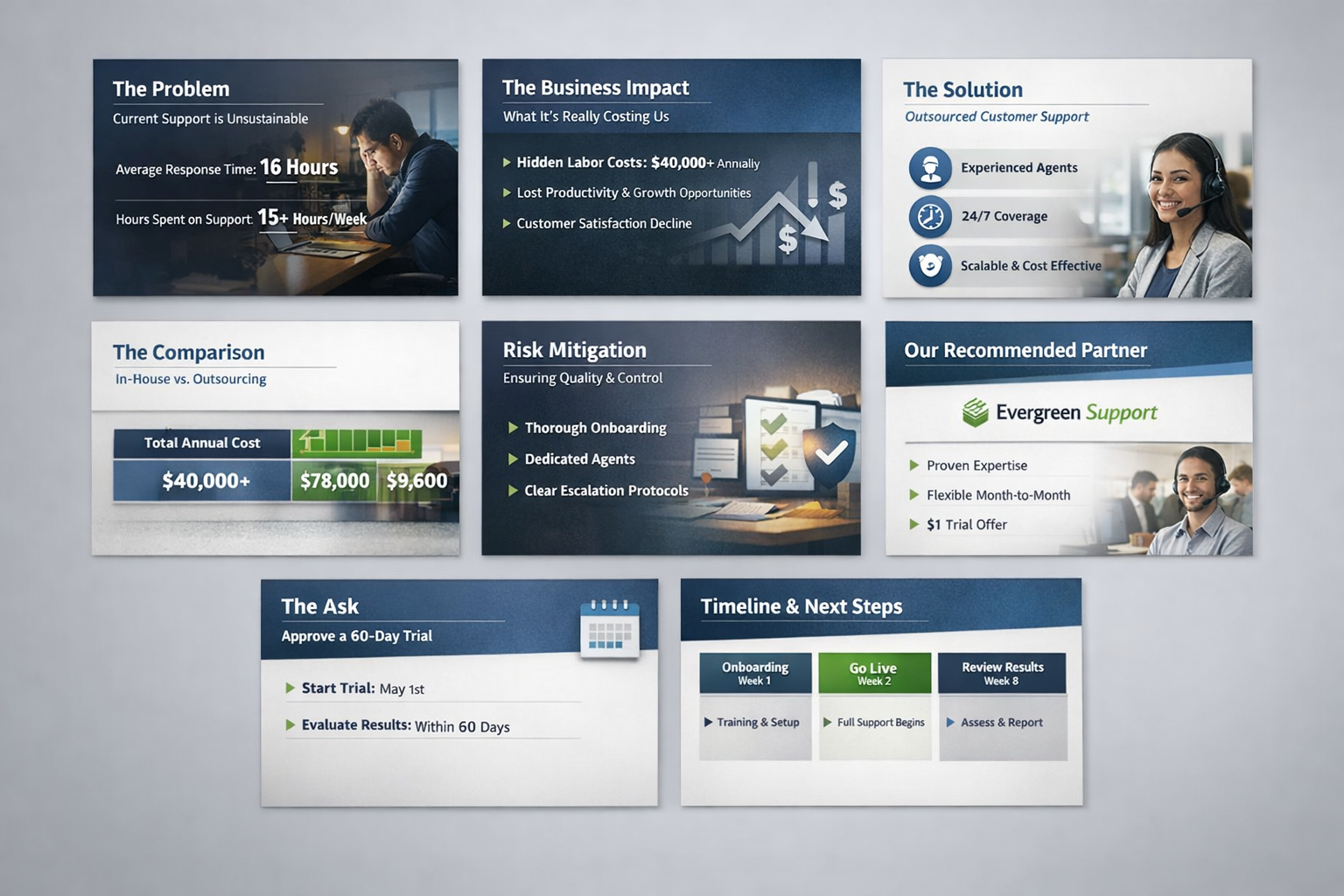
The Pitch Deck Structure
When you're ready to present, structure your deck around decision-maker priorities. Here's a framework that works:
Slide 1: The ProblemCurrent support is unsustainable. [Specific pain point with data: response time trends, hours you're spending, coverage gaps]
Slide 2: The Business ImpactWhat this costs us today. [Hidden labor costs, opportunity costs, any CX metrics]
Slide 3: The SolutionOutsourced customer support from a specialized provider. [Brief explanation of the model]
Slide 4: The ComparisonSide-by-side: status quo vs. hire in-house vs. outsource. [Your financial model]
Slide 5: Risk MitigationHow we maintain quality and control. [Onboarding process, escalation protocols, vendor criteria]
Slide 6: Recommended VendorWhy [specific provider]. [How they meet your criteria, pricing, trial terms]
Slide 7: The AskApprove a [trial period/monthly commitment] starting [date]. [Clear decision request]
Slide 8: TimelineWhat happens next. [Onboarding steps, when you'd expect to see results]
Keep slides visual and sparse. The detailed numbers go in an appendix or leave-behind document.
The Email That Gets Read
Sometimes you need to start the conversation before scheduling a presentation. Here's a template for the initial pitch email to leadership:
Subject: Proposal: Outsourcing Customer Support (Quick ROI Analysis)
Hi [Name],
I've been thinking about how we handle customer support and wanted to share a proposal.
The situation: I'm currently spending ~[X] hours/week on support tickets alongside my [actual job title] responsibilities. That's roughly $[monthly hidden cost] in buried labor costs, plus the work I'm not getting to.
The impact: Our average response time has increased to [X hours/days], and I'm seeing [any relevant metric: more complaints, longer resolution times, my own deliverables slipping].
A potential solution: Outsourcing our support to a specialized agency. For our current volume (~[X] tickets/month), this would cost approximately $[monthly estimate], compared to ~$[cost of in-house hire] for a full-time employee.
Key benefits:
Immediate time recovery (I get [X] hours/week back for [specific high-priority work])
Faster customer response times (most agencies guarantee <24 hours)
Built-in coverage with no vacation/sick day gaps
Month-to-month flexibility—no long-term commitment
I've identified a provider that offers a $1 trial to evaluate fit before committing. Happy to put together a more detailed comparison if you're interested.
Worth a 15-minute conversation?
[Your name]
Adapt the specifics to your situation, but keep the structure: problem, cost, solution, benefits, low-risk next step.
Making the Decision Easy
Leadership teams have limited decision-making bandwidth. Your goal is to make saying "yes" easier than saying "let's think about it more."
Three tactics that help:
Propose a trial, not a commitment. "Let's try this for 60 days" is easier to approve than "let's commit to this for a year." Providers offering low-cost trials make this even simpler.
Own the implementation. Make clear that you'll manage the transition, handle vendor communication, and oversee quality. Leadership just needs to approve the budget.
Set clear success criteria. Define what "working" looks like in advance: response time under X hours, customer satisfaction maintained, your time freed up by X hours weekly. This makes the 60-day review straightforward.
Your Next Step
Building a business case takes effort. But the alternative—continuing to drown in support tickets while your actual job suffers—has its own cost.
If you're ready to make the case internally, start with the financial model. Calculate your true hidden costs, compare the scenarios, and quantify what you're giving up by maintaining the status quo.
For the presentation itself, use the frameworks here. Adapt the numbers to your specific situation, anticipate the objections your stakeholders will raise, and propose a low-risk trial rather than a permanent commitment.
And if you want ammunition for your pitch, consider requesting a free inbox audit from a provider like Evergreen Support. They'll review your current support setup, identify quick wins, and give you concrete recommendations—valuable whether or not you end up working together. It's the kind of third-party validation that strengthens any internal proposal.
The case for outsourcing support isn't complicated. You just need to translate your daily pain into language that resonates with the people holding the budget.
Frequently Asked Questions
How long does it typically take to get internal approval for outsourcing support?
Timeline varies by company size and decision-making culture. In small startups where founders decide quickly, you might get approval in a single meeting. In larger organizations, expect 2-4 weeks for budget review and stakeholder alignment. Prepare for both scenarios by having a detailed leave-behind document ready alongside your verbal pitch.
What if leadership says yes to the concept but wants to hire instead of outsource?
Redirect the conversation to coverage risk and time-to-value. An in-house hire takes weeks to recruit, weeks to train, and creates single-point-of-failure coverage. Outsourcing provides immediate relief with built-in redundancy. Suggest a trial with an agency while exploring the hire option—this isn't either/or in the short term.
How do I handle concerns about outsourcing being "impersonal"?
Emphasize the dedicated agent model. Quality providers assign specific people to your account who develop real product knowledge and customer relationships. This isn't a faceless call center; it's an extension of your team. Offer to arrange an introduction call between leadership and the prospective support agents to demonstrate the human element.
What metrics should I track to prove the outsourcing experiment worked?
Focus on four areas: response time (should decrease), your reclaimed hours (should increase), customer satisfaction or complaint volume (should stay stable or improve), and cost per ticket (should decrease versus hidden costs). Establish baseline measurements before the trial begins so you can show clear before/after comparisons.
Can I use this approach if I'm the founder, not an employee making a pitch?
Absolutely. Even founders sometimes need to convince co-founders, advisors, or themselves with rigorous analysis. The financial model and risk mitigation frameworks work regardless of your role. The main difference is you can skip the internal email and move straight to vendor evaluation.
About Evergreen Support
Evergreen Support is a US-based customer support agency built specifically for small SaaS and ecommerce businesses. Founded by Emma Fletcher and Ellis Annichine, the team delivers human-powered email support with guaranteed response times, dedicated agents, and month-to-month flexibility. Every support specialist is based in the United States, and the service model emphasizes maintaining your brand voice while freeing founders and team leads to focus on growth. With transparent volume-based pricing and a $1 trial to evaluate fit, Evergreen makes outsourcing accessible without long-term risk.
Cited Works
[1] Bureau of Labor Statistics — "Employer Costs for Employee Compensation." https://www.bls.gov/news.release/ecec.nr0.htm
[2] Evergreen Support — "Small Business Customer Response Time: What Customers Actually Expect in 2025."
https://outsourcedemailsupport.com/blog/customer-response-time-expectations
[3] Glassdoor — "Customer Support Specialist Salaries." https://www.glassdoor.com/Salaries/customer-support-specialist-salary-SRCH_KO0,27.htm
[4] Evergreen Support — "Customer Support Agency Pricing." https://outsourcedemailsupport.com/pricing
[5] Evergreen Support — "Should You Outsource Customer Support? The Real Cost Breakdown."
https://outsourcedemailsupport.com/blog/outsource-customer-support-cost-comparison
[6] Evergreen Support — "Start Onboarding for $1." https://outsourcedemailsupport.com/pricing