

You're already stretched thin. Your to-do list has a to-do list. And somewhere between shipping features, closing deals, and remembering to eat lunch, there's that inbox—your support inbox—quietly filling up with questions, complaints, and "quick asks" that somehow eat two hours of your afternoon.
If you're running a small SaaS company or e-commerce store, customer support probably isn't your main job. But it still has to get done. And done well, because slow or sloppy replies cost you customers, reviews, and sleep.
Here's the thing: you don't have to do it all yourself. A customer care agency for small businesses can handle your email support—fast, human, and on-brand—so you can focus on the work that actually grows your business.
Let's walk through five concrete benefits of outsourcing your email support to a specialized agency, with real numbers and practical examples along the way.

1. Save Founder Hours by Offloading Daily Email Triage
The problem: Support emails trickle in all day. You start answering one or two in the morning, then suddenly it's 3pm and you haven't touched your product roadmap.
The benefit: A customer care agency takes over the daily triage—those repetitive "Where's my order?" and "How do I reset my password?" emails—freeing up significant hours of your week.
Research from customer support software provider Zendesk shows that small business owners spend an average of 10–15 hours per week on customer service activities [1]. For founders juggling multiple roles, that's time that could be spent on product development, strategic partnerships, or actual business growth.
Take the story of one app developer we worked with—we'll call him Lucas. He hadn't taken a real break in five years because he couldn't step away from the support queue. Every vacation attempt ended with him answering emails from the beach. After onboarding a fractional support team, he finally booked that month-long trip he'd been postponing. His customers still got replies within hours. He got his life back.
The biggest mistake we see? Founders wait until they're drowning in emails to outsource. By then, customer relationships are already strained, and the founder is burned out. Proactive outsourcing—before you hit crisis mode—prevents that damage.
Bottom line: If support is eating more than a few hours of your week, outsourcing pays for itself in reclaimed founder time alone.
2. Faster First Responses Lift Satisfaction and Reviews
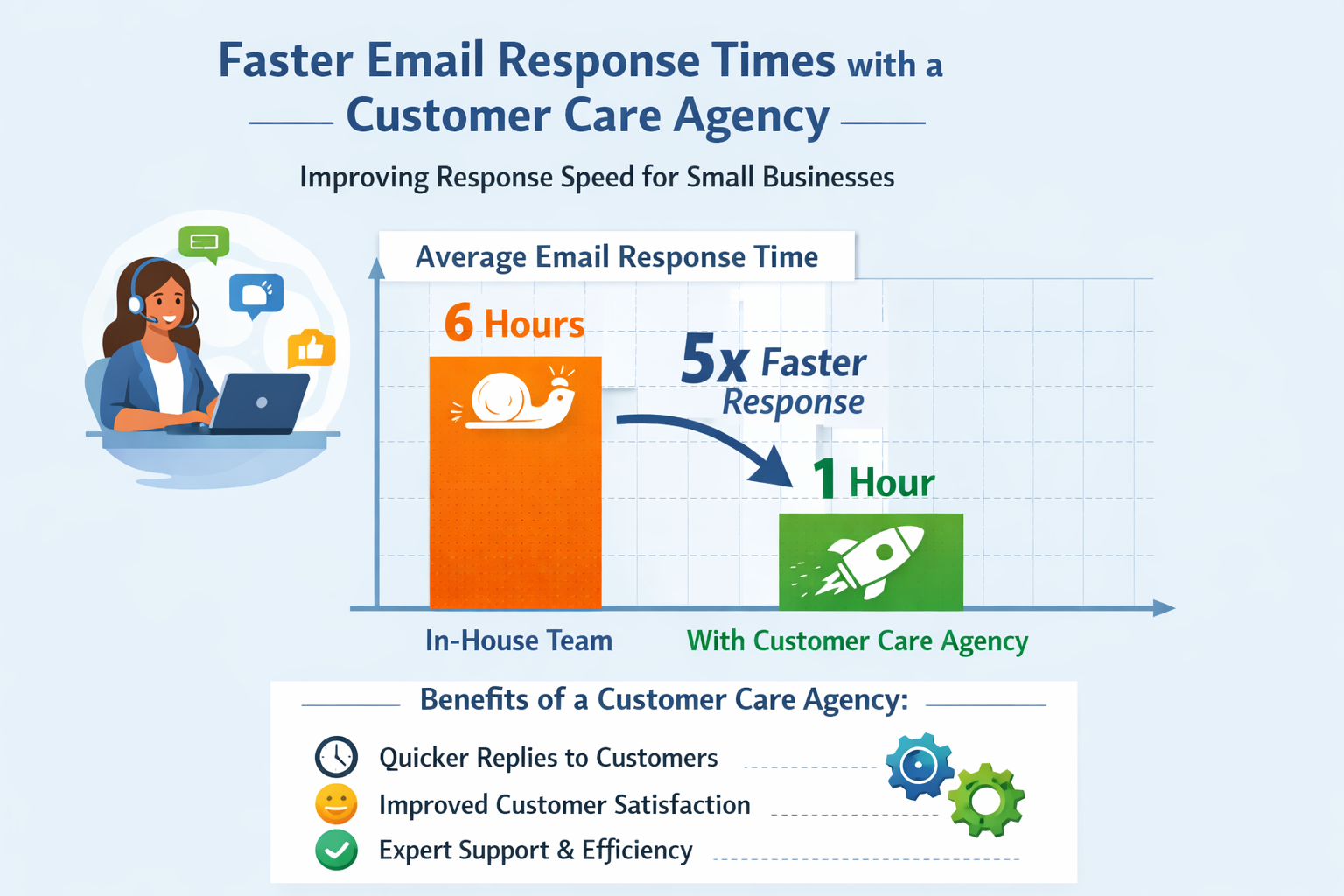
The problem: Customers expect fast replies. If you're juggling support on top of everything else, emails pile up. Response times slip from 4 hours to 2 days. Customers get frustrated. Reviews suffer.
The benefit: A dedicated support agency guarantees consistent, fast response times—often within 24 hours, and frequently much faster [2].
Speed matters more than most founders realize. A HubSpot survey found that 90% of customers rate an "immediate" response as important or very important when they have a support question [3]. SuperOffice research shows that customers now expect responses within 24 hours, with many expecting replies within just a few hours [4].
When you outsource to a customer care agency, you're getting a team whose only job is answering your emails. They're not context-switching between support and shipping code. That translates directly into:
Higher customer satisfaction scores (CSAT)
Better online reviews (happy customers leave 5-star feedback)
Lower churn (especially in SaaS, where slow support is a top reason users cancel)
Consider this scenario: An e-commerce client was averaging 48-hour response times during busy weeks. After bringing in an outsourced team, their average dropped to under 8 hours—even during Black Friday. Their customer complaints dropped by half, and their repeat purchase rate increased measurably.
Bottom line: Faster replies = happier customers = better reviews and retention. An agency delivers that speed consistently.
3. Scale Fractional Email Capacity for Promos and Launches
Your inbox is manageable at 30 tickets a week. Then you launch a new feature, run a holiday promo, or get featured on Product Hunt—and suddenly you're drowning in 200 emails.
The problem: You can't hire a full-time rep overnight, and you can't ignore customers for a week while you scramble.
The benefit: A fractional support team scales with you. Need more coverage for a launch? They flex up. Quiet month? You pay less.
Most customer care agencies for small businesses use volume-based pricing. You're not locked into paying for a full-time salary when you only need part-time help. And when ticket volume spikes—say, around a product release or a seasonal sale—the agency can absorb the surge without you having to post a last-minute job ad.
This elasticity model works particularly well for:
Seasonal businesses (e-commerce stores with holiday rushes)
SaaS companies running periodic campaigns or product launches
Bootstrapped startups testing product-market fit (inconsistent volume)
A SaaS startup we work with had ~50 tickets a month in steady state. But twice a year, they run a big marketing push that doubles inbound support. Instead of hiring (and then laying off) a temp, they just let us know the campaign dates. We handled the spike. Their customers got same-day replies. The founder never touched the inbox.
One caveat: This model works best for predictable volume spikes. If your support needs are truly unpredictable or require instant 24/7 coverage (true emergencies every night), you may need a hybrid approach with some in-house capacity.
Bottom line: Fractional support gives you elasticity. You're not over-staffing in slow months or under-staffed during busy ones.
4. Access Trained Writers Who Match Your Brand Voice
The problem: You've spent years building a brand that feels personal, friendly, maybe a little quirky. The last thing you want is generic, robotic support replies that make customers feel like they're talking to a call center script.
The benefit: A good customer care agency learns your brand voice and writes replies that sound like you (or your team) wrote them [5].
This is one of the biggest fears founders have about outsourcing: "Will they sound like us?" The answer, if you pick the right partner, is yes.
Here's how quality agencies make it work:
Onboarding: The agency reviews your past support emails, your website copy, your tone. They ask questions: Are you casual or formal? Do you use emojis? How do you handle frustrated customers?
Draft approval: Before going live, they write sample responses and send them to you for feedback. You tweak until it's right.
Ongoing refinement: As they handle real tickets, you can review and course-correct. Over time, they internalize your voice.
An e-commerce client of ours has a very warm, conversational brand. Lots of exclamation points, friendly sign-offs. We learned that style in week one. Now, customers regularly reply saying, "Thanks so much! You guys are the best!" They have no idea it's not the founder personally typing those emails.
What to look for: During your agency evaluation, ask for writing samples. Request a test response to a real customer email. If they can't demonstrate voice flexibility in the sales process, they won't deliver it in execution.
Bottom line: You don't lose your brand's personality when you outsource—if you work with a team that takes the time to learn it.

5. Lower Total Cost vs Hiring Before You're Ready
You know you need support help. But hiring a full-time support rep in the U.S. costs $40,000–$50,000+ per year in salary alone, plus benefits, payroll taxes, training time, and management overhead [6].
The problem: That's a big commitment if you're not sure you have 40 hours a week of support work yet.
The benefit: Outsourcing to a customer care agency can cost significantly less than hiring in-house, with faster deployment and no HR headaches.
Let's break down the real numbers:
| Cost Factor | In-House Support Rep (U.S.) | Outsourced Agency |
| Base salary | ~$45,000/year | N/A |
| Benefits & taxes | ~$9,000/year (20%) | Included |
| Recruitment & training | 2–4 weeks + costs | 1 week included |
| Management overhead | Ongoing supervision | Minimal |
| Coverage gaps | Sick days, vacation | Built-in backup |
| Total annual cost | $54,000+ | $7,200–$14,400 (100–200 tickets/month) |
Industry research from Software Advice shows that outsourced customer service typically costs 30–50% less than maintaining an in-house team when volume is below 40 hours per week [7].
Even factoring in opportunity cost: A marketing director at a small DTC brand told us he was spending 15 hours a week on support. His loaded hourly rate (as a salaried employee) was roughly $50/hour. That's $750/week, or $39,000/year in opportunity cost—just in his time. Outsourcing to an agency cost them $800/month ($9,600/year) and freed him up entirely. The ROI was immediate.
The inflection point: Once you're consistently above 30–40 hours of support work per week, hiring in-house might start making economic sense. But until then, outsourcing typically provides better economics and flexibility.
Bottom line: If you're not ready to hire a full-time support person (or can't afford one yet), a customer care agency gives you professional coverage at a fraction of the cost. You can always bring support in-house later when you have the scale and budget.
Data Security & Integration: What to Expect
Before we move to the decision framework, let's address two critical operational concerns:
Data security: Any agency handling your customer emails has access to sensitive information. Reputable agencies maintain:
SOC 2 Type II compliance or equivalent security certifications
Signed NDAs and data processing agreements
GDPR compliance for EU customers
Encrypted data transmission and secure access protocols
Always ask prospective agencies about their security posture and request documentation. This isn't optional—it's a dealbreaker for B2B businesses.
Integration: Quality agencies work within your existing tools rather than forcing you to adopt theirs. Expect seamless integration with:
Helpdesk platforms (Zendesk, Intercom, Help Scout, Freshdesk)
Communication tools (Slack channels for real-time escalation)
CRM systems (for context on customer history)
The onboarding process typically involves providing secure access credentials, setting up escalation workflows, and establishing clear boundaries on which issues get handled vs. escalated back to your team.
When Does Outsourcing Email Support Make Sense?
Not every business needs an agency. Here's a quick gut-check:
You're a good fit if:
You're spending 10+ hours a week on support yourself (or it's falling through the cracks)
You want to maintain fast response times but can't keep up
Your support volume is growing but isn't consistent enough to justify a full-time hire yet
You value human, personalized support and don't want to rely solely on AI chatbots
You operate primarily via email/tickets (not phone or live chat)
You're probably not a good fit if:
You need 24/7 phone support or instant live chat (agencies specialize, so phone-heavy needs require different providers)
Your product requires deep technical support that only your engineering team can handle (though agencies can triage and escalate)
You have fewer than ~20 support emails a week and can comfortably handle them yourself
You have extreme budget constraints and literally cannot afford $600–800/month
Alternative solutions to consider:
AI chatbots: Good for instant FAQ answers but poor at nuanced or emotional issues. Best as a supplement to human support, not a replacement.
In-house junior hire: Makes sense once you have consistent 40+ hours of support work and budget for salary plus management overhead.
Hybrid approach: Some companies handle urgent issues in-house and outsource the backlog to agencies.
If you're in the "good fit" camp, outsourcing can be a game-changer. If not, no worries—keep doing what works until your needs change.

Your Next Step: Try It Risk-Free
If you're curious whether a customer care agency could work for your small business, the easiest way to find out is to just try it.
At Evergreen Support, we offer a $1 trial onboarding so you can see how it feels to hand off your inbox without committing to a big contract. We learn your business, draft sample replies for your approval, and go live only when you're confident we've got your voice down. If it's not a fit, no hard feelings—we refund the dollar and part ways.
Book a call with us to discuss your support situation, or start your $1 trial and see the difference human-powered support can make.
Not ready yet? Check out our related guides:
Frequently Asked Questions
Q: Will an outsourced team really sound like my brand?
Yes—if you work with an agency that takes onboarding seriously. At Evergreen, we spend the first week learning your tone, reviewing past emails, and drafting sample responses for your approval before we go live. You stay in control of your brand voice. Over time, customers won't be able to tell the difference between you and us (in a good way). Ask prospective agencies for writing samples and test responses during your evaluation.
Q: What if I get a support question the agency can't answer?
Quality agencies build an escalation plan during onboarding. We handle all the routine stuff—password resets, shipping questions, billing inquiries—and escalate complex technical issues or edge-case questions back to you via Slack. You stay in the loop on anything that requires your input, but you're not buried in the day-to-day triage. Clear escalation criteria are defined week one.
Q: How fast will I see results?
Most clients notice immediate relief in their own workload (you stop answering emails yourself on day one). Customer-facing results—like improved satisfaction scores or faster response times—usually show up within the first month. If your current response time is slow, customers will notice (and appreciate) the improvement right away. Many agencies provide weekly performance reports so you can track the impact.
Q: Is outsourcing really cheaper than hiring?
For most small businesses, yes—especially if you're not yet at full-time support volume. According to the U.S. Bureau of Labor Statistics, hiring a support rep costs $40k–$50k+ per year in salary alone, plus benefits, taxes, and management time [6]. Industry data from Software Advice shows outsourcing typically costs 30–50% less for businesses under 40 hours per week of support work [7]. Once you're consistently above that threshold, hiring in-house might make economic sense—but until then, outsourcing usually provides better economics.
Q: What happens if the agency isn't working out?
Reputable agencies (like Evergreen) operate month-to-month with no long-term contracts. If it's not a fit, you can cancel anytime. This low-friction model means you're not locked in—we have to keep earning your business every month by delivering great service.
Q: How does the agency integrate with my existing tools?
Professional agencies work within your existing helpdesk platform (Zendesk, Intercom, Help Scout, etc.) rather than forcing you to adopt new software. During onboarding, you provide secure access credentials, and the agency sets up within your workflows. Typically, a shared Slack channel enables real-time communication for escalations or questions. Integration usually takes less than a week.
Q: What about data security and compliance?
This is critical. Reputable agencies maintain SOC 2 Type II compliance (or equivalent), sign NDAs and data processing agreements, ensure GDPR compliance for EU customers, and use encrypted data transmission. Always request documentation during your agency evaluation—legitimate providers will have this readily available.
E-E-A-T Section
This article was written by the team at Evergreen Support, a US-based customer care agency specializing in email support for small SaaS and e-commerce businesses. Our co-founders, Emma Fletcher and Ellis Annichine, have firsthand experience building and managing support teams at startups, and they created Evergreen to solve the exact pain points described in this article: overwhelmed founders, inconsistent response times, and the high cost of hiring in-house before you're ready.
We work with dozens of small online businesses to deliver fast, human-powered, on-brand support—so founders can focus on growth instead of their inboxes. The insights in this article are drawn from our direct experience onboarding and supporting clients, industry research from recognized authorities, and feedback from the small business founders we serve daily.
Transparency note: While we've cited our own experience and processes throughout this article, we've supplemented our perspective with independent research from Zendesk, HubSpot, SuperOffice, Software Advice, and the U.S. Bureau of Labor Statistics to provide balanced, verifiable information.
Cited Works
[1] Zendesk — "2024 Customer Experience Trends Report" (small business owner time allocation). https://www.zendesk.com/blog/customer-experience-trends/
[2] Evergreen Support — Pricing Page (24-hour response guarantee, M–F). https://www.evergreensupport.co/pricing
[3] HubSpot Research — "The State of Service in 2024" (90% of customers rate immediate response as important). https://www.hubspot.com/state-of-service
[4] SuperOffice — "Customer Service Benchmark Report" (customer response time expectations). https://www.superoffice.com/blog/customer-service-benchmark/
[5] Evergreen Support — "Keeping Outsourced Customer Support On-Brand." https://www.evergreensupport.co/blog/keeping-outsourced-customer-support-on-brand
[6] U.S. Bureau of Labor Statistics — "Occupational Outlook Handbook: Customer Service Representatives" (median wages and employment data). https://www.bls.gov/ooh/office-and-administrative-support/customer-service-representatives.htm
[7] Software Advice — "The Cost of Outsourcing Customer Service" (cost comparison analysis). https://www.softwareadvice.com/resources/cost-of-outsourcing-customer-service/