

You've been drowning in support emails for months. Every morning starts with inbox dread. Every evening ends with "just a few more tickets." Your customers are waiting longer than they should, and you know it's hurting your business.
So you start researching customer support agencies. One promise shows up everywhere: 24-hour response time guaranteed.
Sounds perfect, right? Finally, your customers get timely replies, and you get your life back.
But here's the thing most founders miss—not all "24-hour guarantees" mean the same thing. Some agencies deliver exactly what you need. Others leave you with disappointed customers and a contract you regret signing.
After helping dozens of small SaaS and e-commerce businesses set up outsourced support, we've seen what works and what doesn't. This guide walks you through exactly what to verify before you commit to any agency promising 24-hour response times.
Why 24-Hour Response Time Matters (and Why It's Not Enough On Its Own)
Let's start with the reality: your customers expect fast responses. Research consistently shows that 90% of customers rate an immediate response as important or very important when they have a support question—and for many, "immediate" means within a few hours, not a full day.
A 24-hour response time is a solid baseline. It means your customers won't wait days for acknowledgment. It prevents the inbox backlog that kills trust and drives people to your competitors.
But the promise alone doesn't tell you much. What you really need to know is how that agency delivers on it—and whether their version of "24 hours" matches what you actually need.
What Does "24-Hour Response Time" Actually Mean?
This is where things get specific. When an agency says "24-hour response," you need to ask three precise questions.
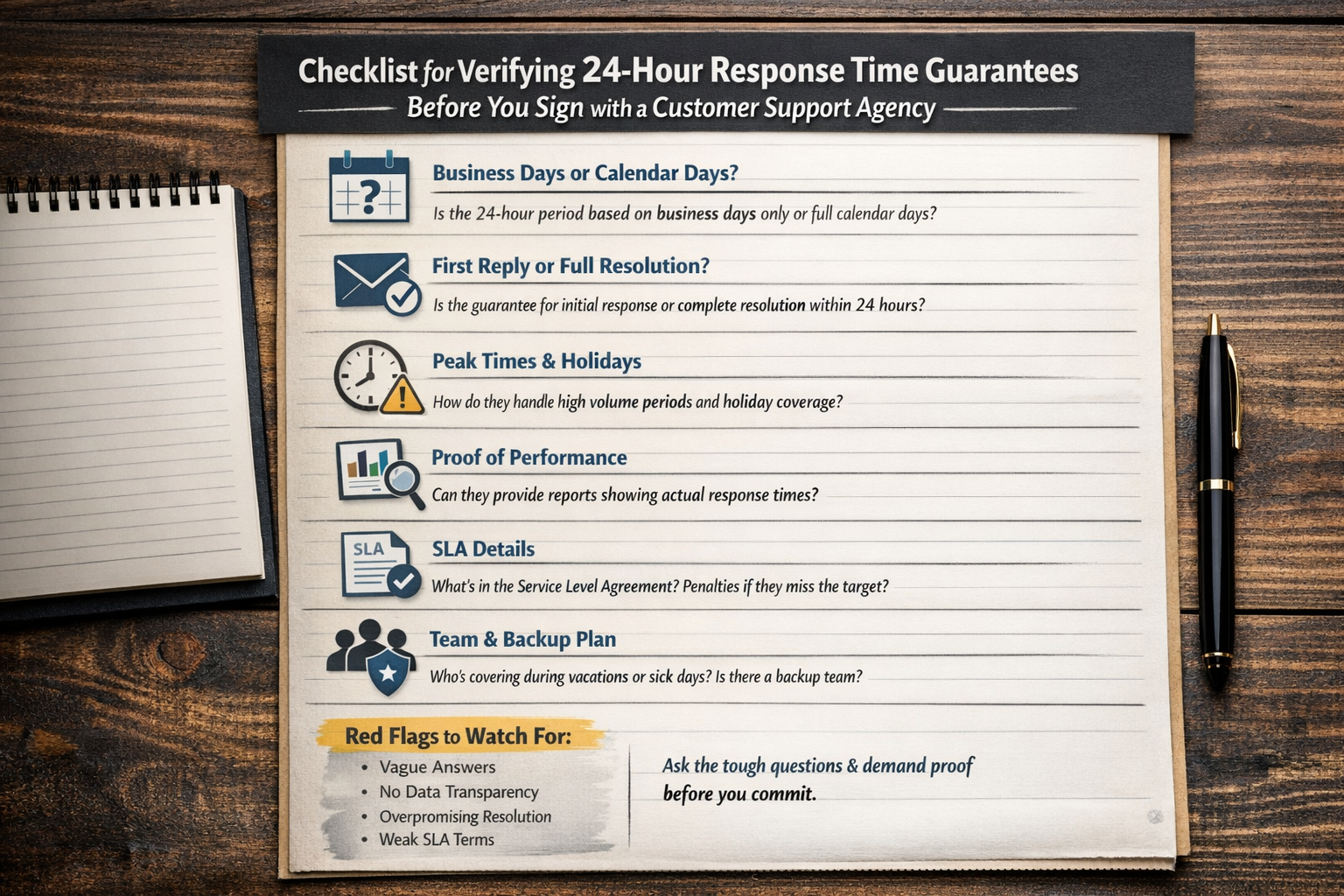
Business Days or Calendar Days?
Most agencies (including Evergreen Support) define 24-hour response time as 24 hours on business days—typically Monday through Friday. If a customer emails Saturday morning, their first reply comes Monday.
That's fine for many small businesses whose customers also work standard hours. But if you promise weekend support or serve international customers across multiple time zones, you need to clarify this upfront.
What to verify: Ask explicitly: "If a customer emails Friday at 5 PM, when will they receive a reply?" And, "Do you provide weekend coverage, or is that an add-on?"
The answer matters more than you might think. Some businesses genuinely need weekend coverage—direct-to-consumer e-commerce brands often see their highest support volume on Saturdays and Sundays. If that's you, a Monday–Friday agency won't work, no matter how good their weekday response times are.
First Reply or Full Resolution?
Here's a critical distinction many founders miss.
First reply means the agency acknowledges the email and provides initial help within 24 hours. If the issue requires escalation or more information, full resolution might take longer.
Full resolution means the customer's problem is completely solved within 24 hours—which sounds great but is often unrealistic for complex issues.
Most reputable agencies (including Evergreen Support) guarantee 24-hour first reply because it's honest. We can't promise to fix every technical bug or process a complicated refund in 24 hours if it requires input from your team. But we can promise your customer hears from a real human quickly, gets initial guidance, and knows their issue is being handled.
What to verify: Ask, "Does your 24-hour guarantee cover first reply or full resolution?" If they claim full resolution for everything, dig deeper—that's often either unrealistic or comes with hidden caveats.
When an agency promises full resolution on everything within 24 hours, one of three things is usually true: they're limiting what counts as a "support issue," they're deflecting complex problems back to you without telling customers, or they're setting themselves up to miss their own SLA regularly.
What Happens During Peak Volume or Holidays?
A guarantee is only as good as the agency's ability to maintain it during crunch time.
Does their 24-hour promise hold during Black Friday? When half their team is on vacation? When your product launches and support volume doubles overnight?
What to verify: Ask about their contingency plans. How do they handle peak periods? What's their agent-to-client ratio? Do they have backup coverage when someone's out sick?
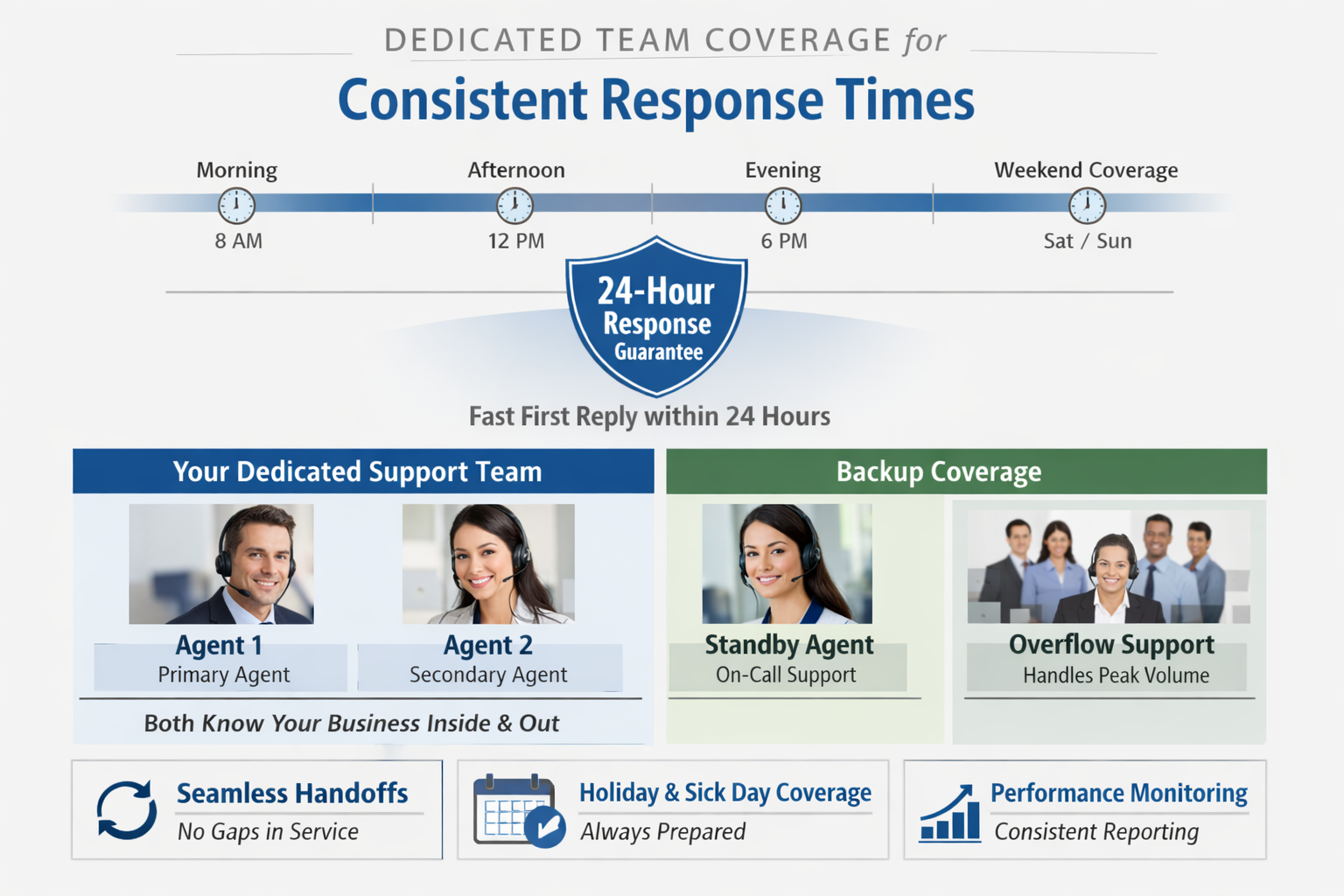
For context, at Evergreen Support, every client gets two dedicated agents. If one is on vacation or out sick, the other already knows your business and covers seamlessly. That built-in redundancy is why we can confidently promise consistent response times without gaps.
The Proof You Should Ask For (Before You Sign Anything)
Promises are easy. Proof is what matters. Here's what to request from any agency before you commit.
Reporting and Transparency
A trustworthy agency will show you exactly how they're performing—not just at the start, but continuously.
What to ask for:
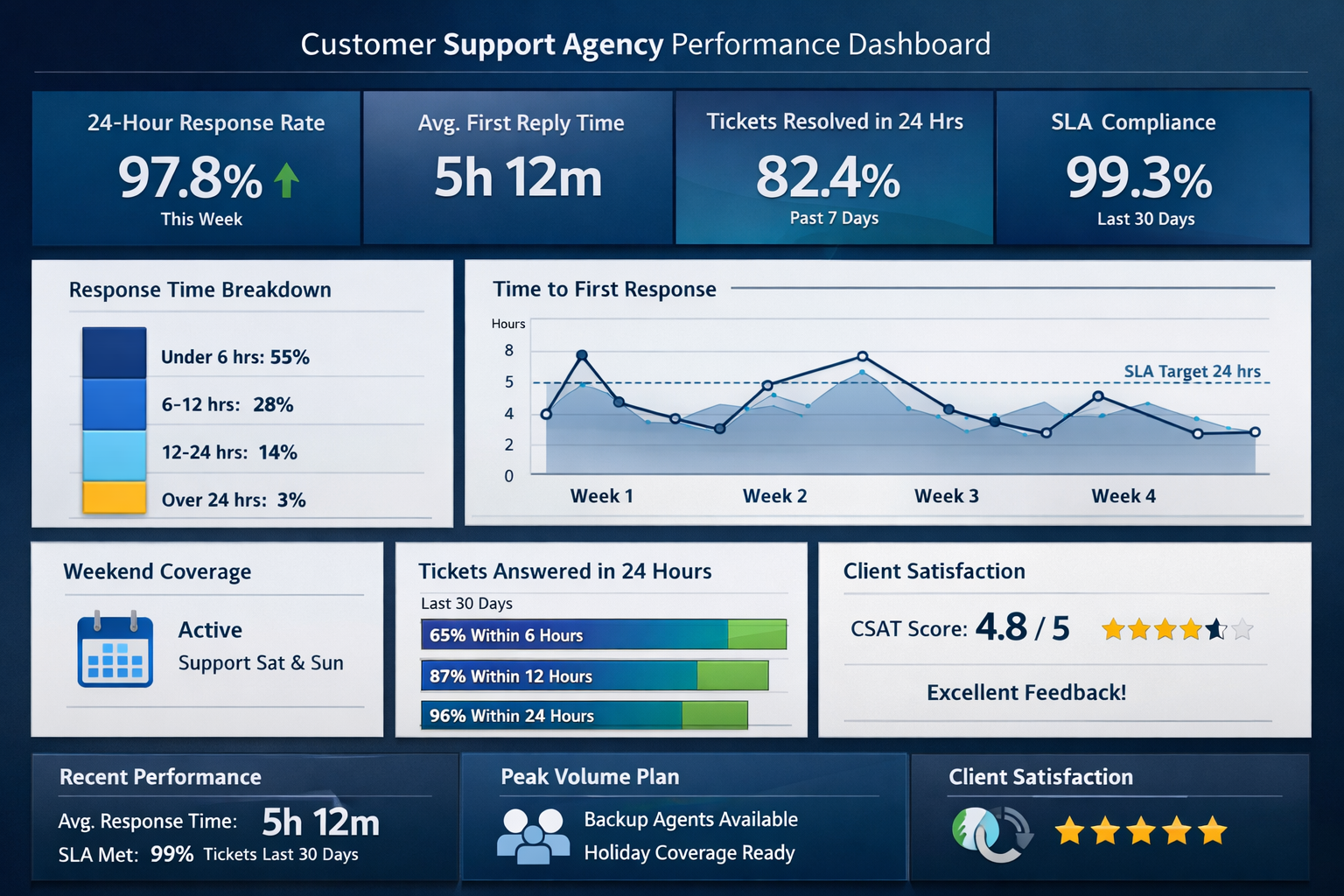
Sample reports showing actual response times (not just averages, but distributions—how often do they hit the 24-hour mark vs. miss it?)
Access to dashboards or regular reporting cadence (weekly or monthly)
Clarity on how they measure response time (from when the ticket arrives, or from when it's assigned?)
If an agency hesitates to show you performance data or doesn't track it rigorously, that's a red flag. You're trusting them with your customers—you deserve transparency.
Ask to see a real report. Not a polished case study, but the actual weekly or monthly data they share with current clients. Look for consistency: are response times stable across weeks, or do they spike during busy periods? Do they track anything beyond averages—like median response time, or percentage of tickets answered within 12 hours?
Service Level Agreement Documentation
A Service Level Agreement (SLA) is the formal promise in writing. It should explicitly state:
Response time guarantee (24 hours or less, business days)
What counts as a "response" (acknowledgment, initial reply with substance, etc.)
Coverage hours and days
What happens if they miss the SLA (credits, refunds, or just an apology?)
What to verify: Read the SLA carefully. Does it match what the sales team promised? Are there carve-outs or exceptions that would let them off the hook during high-volume periods?
At Evergreen Support, our SLA is straightforward: 24 hours or less, Monday through Friday. We put it in writing, and we've built our team structure to deliver on it consistently.
Pay special attention to the "what happens if we miss it" section. Some agencies offer credits or discounts if they consistently miss their SLA. Others have no remedy at all—meaning the SLA is more of a goal than a guarantee.
Process Documentation
How does the agency actually work? What's their system for ensuring nothing falls through the cracks?
Questions to ask:
How do you prioritize tickets?
What's your escalation process for issues that need my input?
How do you train agents on my product and brand voice?
What happens if an urgent ticket comes in at the end of the day—do you hold it until tomorrow or respond same-day?
A good agency will have clear, documented answers. If they're vague or say "we'll figure it out as we go," that's a warning sign.
Ask about their technology, too. Do they use a helpdesk system you're already familiar with, or will you need to learn something new? How do they communicate with your team when they need input—email, Slack, scheduled calls?
How Coverage Actually Works (Vacations, Sick Days, and Real Life)
Here's a scenario that happens all the time: You sign with an agency. They assign one support agent to your account. Three months in, that agent goes on vacation—and suddenly, response times balloon because someone else is scrambling to cover.
Or worse, your agent quits, and you're back to square one training someone new.
This is why team structure matters more than you might think.
Single Agent vs. Team Coverage
Some agencies assign one person to your account. It feels personal, and it works great—until it doesn't.
The problem: Single points of failure. One person sick, on vacation, or leaving the company can disrupt your support for days or weeks.
At Evergreen Support, we assign two dedicated agents to every client. Both agents learn your product, your customers, and your voice. If one is out, the other is already ramped up and covers seamlessly. You never experience a gap in service.
What to verify: Ask how many people will handle your account, how they cover absences, and what the transition process looks like if someone leaves.
This isn't just about redundancy—it's about consistency for your customers. When the same two people answer every email, they start to recognize returning customers, remember past issues, and provide genuinely personalized support.
Peak Volume Planning
What happens when your support volume suddenly doubles? Maybe you run a big promotion, launch a new feature, or your product gets featured somewhere prominent.
Does your agency have the capacity to scale with you, or will response times slip because they're stretched too thin?
What to verify: Ask about their capacity planning and whether your pricing adjusts if volume spikes (and how that works). At Evergreen, our pricing is volume-based and recalculated every two months—so as you grow, we scale with you, but you're not locked into overpaying during slower periods.
Some agencies will tell you they have "backup agents" who can step in during busy periods. That might sound reassuring, but ask: how much do those backup agents actually know about your business? Will they need training time before they can help effectively?
Holiday and Weekend Expectations
Be crystal clear about this upfront. If your customers expect support on weekends or holidays, and your agency doesn't provide it, you'll have a problem.
Most small business-focused agencies (like Evergreen) operate on business days only—Monday through Friday. That's by design, and it works well for clients whose customers also operate on similar schedules.
If you do need 24/7 coverage, that's fine—but make sure the agency you choose actually offers it, and understand the cost difference. Don't assume "24-hour response time" means round-the-clock availability.
Think about your actual support patterns. Pull data from the last three months: what percentage of your tickets come in on weekends? How urgent are they typically? If weekend volume is low and most issues can wait until Monday, you probably don't need weekend coverage—which can save you significant money.

Red Flags to Watch For
Not all agencies are created equal. Here are warning signs that should make you pause:
Vague answers about coverage. If they can't clearly explain who will handle your tickets and what happens when someone is out, walk away.
No performance data. If they won't share actual metrics or examples of their response time performance, they either don't track it or don't want you to see it.
Overpromising. If an agency guarantees full resolution of every issue in 24 hours, they're either being unrealistic or haven't thought through complex scenarios. Good support requires flexibility—what matters is fast acknowledgment and clear communication.
Opaque pricing. If they're evasive about cost or how volume changes affect pricing, you'll get unpleasant surprises later. Look for transparent, straightforward pricing models.
No SLA or weak SLA. If the contract doesn't explicitly guarantee response time, or if the "guarantee" has so many exceptions it's meaningless, you're not actually protected.
Also watch for agencies that seem to have very high client turnover. If you can't find any long-term client testimonials or case studies, that might indicate retention problems—which often stem from inconsistent performance.
How Evergreen Support Delivers on the 24-Hour Guarantee
At Evergreen Support, we've built our entire service model around reliability and transparency—because we know how much trust you're placing in us when you hand over your customer relationships.
Here's how we ensure consistent 24-hour response times:
Two dedicated agents per client. You get a small team, not a single point of failure. Both agents know your business, so coverage is seamless even when someone's on vacation or sick.
Business-day focus. We promise 24 hours or less, Monday through Friday. We don't overpromise weekend coverage we can't consistently deliver. If you need weekend support, we're upfront that it's not our model—because we'd rather be honest than let you down.
Clear escalation process. For issues that need your input (complex technical problems, approvals, policy exceptions), we loop you in immediately via Slack or email, keep the customer informed, and ensure nothing gets dropped.
Transparent reporting. You'll always know how we're performing. We track response times, share regular reports, and if something slips, we own it and explain what happened.
Predictable pricing. Our pricing is based on ticket volume, recalculated every two months. No surprises, no hidden fees—you know what you're paying and why.
And because we know this is a big decision, we offer a $1 trial to onboard and test the service. If it's not the right fit during onboarding, we refund the dollar and part ways—no hard feelings.
Your Next Step: Questions to Ask Before You Sign
Before you commit to any support agency promising 24-hour response times, make sure you can confidently answer these questions:
Does "24 hours" mean business days or calendar days?
Is it first reply or full resolution?
How do they handle absences, vacations, and turnover?
What does the SLA actually say, and are there exceptions?
Can they show you proof of past performance?
How do they handle peak volume periods?
What happens if they miss the SLA?
If the agency gives clear, specific answers to all of those, you're probably in good hands. If they're vague, defensive, or dodging questions—keep looking.
The right agency won't just promise fast responses—they'll show you exactly how they deliver on that promise, day after day, even when things get complicated.
Frequently Asked Questions
Is 24-hour response time fast enough, or should I look for faster guarantees?
For most small businesses, 24 hours is a solid, realistic standard. Anything faster (like 4-hour or same-day guarantees) often costs significantly more and may require 24/7 staffing. The key is consistency—a reliable 24-hour response is better than an inconsistent "as fast as possible" approach. If your business truly needs faster response times, make sure the agency can sustain it during peak periods, not just on average.
What if my support volume fluctuates a lot—will response times slip during busy periods?
This is exactly why you need to ask about capacity planning upfront. A good agency will either have built-in buffer capacity or a clear plan for scaling during surges (adding temporary coverage, prioritization systems, clear escalation paths). At Evergreen, we assign two agents per client specifically so volume spikes don't overwhelm a single person. Always ask how they've handled peak periods for other clients—request specific examples.
How do I know if an agency is really hitting their 24-hour guarantee, or just saying they are?
Demand transparency. Ask to see reporting during the trial period or first month—actual data showing response time distribution, not just an average. A reputable agency will gladly share dashboards or reports. If they're defensive about showing performance data, that's a red flag. You're the client; you have every right to verify what you're paying for. Look for agencies that track response times from the moment a ticket arrives, not from when it's assigned to an agent.
Do I need weekend coverage, or is Monday-Friday enough?
It depends on your customers and your product. If you're a B2B SaaS company serving other businesses, Monday–Friday often works fine—your customers are also offline on weekends. If you're e-commerce or serve consumers who shop and need help outside business hours, you might need weekend coverage. Be honest about your needs, and make sure the agency's model matches. Don't settle for business-day-only support if your customers genuinely expect more—but also don't pay for weekend coverage you don't actually need.
What should I do if the agency I'm working with starts missing their 24-hour guarantee regularly?
First, flag it immediately and ask for an explanation. Is it a temporary issue (someone quit, unexpected volume spike) or a systemic problem (they're understaffed or overcommitted)? A good agency will own the problem, explain what happened, and tell you how they're fixing it. If the issue persists or they make excuses without improving, it's time to consider switching. Your SLA should outline remedies—don't be afraid to use them. Regular missed SLAs usually mean the agency either took on too many clients or didn't build in proper redundancy.
Why You Can Trust This Guidance
This article was written by the team at Evergreen Support, a US-based customer support agency providing human-powered email support for small SaaS and e-commerce businesses. Our co-founders, Emma Fletcher and Ellis Annichine, both worked in customer support roles at startups before founding Evergreen in 2021—they've experienced the pain of overwhelmed inboxes firsthand and built this business to solve it.
We work exclusively with small online businesses (typically 1–5 person teams) who need reliable, personal support without losing their brand voice. Every insight in this article comes from real client engagements, onboarding dozens of businesses, and learning what actually works in outsourced support—not just theory. We've seen what happens when agencies overpromise and underdeliver, and we built Evergreen specifically to avoid those pitfalls.
Ready to experience reliable, human support with a real 24-hour guarantee? At Evergreen Support, we deliver consistent response times with two dedicated US-based agents for your business. Start your $1 trial and see how it works—or schedule a call to discuss your specific needs.
Works Cited
Evergreen Support — "The Human Customer Support Agency for SaaS & Ecomm."
https://www.outsourcedemailsupport.com/
Evergreen Support — "Customer Support Agency Pricing."
https://www.outsourcedemailsupport.com/empty-page-xlcpn/
Microsoft — "2023 Global State of Customer Service Report." https://cloudblogs.microsoft.com/dynamics365/it/2023/09/20/the-state-of-customer-service-and-field-service-in-2023/
Salesforce — "State of the Connected Customer Report, 5th Edition." https://www.salesforce.com/resources/research-reports/state-of-the-connected-customer/
Zendesk — "Customer Experience Trends Report 2024." https://www.zendesk.com/customer-experience-trends/


