You finally outsourced your customer support. The inbox is under control. You can breathe again.
Then your product changes. A new pricing tier launches. Your return policy gets an update. And suddenly, your outsourced team is answering tickets with outdated information—or worse, guessing.
Here's the thing most founders discover too late: hiring a customer support agency without a documentation strategy is like hiring a chef who refuses to write down recipes. Everything works fine until it doesn't. And when it doesn't, you're scrambling to fix problems that should never have happened.
The best customer support agencies don't just answer emails. They build the internal documentation that makes great support sustainable [1]. They create the systems that ensure every response is accurate, on-brand, and consistent—even when your business evolves.
This isn't a nice-to-have. It's the difference between outsourcing that actually frees you up and outsourcing that creates a whole new category of problems to manage.
What "Internal Documentation" Actually Means for Customer Support
Let's get specific. When we talk about internal support documentation, we're not talking about a shared Google Doc with some FAQs. We're talking about a living system that enables your support team—whether internal or outsourced—to handle any situation confidently and consistently.
Whether your team uses Notion, Guru, Zendesk Guide, or a simple shared drive, the specific tool matters less than having complete, accessible documentation that evolves with your business.
The Core Deliverables
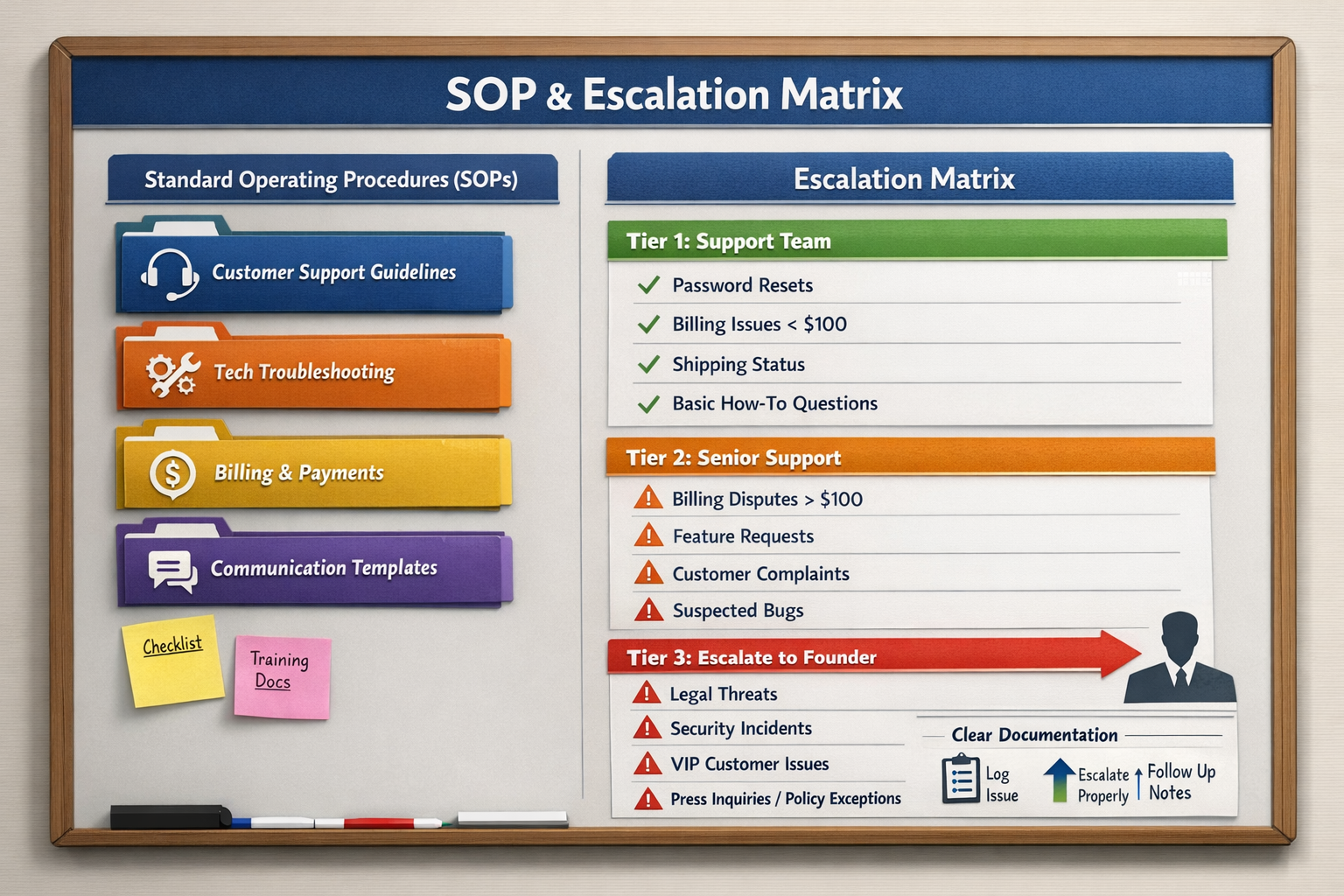
Standard Operating Procedures (SOPs) cover the step-by-step workflows for common scenarios. How do you process a refund? What's the protocol when a customer reports a bug? When does a ticket get escalated versus resolved on the spot?
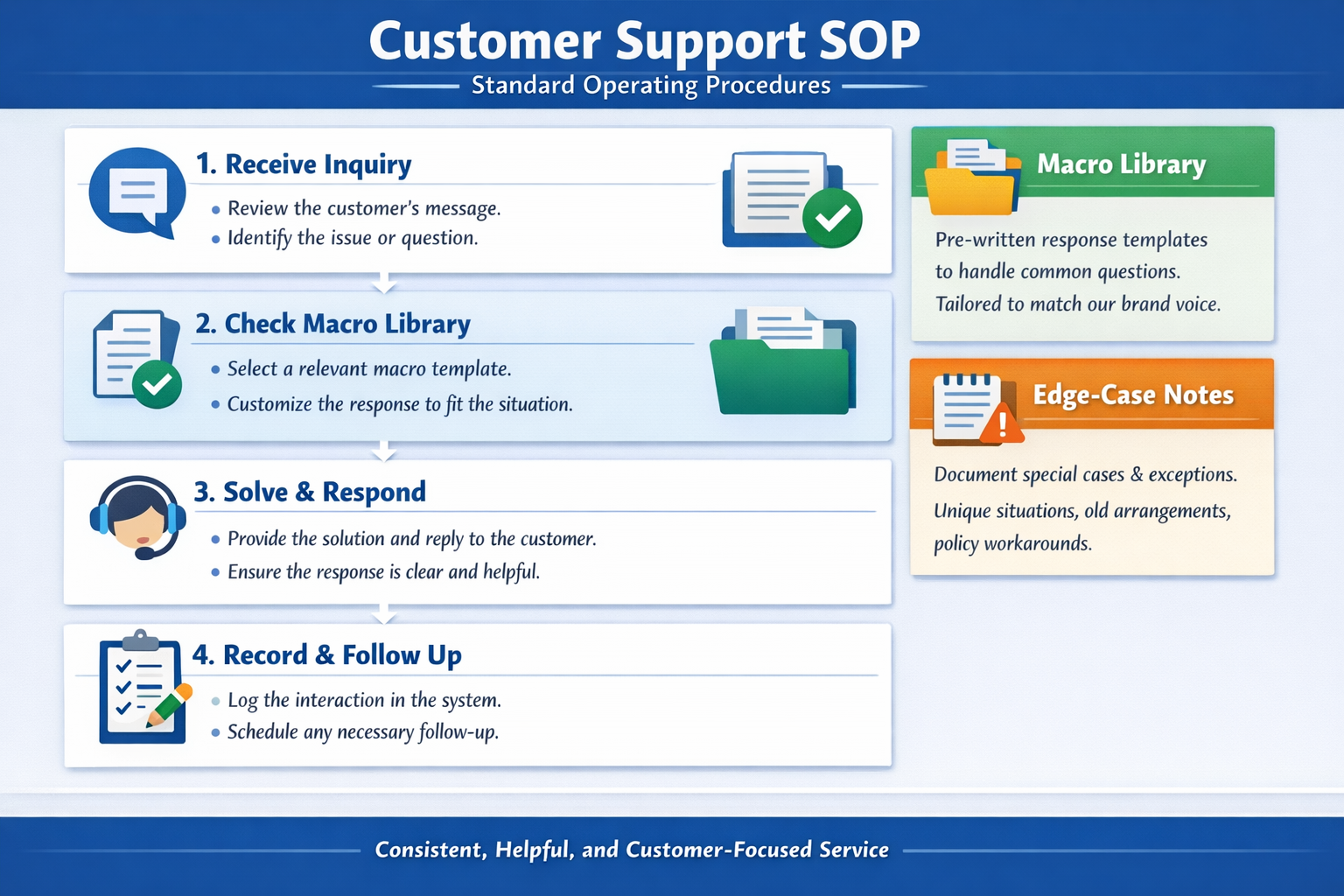
A well-structured SOP includes the trigger condition, the exact steps to follow, any system actions required, and the expected outcome. For example, a refund SOP might specify: "If the customer requests a refund within 30 days of purchase and has used less than 50% of their credits, process the full refund in Stripe and send the 'Refund Confirmation' macro. If outside 30 days, escalate to Tier 2 for review."
SOPs eliminate guesswork and ensure every customer gets the same quality of service.
An Escalation Matrix defines exactly when and how issues move up the chain. This includes which problems require founder input, which go to your technical team, and which the support team can resolve independently.
Here's what a simple escalation matrix might look like in practice:
Tier 1 (Support resolves independently): Password resets, billing questions under $100, shipping status inquiries, basic how-to questions
Tier 2 (Senior support or team lead): Billing disputes over $100, feature requests, complaints about response quality, suspected bugs
Tier 3 (Escalate to client/founder): Legal threats, security incidents, VIP customer issues, press inquiries, any request for policy exceptions
Without this clarity, you'll either get bombarded with unnecessary questions or discover too late that a major issue never reached you [2].
A Macro Library contains pre-approved response templates for frequent inquiries. These aren't robotic copy-paste answers—they're thoughtful starting points that maintain your brand voice while saving time. A good macro library gets refined constantly based on what actually works with your customers.
Edge-Case Notes capture the weird stuff. The customer who has a special arrangement from three years ago. The workaround for that bug you haven't fixed yet. The policy exception you made once that set a precedent. These notes prevent your support team from accidentally contradicting past decisions or commitments.
Why This Matters More for Outsourced Support
When support is in-house, tribal knowledge lives in people's heads. That's not ideal, but it works when your team is small and everyone can tap each other on the shoulder.
When you outsource, that tribal knowledge needs to exist somewhere accessible. Your external support team can't absorb context through osmosis. They need documentation that captures not just the what, but the why behind your policies and processes [3].
The Hidden Cost of Undocumented Support
Most founders who've tried outsourcing without solid documentation end up in one of two frustrating situations.
Situation One: You become the documentation. Your outsourced team pings you constantly with questions because the answers don't exist anywhere else. You're technically not answering support emails anymore, but you're spending just as much time—sometimes more—explaining how to handle them. The time savings you expected never materialize.
Situation Two: Quality slowly deteriorates. Your team does their best without sufficient context, but accuracy suffers. Brand voice drifts. By the time you notice, you've already damaged customer trust and have a backlog of corrections to make.
Both situations share a root cause: treating documentation as optional rather than foundational.
Research consistently shows that poor knowledge management is one of the primary reasons outsourcing relationships underperform expectations [4]. The issue isn't usually the people—it's the systems supporting them.
Who Owns Documentation? And Who Updates It?
This is where many outsourcing relationships fall apart quietly. Documentation gets created during onboarding, then slowly becomes outdated as your product and policies evolve. Six months later, your support team is working from information that's partially wrong.
Shared Responsibility, Clear Ownership
The best approach treats documentation as a shared responsibility with clear ownership lines.
Your responsibility as the business owner:
Communicating product changes, policy updates, and strategic decisions before they affect customers
Reviewing and approving documentation that represents your brand
Providing context that only you can provide (historical decisions, relationship nuances, company values)
Your support agency's responsibility:
Maintaining documentation as a core part of everyday work—not a separate project
Flagging gaps when they discover undocumented scenarios
Updating procedures based on what they learn from real customer interactions
Proactively surfacing patterns that suggest documentation needs attention
The key word is "everyday." Documentation shouldn't be a quarterly project that gets deprioritized when things get busy. It should happen continuously, as a natural byproduct of doing support well [5].
What "Continuous Documentation" Looks Like in Practice
When your support team encounters a new situation, they don't just solve it and move on. They ask: "Will this come up again? Should this be documented?"
When product changes roll out, documentation updates happen before the first customer email arrives—not after a confusing exchange exposes the gap.
When patterns emerge in customer questions, the team doesn't just answer faster. They flag opportunities to improve your public-facing help content, reducing ticket volume altogether. This proactive approach—sometimes called "ticket deflection"—can meaningfully improve your overall support efficiency and customer satisfaction scores.
This is the difference between a support agency that answers emails and one that actually improves your support operation over time.
Questions to Ask Before Signing With a Customer Support Agency
Not every agency prioritizes documentation equally. Here's how to tell who does and who doesn't before you commit.
About Their Documentation Process
"What deliverables can I expect from your onboarding process?"
A serious agency will have a clear answer: SOPs for common workflows, escalation protocols, initial macro library, and a system for capturing edge cases. Vague answers like "we'll figure it out as we go" are a red flag.
"How do you handle documentation when our product or policies change?"
Listen for whether updates happen proactively or reactively. The best agencies have a system for incorporating changes before they create confusion—not after.
"Who maintains documentation on an ongoing basis?"
This should be built into their standard service, not treated as extra work that requires additional budget. Documentation maintenance is part of doing support well, not a premium add-on.
About Ownership and Access
"Do we own the documentation you create?"
This matters more than you might think. If you ever change agencies or bring support in-house, you need access to everything that's been built. Some agencies keep documentation proprietary, which creates problematic lock-in [6].
"How will we collaborate on documentation updates?"
Look for a workflow that matches how you operate. Some agencies use shared documents. Others have dedicated portals. The specific tool matters less than having a clear, low-friction process for both parties.

About Their Approach to Knowledge Gaps
"What happens when your team encounters a situation that isn't documented?"
The answer reveals their philosophy. A good agency escalates appropriately while documenting the situation for future reference. A less mature agency either bothers you with every edge case or makes assumptions that may not align with your brand.
"How do you identify patterns that suggest our documentation needs improvement?"
This question separates agencies that are reactive from those that are proactive. The best teams notice when multiple tickets cluster around a confusing topic—and flag it before you have to ask.
Documentation as Competitive Advantage
Here's what founders often miss: internal support documentation isn't just about avoiding mistakes. It's about compounding improvements over time.
Every documented solution becomes reusable. Every refined macro makes future responses faster and more consistent. Every captured edge case prevents the same confusion from recurring.
After six months with a documentation-focused support agency, you don't just have better support. You have a knowledge base that makes onboarding new team members faster, reduces escalations, and creates consistency that customers notice and appreciate.
This is especially valuable for small businesses where the founder has been the support team for years. All that context trapped in your head? A good agency extracts it systematically and turns it into documented processes that don't depend on you being available.
What Evergreen Does Differently
At Evergreen Support, documentation isn't a side project—it's woven into how we do support every day.
When we onboard a new client, we don't just learn your product. We build the internal documentation that captures your processes, policies, and brand voice. SOPs, escalation protocols, macro libraries, edge-case notes—all the components that make support sustainable [7].
But here's what matters more: we maintain this documentation as part of our ongoing work. When your product changes, our docs update. When we spot a gap, we fill it. When patterns suggest an improvement, we make it happen. We work within whatever tools you already use—whether that's Notion, your existing helpdesk, or something else entirely.
The documentation we create belongs to you. If you ever decide to bring support in-house or move to a different solution, you walk away with everything we've built. No lock-in. No starting from scratch.
This is what human-powered support looks like when it's done right. Not just people answering emails, but a team that strengthens your support operation with every ticket they handle.

Ready to see what documentation-focused support looks like for your business? Book a call with Evergreen Support to discuss your support needs—and the systems that would make outsourcing actually sustainable.
Frequently Asked Questions
What's the difference between internal support documentation and a public help center?
Internal documentation is for your support team—it includes policy details, escalation rules, edge-case notes, and context that customers don't need to see. Your public help center is customer-facing content designed to help users solve problems themselves. Great support agencies improve both, but they serve different purposes and require different approaches.
How long does it take to build comprehensive support documentation from scratch?
Initial documentation typically comes together during onboarding, which takes about one to two weeks for most small businesses. However, documentation is never truly "done"—it evolves continuously as your product and policies change. The goal is a living system that improves over time, not a finished document that sits untouched.
What if I already have some documentation but it's outdated or incomplete?
Most businesses start with partial documentation that needs updating. A good support agency audits what exists, identifies gaps, and systematically builds out what's missing while correcting inaccuracies. Existing docs provide useful starting context even when they need significant work—they reveal how you've historically handled situations.
Should I wait until I have documentation before outsourcing support?
No—documentation creation should be part of your agency's onboarding process. Agencies that can't build documentation from existing knowledge (past tickets, your input, product exploration) are revealing a capability gap. You shouldn't have to do this work before they start; extracting and organizing this knowledge is part of what you're paying them to do.
How do I know if an agency is actually maintaining documentation or just claiming to?
Ask for periodic documentation reviews or access to see updates in real-time. Agencies that treat documentation as a core function can show you what's changed and why. Those who treat it as an afterthought will struggle to demonstrate ongoing maintenance or point to specific recent updates.
About Evergreen Support
Evergreen Support is a US-based customer support agency built specifically for small online businesses—SaaS companies and ecommerce brands with small teams who need reliable, human-powered support without the cost and complexity of building an in-house team. Founded by Emma Fletcher and Ellis Annichine, both former startup operators, Evergreen handles email support with the same care you would—while building the documentation systems that make great support sustainable. Every client gets two dedicated support specialists who learn your brand, maintain your processes, and ensure nothing falls through the cracks.
Works Cited
[1] HelpScout — "How to Build an Internal Knowledge Base." https://www.helpscout.com/blog/internal-knowledge-base/
[2] Zendesk — "What is an escalation matrix? A complete guide." https://www.zendesk.com/blog/escalation-matrix/
[3] McKinsey & Company — "The seven habits of highly effective outsourcing." https://www.mckinsey.com/capabilities/operations/our-insights/the-seven-habits-of-highly-effective-outsourcing
[4] Deloitte — "Global Outsourcing Survey: Knowledge transfer challenges." https://www2.deloitte.com/us/en/pages/operations/articles/global-outsourcing-survey.html
[5] Process Street — "Standard Operating Procedures: The Complete Guide." https://www.process.st/standard-operating-procedures/
[6] Forbes — "10 Questions To Ask Before Outsourcing Any Business Function." https://www.forbes.com/sites/forbesbusinesscouncil/2022/03/15/10-questions-to-ask-before-outsourcing-any-business-function/
[7] Evergreen Support — "What We Do." https://www.evergreensupport.co/