
Why Pricing Models Matter More Than You Think
Here's a conversation that happens at least once a week:
A founder calls us and says, "I got a quote from another agency—$15 per ticket. That sounds pretty good, right?"
Then we ask: "How many tickets do you get per month?"
Long pause.
"Um... I'm not sure. Maybe 200?"
That "$15 per ticket" just became $3,000 a month—potentially triple what they expected to pay.
Here's the thing about outsourcing customer support: the pricing model matters as much as the actual price. Choose wrong, and you'll either overpay dramatically or end up with surprise bills that blow your budget.
This guide walks through the four most common pricing models you'll encounter when shopping for outsourced email support—and more importantly, shows you when each one makes sense (and when it absolutely doesn't).
No fancy marketing lingo. Just the real numbers and tradeoffs we've seen working with dozens of small SaaS and ecommerce businesses.
The Four Most Common Outsourcing Pricing Models
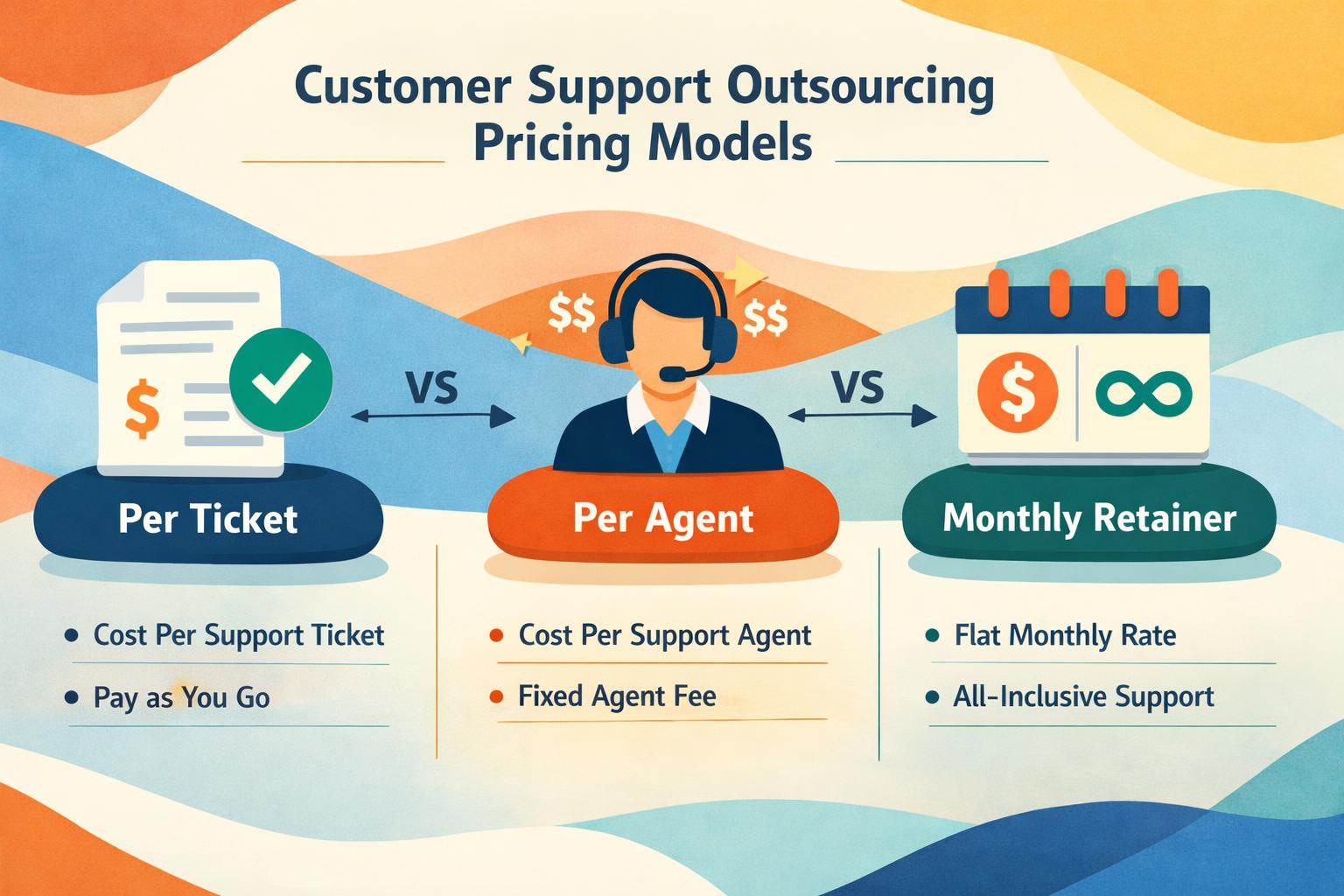
When you start getting quotes from support agencies, you'll see pricing structured four main ways:
1. Per-ticket (or per-reply) pricing – You pay a fixed amount for each customer inquiry the agency handles. Common in ecommerce and simple support scenarios.
2. Pay-per-resolution pricing – A newer outcome-based model where you only pay when a ticket is successfully resolved, typically at $1.25–$2.25 per resolution. Gaining traction with agencies that want to align pricing with results.
3. Dedicated agent / per-seat pricing – You essentially "rent" a support agent (or multiple agents) for a set number of hours or full-time. Common with larger teams or high-volume needs.
4. Monthly retainer / volume-based pricing – You pay a flat monthly fee based on your expected ticket volume, with adjustments if you grow or shrink. (This is what we use at Evergreen.)
Each model has different strengths—and different ways to surprise you with costs you didn't expect.

Let's break them down.
Per-Ticket Pricing: When It Works (and When It Doesn't)
How it works:
You pay a set rate—typically $8–$25 per ticket—for each support inquiry the agency resolves. Some agencies count the entire conversation as one ticket; others charge per reply within a thread (read the fine print).
When it makes sense:
Very low, predictable volume. If you get 20–50 tickets a month and your queries are straightforward (order tracking, password resets), per-ticket can be economical.
Seasonal spikes. Ecommerce stores that need extra hands during Q4 can scale up without paying for unused capacity in January.
You want zero ongoing commitment. Many per-ticket agencies operate on true pay-as-you-go terms.
When it backfires:
You have no idea how many tickets you get. Surprise: most founders don't track ticket counts until they're shopping for outsourcing. If you're sitting at 200+ tickets a month, per-ticket pricing gets expensive fast.
Complex or multi-touch issues. Agencies might count a 5-email back-and-forth as 5 tickets. That "$15 per ticket" just became $75 for one customer problem.
Your volume grows. Success becomes expensive. Going from 100 to 300 tickets in a quarter? Your support bill just tripled, with no advance warning.
Real example:
We spoke with an ecommerce founder paying $12 per ticket with an overseas agency. Sounded great—until holiday season hit and they processed 450 tickets in November. Bill: $5,400 for one month. They weren't prepared, and it nearly wiped out their holiday profit margin.
Bottom line on per-ticket:
Works if you're small and predictable. Gets risky (and potentially expensive) the moment volume fluctuates or complexity increases.
Pay-Per-Resolution: The Outcome-Based Alternative
How it works:
Instead of paying for each ticket or reply, you pay only when an issue is successfully resolved—typically $1.25–$2.25 per resolution. The agency defines "resolution" upfront (usually means the customer's issue is solved and they don't need to follow up).
This is a newer model that some agencies are adopting to align their incentives with yours: they only get paid when they actually help your customers.
When it makes sense:
You want accountability built into pricing. If the agency doesn't solve the problem, you don't pay. This reduces risk of paying for low-quality or incomplete responses.
Your tickets vary in complexity. A simple "where's my order" and a complex technical issue cost the same—the agency's incentive is to resolve efficiently, not drag out conversations.
You're testing a new agency. Pay-per-resolution can be a lower-risk way to trial an outsourcing relationship.
When it backfires:
Agencies may rush to "close" tickets. Some might mark issues resolved prematurely to hit their numbers. Make sure "resolution" is clearly defined in your contract (e.g., requires customer confirmation or no follow-up within 48 hours).
Harder to predict monthly costs. Since you don't know how many issues will be resolved vs. escalated, budgeting can be trickier than with flat retainers.
Not widely offered yet. This model is newer, so fewer agencies support it (especially smaller providers).
Real example:
A SaaS startup we consulted with tried pay-per-resolution at $1.75 per ticket with an agency that specialized in this model. Over three months, they averaged 180 resolved tickets/month—total cost: $315/month. Far cheaper than per-ticket or retainer models because the agency was efficient and didn't pad ticket counts.
However, they discovered the agency was escalating complex technical questions back to them rather than resolving them (since those didn't count as "resolutions"). They eventually switched to a retainer model for better coverage.
Bottom line on pay-per-resolution:
Emerging model with promise—great for accountability and simple support scenarios. Watch for agencies gaming the "resolution" definition.
Dedicated Agent / Per-Seat Pricing: The Fixed-Cost Trap
How it works:
You pay a monthly fee to have one (or more) support agents dedicated to your account. Pricing varies dramatically by location:
Offshore (Philippines, India): $8–$15/hour = $1,280–$2,400/month for full-time
Nearshore (Latin America): $20–$30/hour = $3,200–$4,800/month for full-time
Onshore (US, Canada, UK): $40–$60+/hour = $6,400–$9,600+/month for full-time
Many agencies also offer part-time dedicated agents at proportional rates.
When it makes sense:
High, consistent volume. If you're reliably getting 500+ tickets a month, a dedicated agent often costs less per ticket than pay-as-you-go models.
You need deep product knowledge. A dedicated agent learns your product inside-out and can handle nuanced, technical queries that would eat up time (and money) on a per-ticket model.
You want tight integration. Dedicated agents can participate in your Slack, attend standups, and feel like internal team members.
When it backfires:
You're paying for idle time. Got 200 tickets this month? Your dedicated agent might only be working 15 hours a week—but you're paying for 40. (That's fine if predictability matters more than per-hour efficiency, but it stings if cash is tight.)
No backup when your agent is out. Vacation, sick days, or sudden turnover means your support goes dark unless the agency has a robust backup system (most don't for lower-tier plans).
You're locked into minimums. Many agencies require 3–6 month commitments for dedicated agents. If your needs change—or the agent isn't a fit—you're stuck.
Real example:
A SaaS startup we work with hired a dedicated agent from a popular agency at $2,800/month (nearshore rate). Agent was great—but when she left after four months (for reasons unrelated to the client), it took the agency three weeks to assign a replacement. The startup's inbox piled up, and they had no recourse because the contract said "reasonable effort to replace."
Bottom line on dedicated agents:
Excellent for high-volume or complex support if the agency has real backup coverage and you can stomach the fixed cost regardless of ticket fluctuations. Offshore pricing is tempting but often comes with quality and time-zone tradeoffs—US-based agents typically cost 3–5x more than offshore but deliver better language fluency and cultural alignment.
Monthly Retainer / Volume-Based: The Predictable Middle Ground
How it works:
You pay a flat monthly fee based on your expected ticket volume, with pricing tiers (e.g., 0–100 tickets = $600/month; 101–250 tickets = $900/month). If your volume grows or shrinks consistently, the fee adjusts—but it's not volatile month-to-month like pure per-ticket.
When it makes sense:
You want predictability without overpaying for idle capacity. Volume-based retainers give you a clear monthly budget while still scaling with growth.
Your ticket count fluctuates, but not wildly. If you're at 150 tickets one month and 180 the next, you stay in the same tier—no surprise spikes.
You value flexibility. Most retainer models (including ours) operate month-to-month with no long-term lock-in.
When it backfires (rarely, but it happens):
You have extreme seasonality. If you go from 50 tickets in March to 500 in December, a volume-based model will adjust—but you'll see a big jump. (Still more predictable than per-ticket, but worth planning for.)
You're very small or very large. If you get 10 tickets a month, even the lowest tier might feel like overkill. If you're at 1,000+ tickets monthly, you might need a fully custom enterprise arrangement.
Real example:
One of our clients (a small SaaS tool) started at ~80 tickets/month and paid $600. Over six months, they grew to 220 tickets/month, and their fee adjusted to $900—a 50% increase, but their revenue had grown 3x in the same period. The predictability let them budget accurately, and they weren't penalized for every incremental ticket.
Bottom line on volume-based retainers:
The Goldilocks model for most small online businesses—predictable, fair, and scalable without nasty surprises.

Real Numbers: What Small Businesses Actually Pay (By Region)
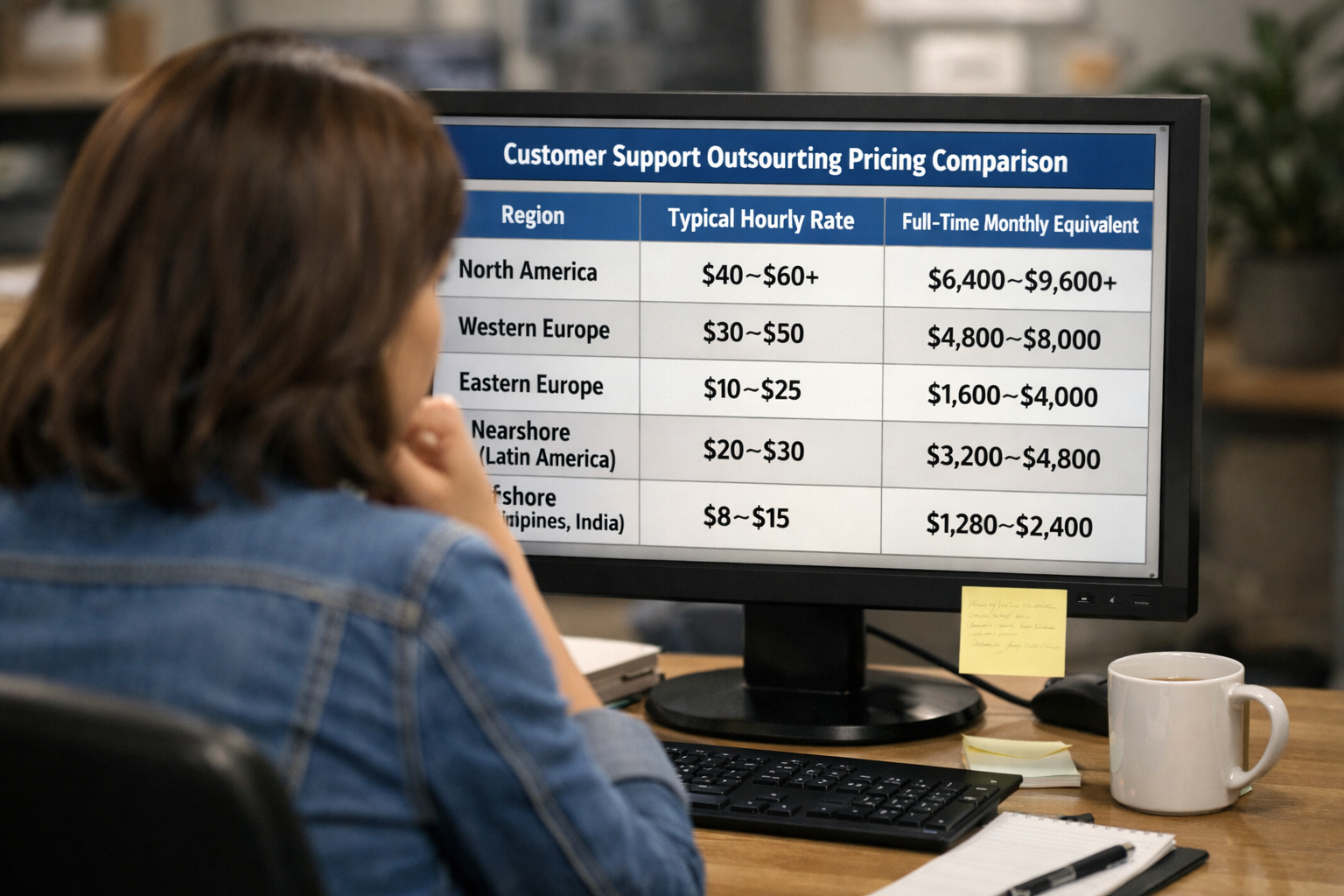
Let's ground this in reality. Here's what small SaaS and ecommerce companies actually pay for outsourced email support, based on current market data and conversations with dozens of founders:
Pricing by Region (Hourly Rates)
| Region | Typical Hourly Rate | Full-Time Monthly Equivalent |
| North America | $40–$60+ | $6,400–$9,600+ |
| Western Europe | $30–$50 | $4,800–$8,000 |
| Eastern Europe | $10–$25 | $1,600–$4,000 |
| Nearshore (Latin America) | $20–$30 | $3,200–$4,800 |
| Offshore (Philippines, India) | $8–$15 | $1,280–$2,400 |
Note: Monthly rates assume ~160 hours/month for full-time work. Many agencies offer part-time or fractional options at proportional rates.
Low-volume businesses (0–100 tickets/month):
Per-ticket: $8–$20/ticket = $0–$2,000/month (highly variable)
Pay-per-resolution: $1.25–$2.25/resolution = $125–$225/month (if resolution rate is high)
Dedicated agent: Not cost-effective at this scale (you'd be paying for 70%+ idle time)
Volume-based retainer: $500–$800/month (Evergreen starts at $600 for up to 100 tickets)
Mid-volume businesses (100–300 tickets/month):
Per-ticket: $8–$20/ticket = $800–$6,000/month (wide range depending on complexity)
Pay-per-resolution: $1.25–$2.25/resolution = $250–$675/month (assumes ~80% resolution rate)
Dedicated agent (part-time): $1,200–$2,400/month (offshore) or $3,200–$4,800/month (nearshore)
Volume-based retainer: $800–$1,500/month
Higher-volume businesses (300–600 tickets/month):
Per-ticket: Typically $2,400–$12,000/month (gets expensive fast)
Pay-per-resolution: $500–$1,350/month (assumes ~80% resolution rate)
Dedicated agent (full-time): $1,280–$2,400/month (offshore), $3,200–$4,800/month (nearshore), or $6,400+/month (onshore)
Volume-based retainer: $1,500–$2,500/month
Enterprise-level (1,000+ tickets/month):
Most businesses at this scale move to custom pricing or multi-agent dedicated teams. Industry benchmarks show:
Small-to-mid-sized businesses: $5,000–$15,000/month on average
Enterprise companies: $50,000+/month (often includes 24/7 coverage, multiple channels, and extensive training)
Variables that affect pricing:
Support complexity – Technical SaaS troubleshooting costs more than "Where's my order?" emails
Response time SLA – 24-hour Monday–Friday (standard) vs. 4-hour or weekend coverage
Agent location – US-based agents typically cost 3–5x more than offshore teams (but quality and time-zone alignment usually justify it for small businesses)
Training depth – How much product knowledge is required? Some agencies charge onboarding fees (typically $500–$1,500) or higher rates for steep learning curves
Integration complexity – Multi-platform support (helpdesk + CRM + Slack) may incur setup fees
A realistic example:
Let's say you run a Shopify store doing ~$50K/month in revenue. You get about 180 support emails a month (mix of pre-sale questions, order issues, and returns).
Per-ticket at $15: $2,700/month (ouch—that's 5.4% of revenue)
Pay-per-resolution at $1.75: ~$250/month (if resolution rate is high and tickets are simple)
Dedicated part-time agent (nearshore): $2,400/month (reasonable, but no backup if they're sick)
Volume-based retainer: $900/month (predictable, includes two-agent coverage for continuity)
For most bootstrapped or early-stage businesses, the volume-based retainer hits the sweet spot between cost and reliability.
Questions to Ask Before You Sign (The Hidden Fee Checklist)
Pricing models are one thing—but hidden fees and fine print are where outsourcing deals often go sideways.
Here's a checklist of questions to ask any support agency before you commit:
On pricing structure:
[ ] How do you define a "ticket" or "resolution"? (Is a 5-email thread one ticket or five? What counts as successfully resolved?)
[ ] What happens if my volume spikes unexpectedly? (Do you get charged overage fees? How much notice for tier changes?)
[ ] Are there onboarding or setup fees? (Industry average: $500–$1,500, but some charge $2,000+)
[ ] What's included in the base price? (Response time SLA? Agent training? Access to helpdesk software?)
On coverage and continuity:
[ ] How many agents will work on my account? (One agent = single point of failure. Two+ = better continuity.)
[ ] What happens if my assigned agent quits or goes on vacation? (Do you go dark, or is there automatic backup?)
[ ] What hours/days are covered? (Weekdays only? Weekends? Holidays?)
On quality and control:
[ ] How do you ensure agents sound like my brand? (Training process? Review/approval workflows?)
[ ] Can I review and approve responses before you go live? (Good agencies say yes.)
[ ] What's your agent turnover rate? (High turnover = constant retraining and quality drops. For reference, offshore call centers often see 40–60% annual turnover; ask for their specific numbers.)
On flexibility:
[ ] What's the contract term? (Month-to-month is ideal. 6–12 month commitments are risky if you're unsure.)
[ ] Can I pause or reduce service if needed? (Bootstrapped businesses need flexibility.)
[ ] How much notice to cancel? (30 days is standard; anything longer is a red flag.)
On hidden costs:
[ ] Do you charge for time spent in meetings, training, or Slack? (Some agencies bill hourly for "collaboration time"—typically $40–$100/hour on top of base fees.)
[ ] Are there fees for integrating with my helpdesk or CRM? (Common add-ons: $200–$500 per integration, ongoing licensing fees if they provide the software.)
[ ] What happens if I exceed my ticket allotment mid-month? (Overage fees? Automatic tier jump? Some charge 20–50% more for overages.)
[ ] Are there escalation or Tier-2 support fees? (If complex issues require senior agents, do you pay extra?)
Pro tip:
If an agency resists answering these questions directly—or gives vague "we'll work it out" answers—that's a warning sign. Transparent agencies put pricing, terms, and processes in writing upfront.

How Evergreen Support's Pricing Works
We built our pricing model specifically to solve the problems we kept seeing with other agencies: surprise bills, rigid contracts, and paying for capacity you don't use.
Here's how it works:
Volume-based monthly pricing (no per-ticket surprises)
You pay a flat monthly fee based on your ticket volume, with transparent tiers:
0–100 tickets/month: $600/month
101–250 tickets/month: $900/month
251–500 tickets/month: $1,500/month
500+ tickets/month: Custom pricing (we'll talk through your specific needs)
Your pricing tier is based on the average of the previous two months—so one spike month won't suddenly double your bill. If your volume grows consistently, we adjust. If it drops, your fee drops too.
What's included (no hidden fees):
Two dedicated US-based agents working your account (so you always have backup coverage)
24-hour response time, Monday–Friday (guaranteed)
Shared Slack channel for real-time collaboration
Internal documentation we build as we go (FAQs, saved replies, process docs—yours to keep)
Proactive issue flagging (we'll tell you if we see patterns or problems in your inbox)
Works with any helpdesk or CRM you prefer (HelpScout, Zendesk, Front, email—whatever you use)
No onboarding fees (unlike many agencies that charge $500–$1,500 upfront)
No integration fees (we set up your tools as part of standard service)
No meeting or collaboration time charges (Slack access and periodic check-ins are included)
Month-to-month. No long-term contracts.
You're not locked in. If it's not working, you can cancel with 30 days' notice. We keep clients because they're happy, not because they're contractually stuck.
$1 trial onboarding
New clients start with a $1 onboarding week. We'll:
Review your past tickets and build an internal FAQ
Draft sample responses for you to review and approve
Set up integrations and processes
Only start handling live support once you're comfortable
If at any point you decide it's not a fit, we refund the $1—no questions asked.
Why this model?
Because we wanted pricing that's predictable, fair, and scales with you—without the gotchas that make most outsourcing relationships feel like a gamble. And because we're US-based, you get native English speakers with time-zone alignment at a rate that's typically 30–50% less than hiring an in-house support person in the U.S.
Bottom Line: Picking the Right Model for Your Business
There's no universally "best" pricing model—it depends on your volume, complexity, and tolerance for variability.
Choose per-ticket pricing if:
You get fewer than 50 tickets/month and they're simple
You need true seasonal flex (e.g., ecommerce with massive Q4 spikes)
You're comfortable with variable monthly bills
Choose pay-per-resolution pricing if:
You want outcome-based accountability built into pricing
Your tickets are mostly simple and have high resolution rates
You're willing to accept some month-to-month variability for potentially lower costs
Choose dedicated agent pricing if:
You consistently get 500+ tickets/month
Your support requires deep product/technical knowledge
You value tight integration and fixed costs (even if you overpay for idle time)
You're willing to pay 3–5x more for US-based vs. offshore agents to get better quality and time-zone alignment
Choose volume-based retainer pricing if:
You get 50–500 tickets/month
You want predictable budgeting without overpaying for unused capacity
You value flexibility (month-to-month, no lock-in)
You need reliable backup coverage (not dependent on one agent)
For most small SaaS and ecommerce businesses, volume-based retainers hit the sweet spot—predictable, scalable, and far less likely to surprise you with a bill that tanks your month.
FAQ
Q: What if I have no idea how many tickets I get per month?
Check your email or helpdesk software. Most platforms (HelpScout, Zendesk, Gmail, etc.) can show you monthly email volume. If you're using plain Gmail, a rough rule of thumb: count support emails over a week and multiply by 4.
If you're still unsure, start with a volume-based model—it's more forgiving than per-ticket if you underestimate.
Q: Can I negotiate pricing with agencies?
Sometimes. Larger agencies often have set pricing, but smaller providers (especially for dedicated agent models) may offer discounts for longer commitments or bundled services.
That said, cheapest isn't always best. We've talked to multiple founders who went with the lowest bid, only to deal with terrible quality, high agent turnover, or surprise fees that wiped out the savings.
Q: What about offshore vs. US-based pricing?
Offshore support (Philippines, India, Latin America) typically costs $8–$15/hour (full-time ~$1,280–$2,400/month), while US-based agents run $40–$60+/hour (full-time ~$6,400–$9,600+/month)—making US-based support roughly 3–5x more expensive than offshore.
For very simple, high-volume support (e.g., order tracking for ecommerce), offshore can work.
But for most small businesses, US-based support is worth the premium because:
Native English speakers who understand cultural context and tone
Time-zone alignment (no overnight delays)
Lower turnover (offshore call centers often have 40–60% annual turnover vs. 15–25% for quality US-based agencies)
You're paying for quality and reliability—not just warm bodies.
Q: How do I know if an agency's pricing is fair?
Benchmark against the ranges in this guide, but also consider:
What's included (training, documentation, integrations, backup coverage)
Response time SLA
Contract terms (month-to-month vs. locked-in)
Agent quality and location
Hidden fees (onboarding, integration, overage, collaboration time)
If something seems way cheaper than market rate, ask why. Often it's because they're cutting corners somewhere (training, agent pay, backup coverage).
Q: What if my ticket volume is wildly inconsistent?
If you swing from 50 tickets one month to 400 the next, talk to agencies about hybrid models (e.g., base retainer + per-ticket overages) or simply accept that volume-based tiers will adjust.
Seasonal businesses (especially ecommerce) should also ask about pause or scale-down options for off-peak months.
Q: Do I need to commit long-term to get good pricing?
Not necessarily. Some agencies discount for annual contracts, but many (including Evergreen) offer the same pricing month-to-month because they'd rather earn retention through quality than lock you in contractually.
If an agency requires 6–12 months upfront, make sure you're confident in the fit—because you're stuck if it doesn't work out.
Q: What are typical onboarding fees, and are they negotiable?
Most agencies charge $500–$1,500 for onboarding and initial training, though some charge up to $2,000+ for complex products. These fees usually cover:
Initial discovery calls and process mapping
Agent training on your product/brand voice
Helpdesk and CRM integration
Documentation setup
Some agencies (like Evergreen) waive onboarding fees entirely as part of their service model. Always ask if this fee is negotiable or can be credited toward your first month.
Ready to see how Evergreen Support's pricing works for your business?
We're happy to walk through your ticket volume, answer questions, and show you exactly what you'd pay—with no surprises and no pressure.
Schedule a call or start your $1 trial to test-drive our service with zero risk.
Works Cited
Outsource Accelerator. "Outsourced Customer Service Costs: The 2024 Pricing Guide." Accessed January 2025. https://www.outsourceaccelerator.com/articles/outsourced-customer-service-costs/
Smith.ai. "How Much Does Outsourcing Customer Service Cost?" Accessed January 2025. https://smith.ai/blog/how-much-does-outsourcing-customer-service-cost
Unity Connect. "Customer Service Outsourcing Pricing Models Explained." Accessed January 2025. https://www.unityconnect.com/customer-service-outsourcing-pricing/
VirtualHelper. "Outsourced Customer Support Costs (2024 Edition)." Accessed January 2025. https://www.virtualhelper.io/blog/outsourced-customer-support-costs
SupportNinja. "How Much Does It Cost to Outsource Customer Service?" Accessed January 2025. https://www.supportninja.com/resources/how-much-does-it-cost-to-outsource-customer-service
Evergreen Support. "Outsource Customer Support Costs vs In-House: 2025 Guide." https://www.evergreensupport.co/blog/outsource-customer-support-cost-comparison
Evergreen Support. "Customer Support Agency Pricing." https://www.evergreensupport.co/pricing