

Finding the right customer support partner feels a lot like hiring a key employee—except you're trusting an entire team with your most valuable asset: your customer relationships.
If you're a founder or small business operator exploring US-based customer support outsourcing, you've probably already discovered that not all providers are created equal. Some promise the world and deliver offshore scripts. Others hide fees in the fine print. A few actually deliver what they promise.
This guide gives you a practical framework for evaluating support partners, spotting warning signs before you sign anything, and verifying that "US-based" actually means US-based. Plus, we've included a scorecard you can use during your search.

Why "US-Based" Matters More Than You Think
Before diving into evaluation criteria, let's address why location matters at all—and the real cost tradeoff you're weighing.
Yes, US-based support costs more than offshore alternatives. That's the elephant in the room. But the appeal isn't about geography for its own sake. It's about three things that directly impact your customers' experience and your bottom line:
Cultural fluency. US-based agents understand American idioms, expectations, and communication styles without translation gaps. When a customer says "this is driving me crazy," a culturally fluent agent recognizes frustration without taking the phrase literally. Research from PwC found that 82% of US consumers want more human interaction in customer service, and that interaction works best when there's no cultural or linguistic friction [1].
Time zone alignment. For businesses serving primarily US customers, having support staff working during American business hours means faster response times and more natural back-and-forth communication. According to customer experience research, 90% of customers rate an "immediate" response as important when they have a support question—and "immediate" typically means within 10 minutes [2]. That's much easier to achieve when your team is awake during your customers' business hours.
Quality consistency and the hidden cost equation. While excellent support professionals exist everywhere, the real math isn't just about hourly rates. Consider: How much management time will you spend fixing miscommunications? What's the cost of a churned customer due to a frustrating support interaction? What's your time worth when you're reviewing every ticket because you can't fully trust the quality?
For many small businesses, US-based support costs roughly 30-60% less than hiring a full-time in-house employee when you factor in benefits, taxes, training, and turnover [3]. The premium over offshore options often pays for itself in reduced management overhead and better customer retention.
The challenge? Many providers claim "US-based" while routing tickets overseas or using AI chatbots behind the scenes. Knowing how to verify these claims separates smart buyers from disappointed ones.
A Simple Scoring Rubric for Evaluating Support Partners
When comparing potential partners, score each provider across these five dimensions. Rate each area from 1-5, with 5 being excellent.
1. Service Level Agreement (SLA) Clarity
What to look for:
Specific, measurable response time commitments (not vague promises)
Clear definitions of "response" versus "resolution"
Written guarantees you can reference later
Consequences if SLAs aren't met
Questions to ask:
"What's your guaranteed response time for email support?"
"How do you define 'response time'—first acknowledgment or substantive reply?"
"What happens if you miss your SLA targets?"
Score 5: Written guarantee of specific response times (e.g., 24 hours or less, Monday-Friday) with clear definitions and accountability measures.
Score 1: Vague language like "we respond quickly" or "typically same-day" with no written commitments.
2. Coverage Model
What to look for:
Clear hours of operation that match your customers' needs
Backup systems for agent absences
Holiday and weekend policies stated upfront
Staffing redundancy built into the model
Questions to ask:
"What hours do you provide coverage?"
"What happens when our assigned agent is sick or on vacation?"
"How many agents will know our account?"
Score 5: Dedicated agents with built-in backup coverage (e.g., two agents per account), clear hours, and transparent holiday policies.
Score 1: Single point of failure with no backup plan, unclear hours, or rotating anonymous agents.
3. Escalation Process
What to look for:
Clear tiers of support (what they handle vs. what comes back to you)
Defined escalation triggers and timelines
Communication protocols for urgent issues
Flexibility to customize based on your needs
Questions to ask:
"What types of issues will you escalate to our team?"
"How quickly do escalations reach us?"
"Can we define custom escalation rules for specific scenarios?"
Score 5: Documented escalation framework with customizable triggers, clear handoff procedures, and real-time communication channels (like Slack).
Score 1: No clear escalation process, or everything gets escalated (defeating the purpose of outsourcing).
4. Documentation and Knowledge Building
What to look for:
Proactive documentation of your processes and FAQs
Ongoing updates as your product evolves
Knowledge base ownership (you keep it if you part ways)
Pattern identification and reporting
Questions to ask:
"Who creates and maintains our support documentation?"
"Do we own the documentation you create?"
"How do you flag recurring issues or trends?"
Score 5: Active documentation building, regular trend reporting, and clear ownership of all materials created for your account.
Score 1: No documentation services, or documentation belongs to the provider.
5. Transparency and Communication
What to look for:
Clear, published pricing without hidden fees
Regular communication channels and check-ins
Honest about what they can and can't do
Willingness to share references or case examples
Questions to ask:
"What's included in your monthly fee, and what costs extra?"
"How will we communicate day-to-day?"
"Can you connect me with a current client as a reference?"
Score 5: Transparent pricing, dedicated communication channels, regular reporting, and willingness to share references.
Score 1: Unclear pricing, hard to reach, defensive about providing references.
Partner Evaluation Scorecard
Use this table during your evaluation process:
| Evaluation Criteria | Provider A | Provider B | Provider C |
| SLA Clarity (1-5) | |||
| Coverage Model (1-5) | |||
| Escalation Process (1-5) | |||
| Documentation (1-5) | |||
| Transparency (1-5) | |||
| TOTAL |
How to interpret your total:
21-25: Strong candidate. Move forward with confidence after reference checks.
16-20: Promising but dig deeper. Clarify weak areas before committing.
11-15: Proceed with caution. Significant gaps may cause problems later.
Below 11: Look elsewhere. Too many fundamental concerns.

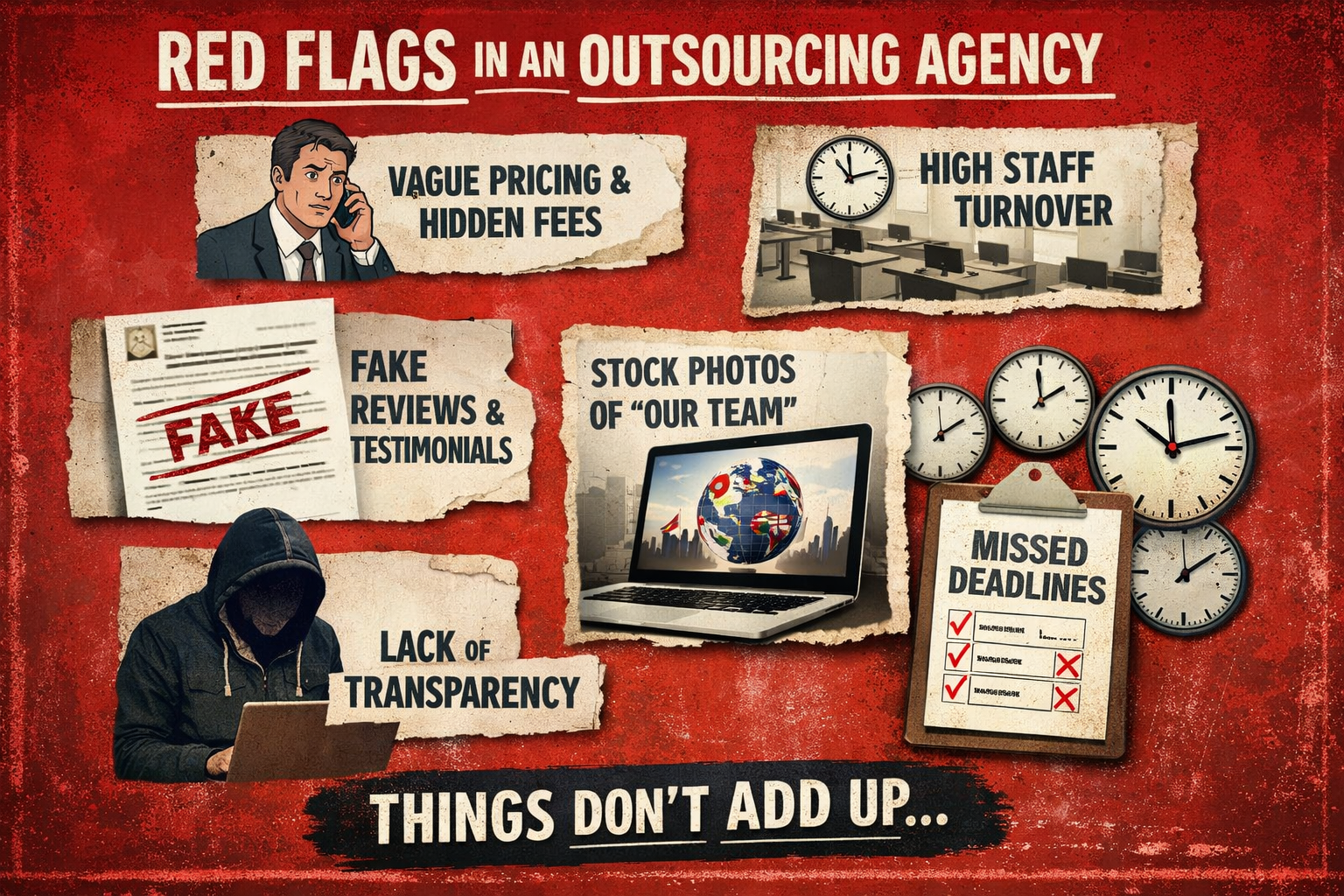
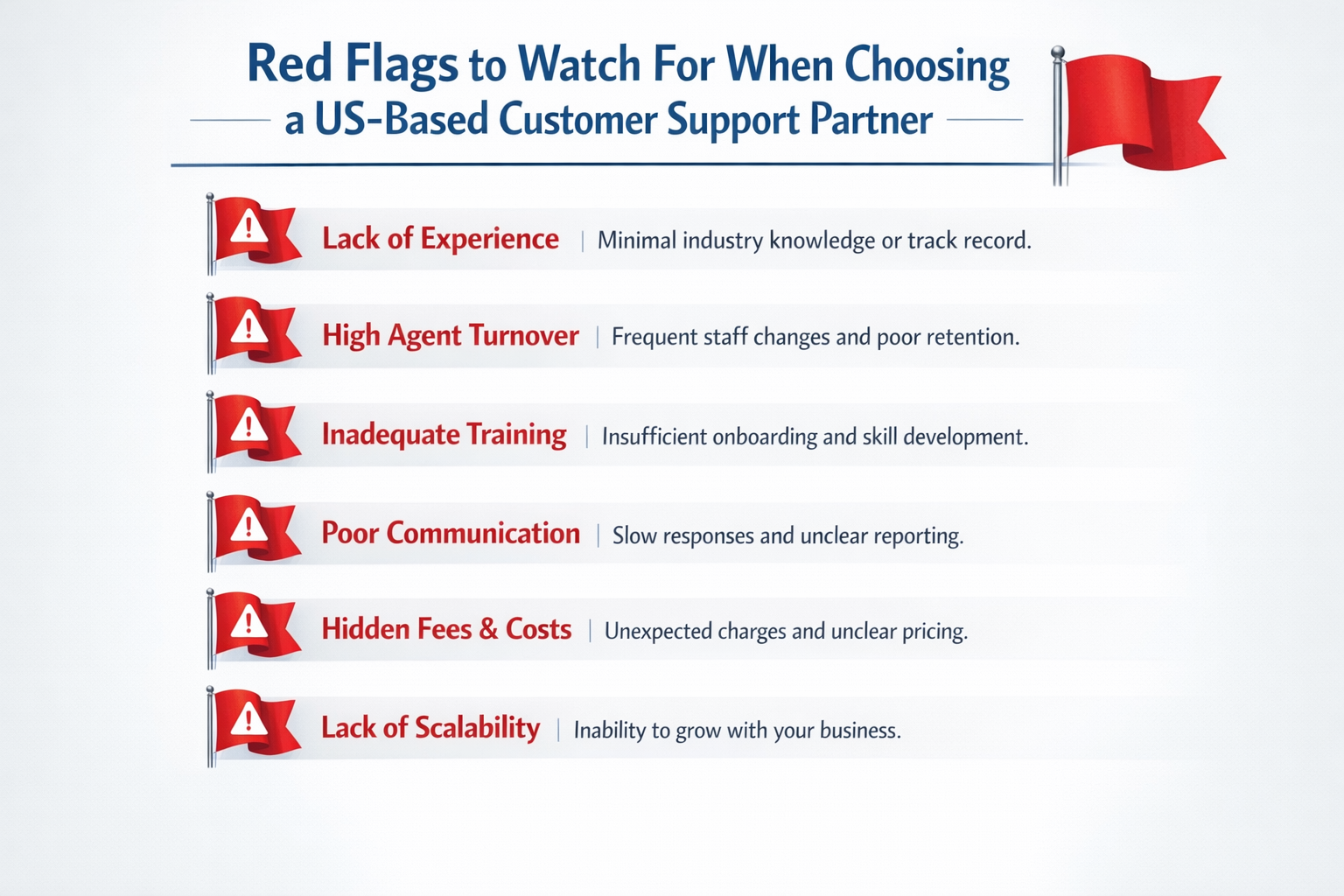
Red Flags That Should Make You Walk Away
Beyond the scorecard, watch for these warning signs during your evaluation. Any of these should give you serious pause:
Bait-and-Switch Staffing
What it looks like: During sales, you meet impressive, articulate team members. After signing, your tickets get handled by completely different people—often with noticeably different quality.
How to spot it: Ask specifically who will handle your account. Request introductions to actual agents during the evaluation process. If they deflect or say "it depends on capacity," that's a warning sign.
Why it matters: The people you meet during sales set expectations. If they won't be doing the work, you're buying a promise, not a proven capability.
Hidden Fees and Pricing Surprises
What it looks like: The base price seems reasonable, but then you discover charges for "after-hours" responses, setup fees, "premium" escalation handling, or per-ticket overages.
How to spot it: Ask for a complete breakdown of all possible charges. Request examples of actual invoices (with sensitive info redacted). Ask point-blank: "What fees have surprised clients in the past?"
Why it matters: Unpredictable costs make budgeting impossible and erode trust. A good partner has predictable, transparent pricing [4].
No Quality Assurance Loop
What it looks like: Once tickets are "resolved," there's no review process. Nobody checks whether responses were accurate, on-brand, or actually helpful.
How to spot it: Ask about their QA process. How do they review agent performance? Do they audit responses? How do they handle mistakes?
Why it matters: Without QA, quality degrades over time. Small mistakes compound. By the time you notice problems, your customer relationships have already suffered.
Resistance to Letting You Observe
What it looks like: They won't let you see real ticket responses before going live. They're vague about their review process. They seem uncomfortable with oversight.
How to spot it: Request to review sample responses during onboarding. Ask to see drafts before they go to customers. If they resist reasonable visibility, something's off.
Why it matters: A confident partner welcomes scrutiny. Resistance usually means they know their quality won't hold up under examination.
Vague "US-Based" Claims
What it looks like: They say "US-based" prominently but won't provide specifics. Or they're technically US-based (headquarters) while actual support happens overseas.
How to spot it: Use the verification methods in the next section. If they get defensive or evasive about basic questions, trust your instincts.
Why it matters: If they're misleading you about location, what else are they misrepresenting?
How to Verify "US-Based" Claims
Claims are easy. Verification takes a little more effort. Here's how to confirm that a provider's US-based promise is actually true:
Check Their Time Zone Responsiveness
The test: Send inquiries at different times—early morning, midday, and late afternoon US time. Note response patterns.
What to look for: US-based teams typically respond during American business hours with consistent quality. If you get immediate responses at 3 AM Eastern on a Tuesday, that's suspicious for a supposedly US-based operation.
Why it works: Time zones don't lie. A truly US-based team has natural response patterns that match American working hours.
Examine Their Hiring Pages
The test: Look at their careers page and job postings. Check LinkedIn for employee locations.
What to look for: Job postings specifying US locations, salaries in USD that make sense for US workers, and employees listing American cities on LinkedIn.
Red flags: Only posting jobs in other countries, salaries that would be below US minimum wage, or no information about where employees are located.
Review Team Bios and Photos
The test: Look for actual team member profiles on their website.
What to look for: Named individuals with photos, location information, and professional backgrounds you can verify on LinkedIn.
Red flags: Generic stock photos, no names, or bios that don't check out when you search for them.
Ask Direct Questions
Sometimes the simplest approach works best. Ask:
"Where are the specific agents who will handle our account located?"
"Can we meet them on a video call before signing?"
"What percentage of your support staff is based in the US?"
What to look for: Straightforward, specific answers. "Our entire support team works from home across the US" is clear. "We have US-based operations" is evasive.
Request a Trial Period
The test: Before committing long-term, try a short trial or pilot period.
What to look for: Consistent quality, appropriate response times, and communication that feels natural and culturally aligned.
Why it works: Performance during a trial reveals more than any sales pitch. A confident provider will offer low-risk ways to test their service before you're locked in.
Questions to Ask Every Potential Partner
Before making a decision, get clear answers to these questions:
About their team:
Who specifically will work on our account?
What's their background and experience level?
How do you train new agents on client accounts?
About their process:
How long is your onboarding process?
How do you learn our brand voice and policies?
What tools do you use, or will you work in our existing systems?
About their pricing:
What's included in the monthly fee?
How do you handle volume increases?
Are there any additional charges we should know about?
About their track record:
How long have you been in business?
Can you share examples of similar clients you've helped?
What's your typical client retention rate?
About ending the relationship:
What happens if we need to cancel?
Do we own the documentation you create?
Is there a minimum commitment period?
Good partners answer these questions directly and completely. Evasive or defensive responses tell you something important about how the relationship would work.
The Bottom Line
Choosing a customer support partner is a significant decision. You're trusting someone else with conversations that directly impact your revenue, reputation, and customer loyalty.
The good news: with the right evaluation framework, you can separate the genuinely good providers from the ones who just talk a good game.
Use the scoring rubric to structure your evaluation. Watch for red flags that signal trouble ahead. Verify US-based claims with concrete evidence. And ask direct questions that reveal how a partner actually operates—not just how they sell.
The best partnerships feel like extensions of your own team. They should make your life easier, not add another management headache to your plate.
Ready to see what human-powered, US-based support actually looks like?
Schedule a call with Evergreen Support to discuss your specific situation, or start onboarding for just $1 to experience the process firsthand. If it's not the right fit during onboarding, we'll refund your dollar—no questions asked.
Frequently Asked Questions
How much does US-based customer support outsourcing typically cost?
Pricing varies based on volume, coverage hours, and service level. Many providers charge monthly packages based on ticket volume rather than hourly rates, which makes budgeting more predictable. For a small business handling around 100 tickets monthly, expect costs roughly equivalent to 30-60% of a full-time employee when you factor in benefits and overhead. The key is understanding exactly what's included and watching for hidden fees that inflate the actual cost.
How long does it take to onboard a new support partner?
A thorough onboarding typically takes one to two weeks for basic setup and initial response drafts. During this time, a good partner reviews your past tickets, builds documentation, drafts sample responses for your approval, and sets up communication channels. Rushing this process often leads to quality problems later, so be wary of providers promising instant setup.
Can an outsourced team really match our brand voice?
Yes, with the right onboarding process. The key is a structured approach where the partner studies your existing communication style, creates draft responses for your review, and incorporates your feedback before going live. Look for partners who actively work to understand your brand rather than applying a generic template to every client.

What if we're not happy with the service?
This depends entirely on the contract terms. Look for month-to-month arrangements without long-term lock-ins. A confident provider doesn't need lengthy contracts to keep clients—they rely on actually delivering value. Also clarify what happens to any documentation or processes created during the engagement; you should retain ownership of materials specific to your business.
Should we choose a partner that specializes in email or one that covers all channels?
Not necessarily a generalist. A provider specializing in email support often delivers better quality in that channel than one trying to cover everything. Consider your actual needs: if 90% of your support happens via email, a specialist might serve you better than a jack-of-all-trades. Match the partner's strengths to your primary support channel.
About Evergreen Support
Evergreen Support is a US-based customer support agency built specifically for small online businesses. Founded by Emma Fletcher and Ellis Annichine—who experienced firsthand the challenges of providing excellent support at a startup—Evergreen assigns two dedicated human agents to each client account, ensuring consistent coverage and deep product knowledge. With transparent month-to-month pricing, a $1 trial onboarding, and a commitment to real human support (never AI chatbots), Evergreen helps founders reclaim their time while keeping customers happy.
Works Cited
[1] PwC — "Experience is Everything: Here's How to Get It Right." https://www.pwc.com/us/en/services/consulting/library/consumer-intelligence-series/future-of-customer-experience.html
[2] HubSpot Research — "The Hard Truth About Acquisition Costs (and How Your Customers Can Save You)." https://research.hubspot.com/customer-acquisition-study
[3] Evergreen Support — "Outsource Customer Support Costs vs In-House: 2025 Guide." https://www.evergreensupport.co/blog/outsource-customer-support-cost-comparison
[4] Evergreen Support — "Customer Support Agency Pricing." https://www.evergreensupport.co/pricing