
You're drowning in customer emails. Your inbox has become a second job—one that pulls you away from the work that actually grows your business. You've heard about outsourcing support, maybe even researched a few agencies, but here's the thing: most of them seem designed for companies ten times your size.
So when you stumble across Evergreen Support, you wonder if this might finally be the right fit.
Let me save you some time. This isn't a sales pitch dressed up as a blog post. Instead, it's an honest look at who Evergreen Support works best for—and who should probably look elsewhere. Because the truth is, we're not the right choice for everyone.
What Evergreen Support Actually Does
Before diving into fit criteria, let's get clear on what this service is.
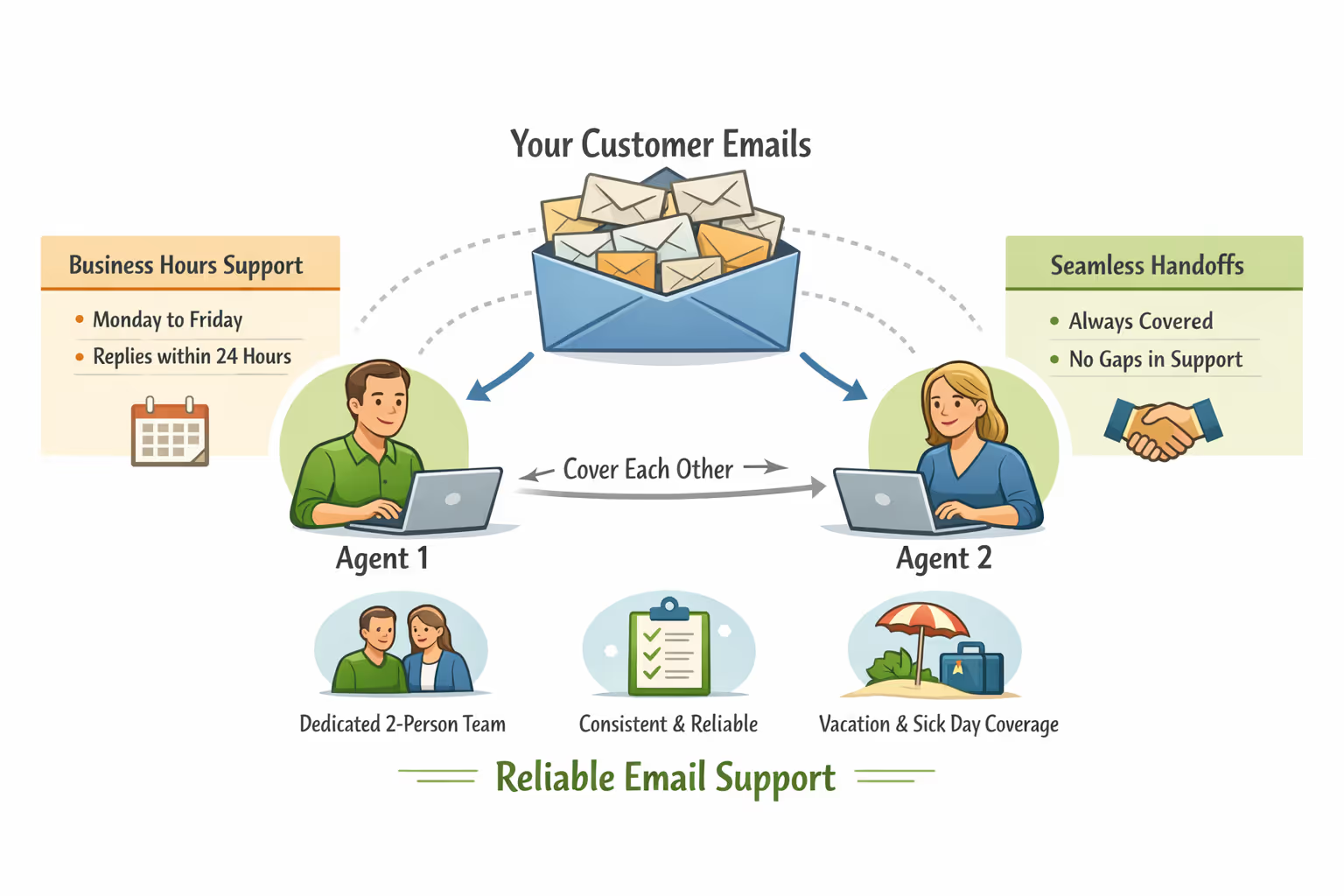
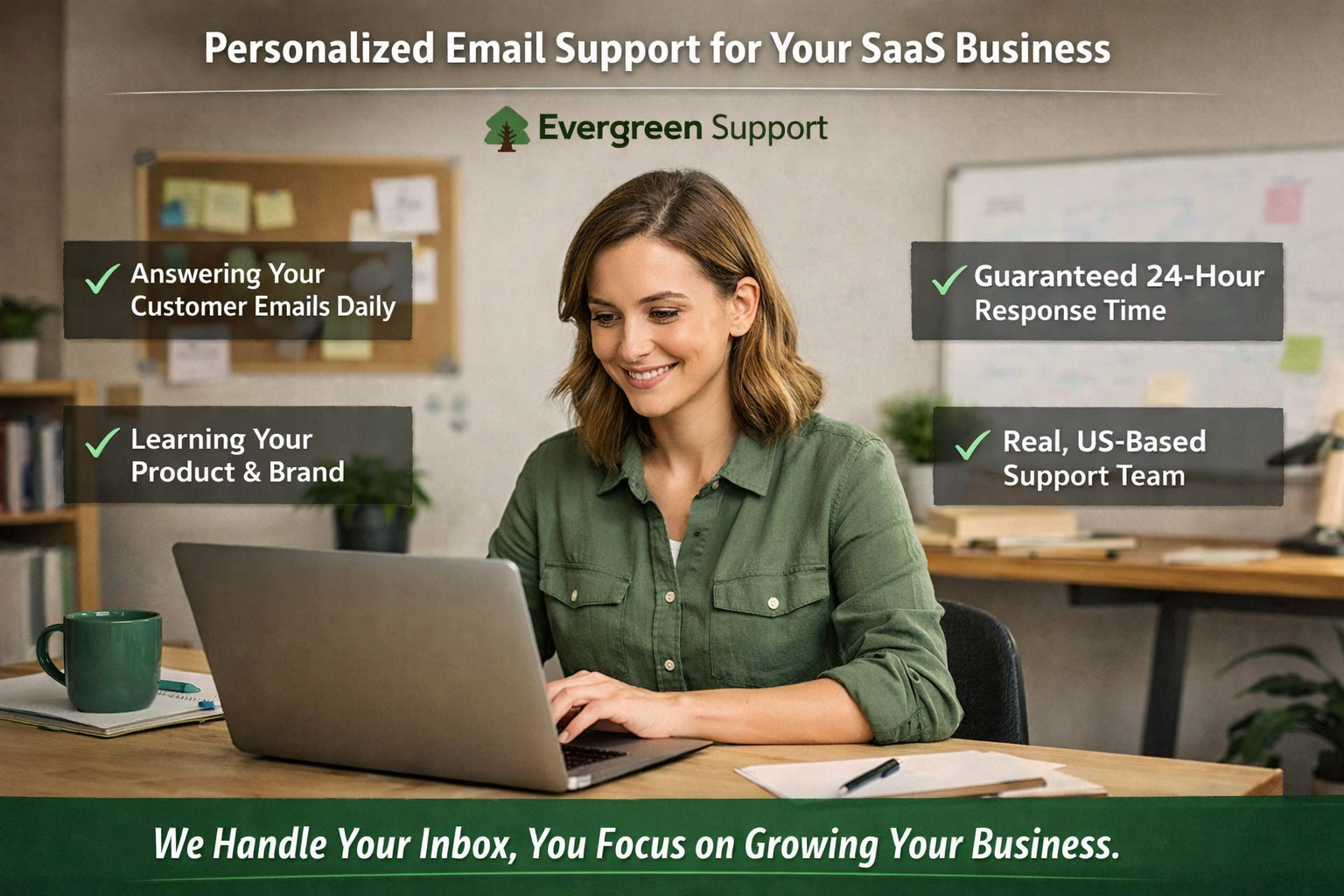
Evergreen Support provides US-based, human-powered email support for small online businesses. That means real people—not chatbots, not overseas call centers—answering your customers' emails Monday through Friday with guaranteed responses within 24 hours [1].
The model is straightforward. You get two dedicated support specialists assigned to your account. They learn your product, your brand voice, and your customers. They handle the day-to-day inbox work so you don't have to.
Here's what's included:
Daily email ticket handling during business hours
Internal documentation and knowledge base creation
Trend identification and proactive issue reporting
Slack channel for real-time communication with your team
Integration with whatever helpdesk software you already use
Month-to-month pricing based on ticket volume. No long-term contracts. A $1 onboarding trial to make sure it actually works before you commit [2].
Who Thrives With Outsourced Email Support (And Why Evergreen Fits)
Not every small business needs outsourced support. But certain situations make this model—and Evergreen specifically—an obvious match.
You Run a Small Online Business (SaaS or Ecommerce)
This is the sweet spot. If you're a founder, operator, or key team member at a company with roughly one to five people, you're exactly who this service was built for.
Maybe you're running a mobile app with thousands of users. Maybe you've got a Shopify store that's growing faster than you can handle. Either way, you're wearing multiple hats—and customer support shouldn't be one of them permanently.
Evergreen specializes in small online businesses for a reason. The team understands what it's like to bootstrap something from scratch. They know that you care deeply about every customer interaction because you built this thing yourself.
Email Is Your Primary Support Channel
Here's where specificity matters. Evergreen handles email support. That's the focus. That's where the expertise lives.
If most of your customer communication happens through email or a helpdesk ticketing system—whether that's Help Scout, Zendesk, Freshdesk, or something else entirely—this model fits naturally.
The team becomes an extension of your inbox, not a replacement for channels you don't actually use.
You Value Human Connection Over Automation
Some businesses want efficiency at all costs. They're happy to route customers through chatbots and automated flows, and that's a valid choice.
But if you've built your brand on personal service—if your customers expect (and deserve) thoughtful, human responses—then you need support that reflects that.
Evergreen's entire philosophy centers on "humans helping humans." The agents who answer your emails are real people with names and faces, trained specifically on your product and brand voice. They're not reading scripts or copying generic templates.
For businesses where customer relationships matter more than ticket throughput metrics, this approach makes sense.
You Don't Need 24/7 or Weekend Coverage
Let's be direct about this one. Evergreen provides support Monday through Friday, generally aligned with US business hours. They guarantee responses within 24 hours on weekdays [1].
If your business model works fine with next-business-day responses—if your customers aren't expecting instant replies at 2 AM on a Saturday—then this coverage works.
Many small SaaS and ecommerce businesses fall into this category. Their customers understand that the founders aren't staffing a call center around the clock. A prompt, helpful response the next morning is perfectly acceptable.
You Want Reliable Backup (Not Another Thing to Manage)
One of the hidden benefits of Evergreen's model is the two-agent system. Each account gets two dedicated specialists who cover each other's vacations and sick days.
Think about what that means. Right now, if you get sick, your inbox piles up. If you want to take a week off, you're still checking emails from the beach. With two agents who know your business, support keeps running whether anyone is out or not.
This isn't about scaling to enterprise size. It's about having reliable coverage without the headaches of managing employees yourself.
When Asynchronous Email Support Isn't Enough (And What to Consider Instead)
Being honest about limitations builds more trust than pretending they don't exist. Here's when Evergreen isn't the right choice—and what alternatives might work better.
You Need Weekend or Holiday Coverage
If your customers genuinely require support on Saturdays, Sundays, or federal holidays, Evergreen's standard model won't meet that need.
Some businesses—especially those with heavy consumer traffic or time-sensitive products—can't wait until Monday for responses. If a weekend without support would cause real damage to your customer relationships or revenue, you need a provider with broader coverage hours.
What to consider instead: Larger BPO (business process outsourcing) providers like PartnerHero or Influx offer 24/7 coverage options, though they typically require higher minimum volumes and longer contracts. For some businesses, a hybrid approach works—using Evergreen for weekday coverage while maintaining a small on-call rotation for weekend emergencies.
This isn't a flaw in the service. It's a deliberate focus. Evergreen targets businesses that don't promise 24/7 availability to their end users, and that's a legitimate market segment. Just not every market segment.
You Need Phone or Live Chat Support
Evergreen handles email. Period.
If your support strategy depends heavily on phone calls or real-time live chat—if customers expect to click a button and immediately talk to someone—this service won't cover those channels.
What to consider instead: For phone support, companies like Ruby Receptionists or Smith.ai specialize in answering calls for small businesses. For live chat, tools like Intercom or Drift offer chatbot-first approaches with human escalation, or you might explore agencies like ModSquad that handle multi-channel support including chat.
Some businesses absolutely need phone support. B2B products with complex implementations, high-ticket items that require consultation, industries where voice communication is standard practice. Those situations call for different solutions.
The email-only focus isn't a limitation for everyone. For many small online businesses, email is the dominant channel anyway. But if it's not dominant for you, know that going in.
You're a Professional Services Firm
Evergreen specifically serves product-based online businesses—SaaS companies and ecommerce stores.
If you're running a law firm, marketing agency, CPA practice, or similar professional services business, this isn't designed for you. The support patterns, customer expectations, and communication styles differ significantly between product businesses and service businesses.
What to consider instead: Virtual assistant services like Belay or Time Etc often work better for professional services firms, since they can handle a broader range of administrative and client communication tasks beyond pure customer support.
It's not that professional services firms don't deserve great support. They just need different support.

You Require Instant Response Times
The guarantee is responses within 24 hours on business days. In practice, many responses happen much faster. But if your business model requires guaranteed responses within minutes—if customers will leave or escalate without near-instant acknowledgment—then this SLA won't suffice.
What to consider instead: Enterprise-focused support providers with dedicated teams and tighter SLAs may be necessary. Alternatively, consider whether live chat software with automated initial responses could handle the "instant acknowledgment" need while human agents follow up within normal timeframes.
Some industries and customer bases have those expectations. Enterprise software with high-value contracts. Urgent consumer services. Anything where delay equals disaster.
For most small SaaS and ecommerce businesses, 24-hour response times are perfectly competitive. But "most" isn't "all."
How Onboarding Actually Works
Understanding the process helps you evaluate fit. Here's what happens if you decide to try Evergreen.
The $1 Trial
You pay one dollar. That's it. This covers roughly the first week of onboarding, during which the team learns your business without you paying full subscription rates [2].
During this time, they'll schedule a kickoff call to understand your product, customers, and support challenges. They'll get access to your existing support systems and start reviewing past tickets to learn common questions.
If at any point during onboarding you or Evergreen decides it's not a good fit, you get your dollar back. No hard feelings, no complicated cancellation process [2].
Knowledge Transfer
The team doesn't just show up and start answering emails blindly. They build documentation.
They'll create internal FAQ resources based on your past support tickets. They'll draft sample responses for common questions and share them with you for approval before going live. You get to see exactly how they'll represent your brand.
This documentation becomes yours. If you ever part ways with Evergreen, you keep the knowledge base they built.
Going Live
Once you approve the approach—typically within about seven days—the team starts handling real customer emails. Your first full month's billing begins at that point.
From there, you communicate through a shared Slack channel. Questions get answered quickly. Anything that requires your input gets escalated. Anything routine gets handled without you ever seeing it.
Understanding the Real Cost of Customer Support
Before looking at specific pricing, it helps to understand what customer support actually costs—whether you do it yourself or hire someone.
The Hidden Cost of DIY Support
When founders handle support themselves, the cost isn't zero. It's measured in opportunity cost. Every hour spent answering "Where's my order?" emails is an hour not spent on product development, sales, or strategic planning.
According to the Bureau of Labor Statistics, customer service representatives in the US earn a median hourly wage of around $18-20, with total compensation (including benefits) adding another 30% or more to that base [3]. But when founders do the work themselves, the true cost is much higher—their time is typically worth far more than entry-level support wages.
What Hiring Actually Costs
If you're considering hiring a dedicated support person, the real numbers look something like this:
Base salary: $35,000-$50,000 annually for entry-level support roles in the US
Benefits and taxes: Add 25-40% on top of base salary
Training time: 2-4 weeks before they're fully productive
Management overhead: Your time spent hiring, training, and supervising
Coverage gaps: Sick days, vacation, turnover—single employees create single points of failure
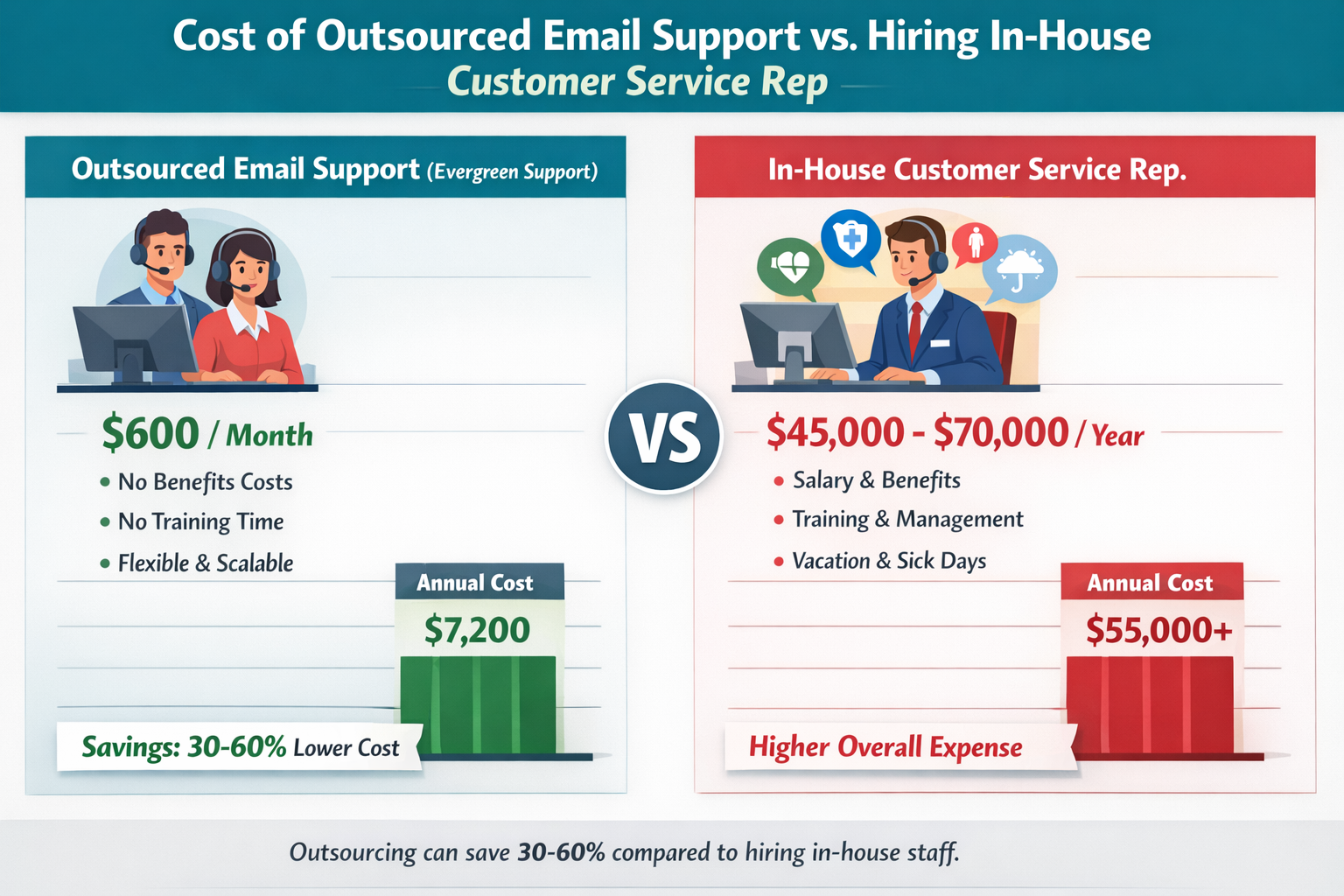
For a small business, the all-in cost of one full-time support hire typically lands between $45,000 and $70,000 per year when you account for everything [4].
Where Outsourcing Fits
Evergreen's pricing starts at around $600 per month for up to 100 tickets [5]. That's $7,200 per year—roughly 10-15% of what a full-time hire would cost.
The trade-off is clear: you get professional coverage during business hours without the overhead of employment. For businesses with moderate support volume who don't need 24/7 coverage, the economics work strongly in favor of outsourcing.
Industry research consistently shows that outsourcing customer support can reduce costs by 30-60% compared to building equivalent in-house capabilities [6]. The exact savings depend on your volume, complexity, and current approach.
Pricing Reality Check
Evergreen uses volume-based monthly pricing. For up to 100 tickets per month, expect around $600 [5].
Compare that to hiring someone. A full-time customer support representative costs salary, benefits, training, management overhead, and the risk of turnover. Even a part-time employee comes with payroll complexity, tax obligations, and coverage gaps.
The monthly cost is predictable, adjusts with your volume, and comes with no surprise fees. Pricing is recalculated based on your previous two months of ticket volume, so growth is accommodated automatically [5].
The Real Benefits (Without Overpromising)
Let's talk about what actually improves when this works well.
Time Back in Your Day
The founder time sink is real. Customer support can easily consume ten to twenty hours per week—time currently spent reading, responding to, and worrying about customer emails.
What would you do with that time? Build new features? Close more sales? Actually take a weekend off without checking your phone every hour?
The math works out simply. If your time is worth more than what you're paying for support, outsourcing makes financial sense—not just emotional sense.
Consistent Coverage
The two-agent model means your support quality doesn't depend on your personal health, schedule, or mental state.
Having a bad week? Support still runs.Traveling for a conference? Support still runs.Finally taking that vacation you've postponed for three years? Support still runs.
Consistency matters for customer experience. People notice when response times suddenly double or tone becomes more frazzled.
Your Customers Still Get You
Here's what some founders fear: that outsourcing means their customers will get generic, impersonal service.
The reality is different. Evergreen agents are trained on your specific brand voice. They learn how you talk to customers. They understand your product deeply enough to troubleshoot common issues.
Customers don't notice a difference—except that responses come faster and more reliably than when one overwhelmed founder was trying to do everything.
Questions to Ask Yourself
Before reaching out, work through these honestly:
Is email your primary support channel? If yes, good fit. If you need phone or chat, look elsewhere.
Can your customers wait until the next business day for responses? If yes, good fit. If they need instant or weekend coverage, look elsewhere.
Are you a product business (SaaS or ecommerce)? If yes, good fit. If you're a professional services firm, look elsewhere.
Do you value human, personal customer interactions? If yes, good fit. If you'd rather automate everything, look elsewhere.
Are you spending significant time on support that could go toward growing your business? If yes, it's probably time to explore options.
Take the Next Step (Or Don't)
Here's the honest conclusion: Evergreen Support works extremely well for a specific type of business. Small online companies. Email-focused support needs. Founders who want to reclaim their time without sacrificing customer experience quality.
If that describes you, scheduling a call costs nothing and commits you to nothing. You'll talk with actual humans who will tell you directly whether your situation makes sense for this service.
If it does make sense, the $1 onboarding gives you a real trial with a full refund available if things don't work out [2].
And if this doesn't describe you—if you need weekend coverage, phone support, or serve a different market entirely—that's fine too. Better to know now than waste time on both sides.
Ready to see if Evergreen Support fits your business? Schedule a call to discuss your situation, or start onboarding for $1 with a refund available anytime during the trial.
Frequently Asked Questions
What happens if Evergreen Support isn't a good fit during the trial?
You get your dollar back, no questions asked. The onboarding period exists precisely to discover whether the service works for your specific situation. If you or Evergreen determines the fit isn't right—whether because of volume, complexity, or coverage needs—you part ways amicably with a full refund [2].
How does Evergreen ensure agents match my brand voice?
During onboarding, agents review your past support tickets and draft sample responses for your approval before going live. You see exactly how they'll communicate with your customers and can request adjustments. The same two agents work on your account consistently, building deep familiarity with your brand over time.
Can Evergreen handle technical support questions about my product?
Agents can handle tier-one technical support—common troubleshooting steps, known issues, feature explanations—based on documentation they build during onboarding. More complex technical issues get escalated to your team with gathered information, so you can resolve them efficiently. The system is designed to handle routine inquiries while routing exceptions appropriately.
What if my support volume increases significantly?
Pricing adjusts based on the previous two months of ticket volume, so growth is accommodated automatically without surprise fees or contract renegotiations. You simply move into a higher tier as your business scales [5].
Do I need to switch helpdesk software to use Evergreen?
No. Evergreen agents work within whatever support system you already use—Help Scout, Zendesk, Freshdesk, or others. There's no required migration or new tools to learn on your end.
Why Trust This Information
This article was written by Evergreen Support, a US-based customer support agency founded by Emma Fletcher and Ellis Annichine. Both founders previously ran support operations at startups and understand firsthand the challenges small business operators face managing customer communications while growing their companies. Evergreen has served SaaS and ecommerce businesses since 2021, developing specialized expertise in email support for small online teams.
Cited Works
[1] Evergreen Support — "Pricing: 24 hours or less, Monday - Friday." https://www.evergreensupport.co/pricing
[2] Evergreen Support — "Start Onboarding for $1 with no-questions-asked refund if not a fit." https://www.evergreensupport.co/pricing
[3] Bureau of Labor Statistics — "Occupational Employment and Wages: Customer Service Representatives." https://www.bls.gov/oes/current/oes434051.htm
[4] Society for Human Resource Management — "Total Cost of Hiring Employees." https://www.shrm.org/
[5] Evergreen Support — "Pricing: 0-100 tickets at $600/Month, based on previous two months of ticket volume." https://www.evergreensupport.co/pricing
[6] Deloitte — "Global Outsourcing Survey." https://www2.deloitte.com/