Signing a 12-month contract for customer support outsourcing feels a bit like getting married on the first date. You've had one demo call, maybe two. You've seen a polished slide deck. And now someone's asking you to commit for a full year—with penalties if you want out early.
For small business owners already burned by freelancers who ghosted or offshore teams that went rogue, that kind of lock-in triggers every alarm bell. The good news? Month-to-month customer support outsourcing exists, and it's becoming more common. But like most things in business, the flexibility comes with its own set of considerations.
Here's what you actually need to know before signing anything—or walking away.

Why Long-Term Contracts Exist in the First Place
Before celebrating the death of the annual contract, it's worth understanding why so many support agencies still push them.
Training and ramp-up costs are real. Getting an external team up to speed on your product, tone, and workflows takes time. Agencies invest hours (sometimes weeks) building documentation, training agents, and learning your brand voice. A one-year contract helps them recoup that investment.
Staffing stability matters. When an agency commits dedicated agents to your account, they need some assurance you won't disappear in 30 days. Long contracts let them plan headcount and avoid the chaos of constant agent shuffling.
Volume predictability. Support outsourcing often involves volume-based pricing. Annual contracts give agencies a baseline to work from, which theoretically benefits everyone through more stable pricing.
Some businesses genuinely need that structure. Enterprise clients with complex integrations, multiple product lines, and 24/7 requirements often benefit from longer engagements. The contract forces both sides to invest properly.
Here's the honest truth: long contracts aren't inherently predatory. They're just not always appropriate—especially for small online businesses that need to stay nimble.
When Month-to-Month Makes More Sense
For most small SaaS and ecommerce companies, month-to-month arrangements align better with how the business actually operates.
Your support volume fluctuates. Maybe you're seasonal. Maybe you just launched and have no idea what "normal" looks like yet. Locking into a 12-month contract based on guesswork creates problems when reality diverges from projections.
You've been burned before. If you tried outsourcing and it went poorly—whether due to quality issues, communication gaps, or agents who clearly didn't understand your product—you're understandably cautious. Month-to-month lets you test without betting the farm.
Your business model is evolving. Startups pivot. Product lines get discontinued. Customer bases shift. The support structure that makes sense today might be completely wrong in six months.
You value the accountability. There's something clarifying about knowing your support partner has to earn your business every single month. It tends to keep quality high and communication proactive.
The Landscape: Types of Month-to-Month Support Options
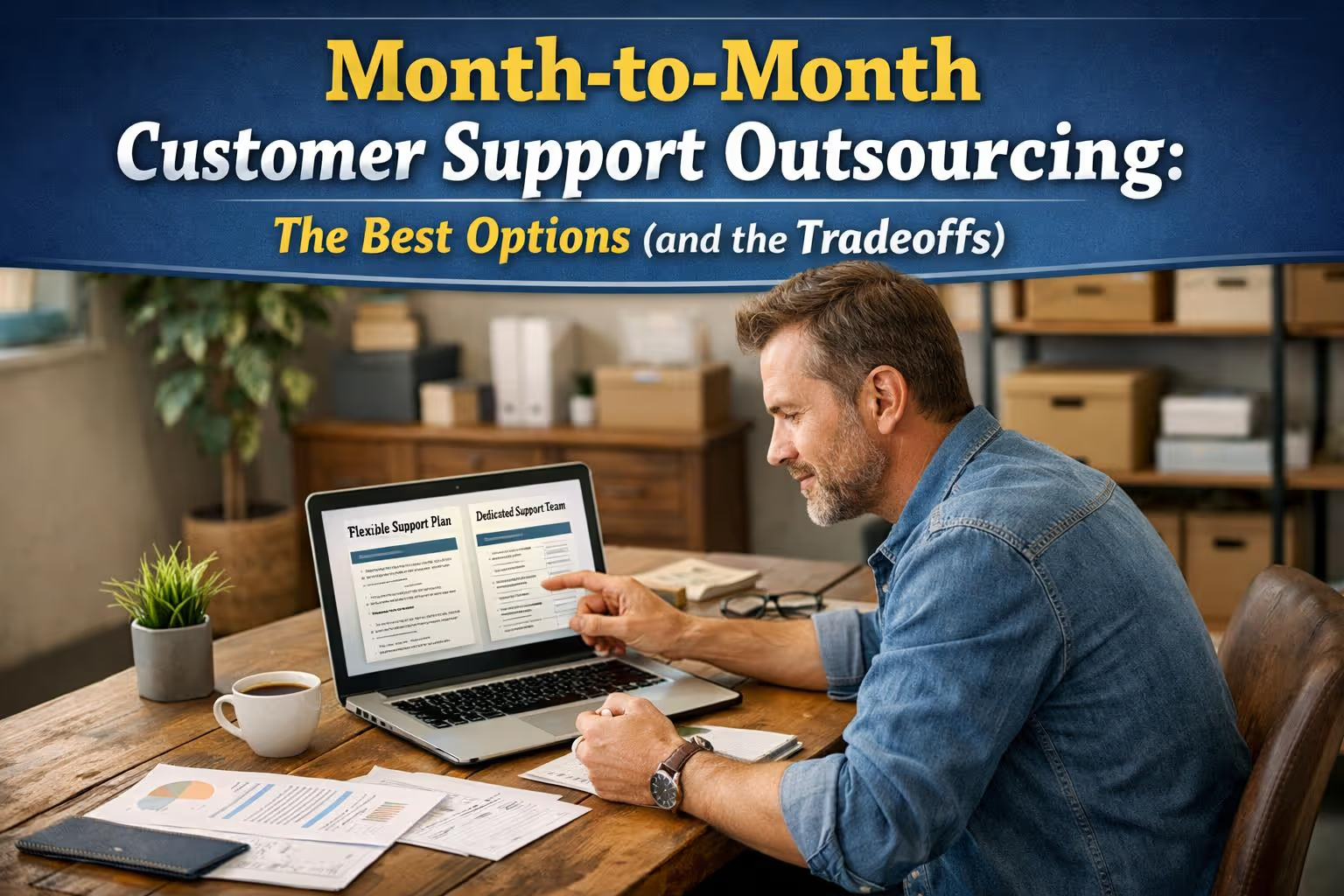
When exploring flexible support arrangements, you'll encounter several distinct categories. Understanding the differences helps you choose the right fit.
Freelancer Marketplaces
Platforms like Upwork or Fiverr let you hire individual support reps on flexible terms. The upside: low cost and no contracts. The downside: you're managing the person directly, handling backup coverage yourself, and dealing with turnover when they move on to other gigs. For businesses with minimal ticket volume, this can work. For anything beyond a handful of emails per day, the management overhead often becomes unsustainable.
Traditional BPO Providers
Large business process outsourcing firms typically offer multi-channel support (phone, chat, email) and can scale to enterprise volumes. Some offer month-to-month options, though many still prefer annual commitments. The challenge for small businesses: you're often a small fish in a big pond, which can mean less personalized attention and agents who cycle between many accounts.
Boutique Support Agencies
These smaller, specialized agencies focus on specific niches—like SaaS or ecommerce—and often offer more flexible terms. They tend to provide dedicated agents who learn your business deeply, with month-to-month pricing that scales with your ticket volume. The trade-off is typically a narrower service scope (email-only rather than omnichannel, for example) in exchange for deeper expertise and attention.

Virtual Assistant Services
General VAs can handle support among other tasks. This works for very early-stage businesses, but lacks the specialization, backup coverage, and quality assurance processes that dedicated support providers offer. If your VA gets sick or quits, you're back to square one.
Each option involves different trade-offs between cost, quality, flexibility, and management overhead. The right choice depends on your volume, complexity, and how much time you want to spend managing the relationship.
The Tradeoffs You Should Actually Expect
Flexibility isn't free. Here's what you might give up with month-to-month arrangements:
Potentially higher per-ticket or per-hour rates. Some agencies charge a premium for flexibility. They're hedging against the risk that you'll leave before they've fully recouped onboarding costs.
Less customization upfront. If an agency knows you could leave in 30 days, they might invest less in deeply customizing their approach for your specific needs. The level of "white-glove" treatment can vary.
Possible staffing variability. Without guaranteed revenue, some agencies rotate agents more frequently or share staff across multiple accounts. That's not universal, but it's worth asking about directly.
You carry more responsibility for the relationship. Month-to-month works best when you're actively engaged—reviewing quality, providing feedback, keeping documentation current. It's not truly "set and forget."
None of these are dealbreakers. They're just realities to plan for.
What to Verify Before Signing Any Month-to-Month Agreement
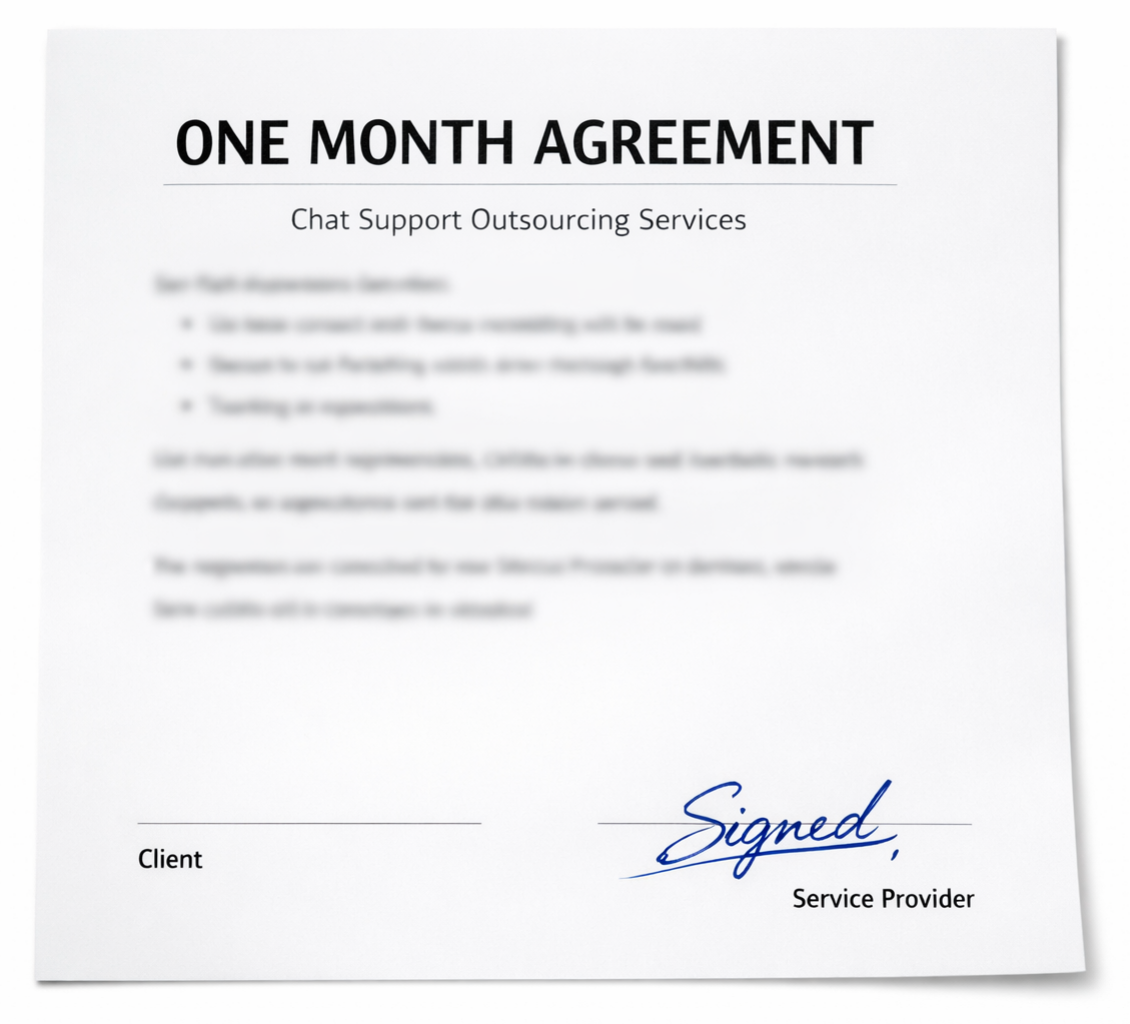
Not all flexible contracts are created equal. Here's what separates solid partners from risky ones:
Service Level Agreements (SLAs)
What's the guaranteed response time? (Get this in writing, not just in conversation.)
What happens if they miss it? Is there any accountability mechanism?
Are response times measured in business hours or calendar hours?
Quality Assurance Processes
Who reviews agent responses for accuracy and tone?
How often does QA happen—randomly, systematically, or only when you complain?
Can you see QA reports or audit trails?
Staffing Stability
Will you have dedicated agents, or is staffing pooled?
What happens if an agent is sick or leaves? Is there backup coverage?
How much turnover should you expect on your account?
Documentation and Knowledge Transfer
Who owns the documentation created during the engagement?
If you leave, do you get access to all the saved replies, FAQs, and process docs?
How quickly can you transition to another provider or bring support in-house?
Cancellation Terms
How much notice is required?
Are there any hidden fees for early termination (even on "month-to-month")?
What does the handoff process look like?
If an agency can't answer these questions clearly, that's a red flag regardless of contract length.
How to Transition Without Chaos
Switching support providers—or going from in-house to outsourced—can feel overwhelming. But it doesn't have to be chaotic if you plan the handoff properly.
Before You Start
Document everything you can. Even rough documentation is better than none. Common questions, product quirks, refund policies, escalation triggers—write it down. Your new partner will build on this foundation [1].
Export your support data. Pull reports on ticket volume, response times, common issue categories, and any existing saved replies. This gives your new team a head start.
Identify your "must-know" scenarios. What are the five situations that absolutely cannot be handled wrong? A VIP customer complaint? A billing dispute? A security concern? Flag these explicitly.

During Onboarding
Expect an overlap period. Good agencies will want to shadow your existing process, review past tickets, and draft responses for your approval before going live. This isn't wasted time—it's how quality gets built in.
Set up clear escalation paths. Define exactly which issues should come back to you (Tier 2) versus what the outsourced team handles independently (Tier 1). Ambiguity here causes problems fast.
Create a shared communication channel. Whether it's Slack, Teams, or something else, you need a way to quickly answer questions and provide feedback. Email-only communication slows everything down [2].
After Launch
Review early and often. The first two weeks are critical. Spot-check responses. Give direct feedback. Catch tone issues before they become habits.
Establish a regular check-in cadence. Monthly at minimum, weekly if you're in high-growth mode. These don't need to be long—just consistent.
Keep documentation updated. Your product will change. Your policies will evolve. Build a habit of pushing updates to your support partner proactively.
The Real Cost of Flexibility (And Why It's Usually Worth It)
Let's talk numbers.
A dedicated in-house support hire costs somewhere between $45,000 and $65,000 annually in salary alone—before you factor in benefits, training, management overhead, and the coverage gap when they take vacation or get sick [3].
Here's a straightforward comparison:
| Cost Factor | In-House Hire | Outsourced (Month-to-Month) |
| Base Salary | $50,000/year | N/A |
| Benefits (~20%) | $10,000/year | N/A |
| Training & Onboarding | $2,000-5,000 | Included |
| Coverage Gaps (PTO, sick days) | Your problem | Built-in backup |
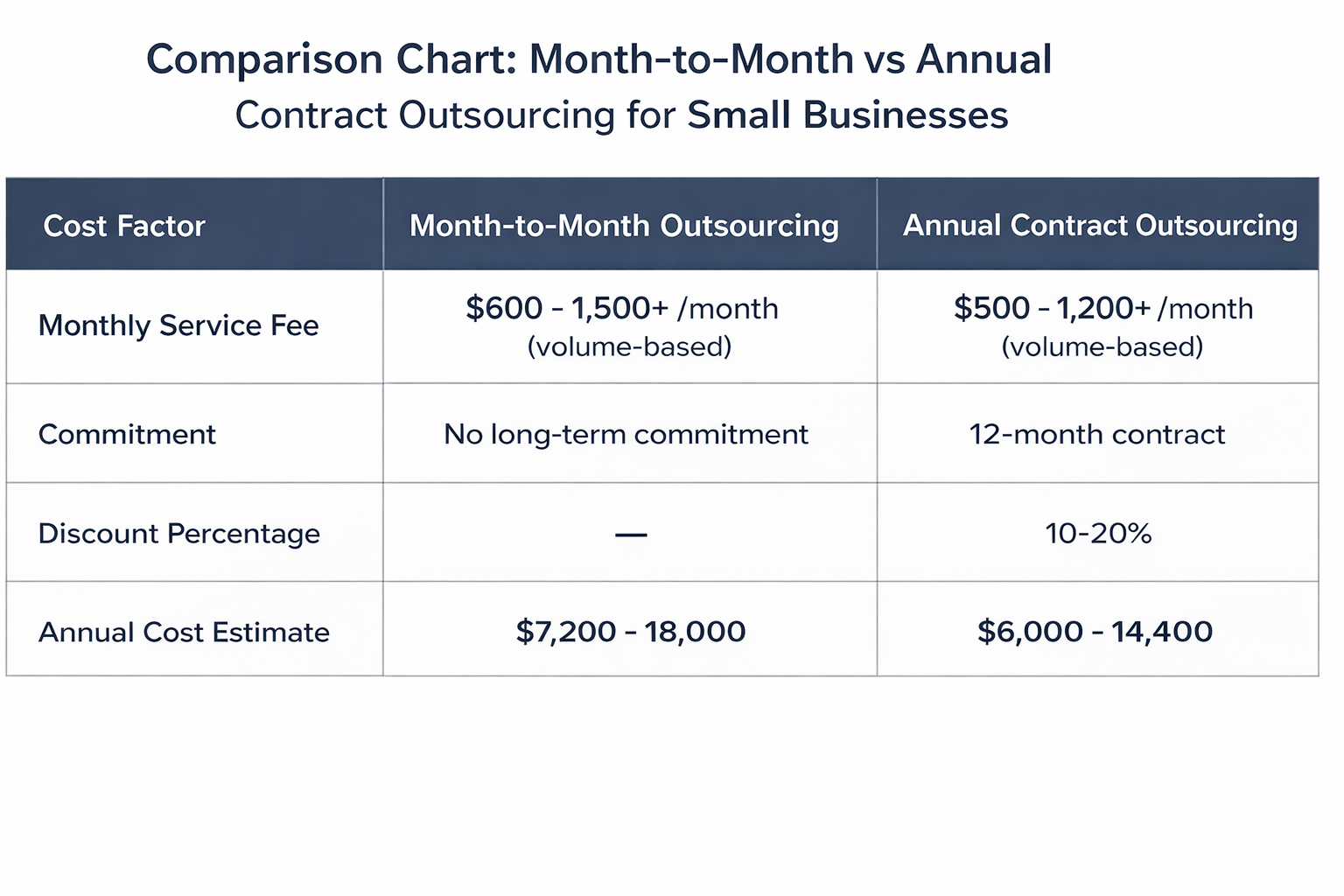
| Monthly Service Fee | N/A | $600-1,500+ (volume-based) |
| Annual Estimate | $62,000-65,000 | $7,200-18,000 |
Outsourced support, even on a month-to-month basis, often runs significantly less than that fully-loaded in-house cost [4]. More importantly, you're not carrying the risk of a bad hire. If the relationship isn't working, you adjust without severance packages or painful conversations.
For small businesses, this flexibility isn't just nice to have. It's often the difference between getting support help at all versus continuing to drown in your own inbox.
Finding the Right Month-to-Month Partner
The best month-to-month arrangements share a few characteristics:
Transparent pricing tied to actual usage. Volume-based models (like pricing per ticket bracket) let you predict costs and scale up or down naturally [5].
Low-friction onboarding. If the agency requires a massive upfront investment before proving value, that's a warning sign. Look for partners who can get started quickly and refine over time.
Clear ownership of deliverables. Documentation, saved replies, process improvements—these should belong to you. You're paying for the work; you should own the output.
Genuine accountability. The best partners operate like they have to earn your business every month—because they do. That mindset shows up in proactive communication, quality obsession, and continuous improvement.
Dedicated agents who actually learn your business. Rotating staff across dozens of accounts is cheaper for the agency, but worse for you. Ask whether you'll have consistent agents assigned to your account.
Evergreen Support operates on exactly this model: month-to-month pricing based on ticket volume, no long-term contracts, and a $1 onboarding process that lets you test the relationship before committing [6]. If the fit isn't right during onboarding, you walk away—no hard feelings, no hidden fees.
That kind of risk reversal isn't just good marketing. It's how support partnerships should work for small businesses that need flexibility without sacrificing quality.
The Bottom Line
Month-to-month customer support outsourcing is real, it's increasingly common, and for most small online businesses, it's the smarter choice. Long contracts have their place, but they often protect the agency more than they protect you.
The key is doing your homework. Verify the SLAs. Ask about staffing stability. Understand who owns the documentation. Plan the transition carefully. And choose a partner whose incentives align with yours—one that earns your business month after month rather than relying on contractual lock-in.
Your inbox isn't going to manage itself. But you shouldn't have to bet a year's commitment to find out if someone can actually help.
Ready to see what flexible, human-powered support looks like? Book a call with Evergreen Support to discuss your situation—or start onboarding for $1 and evaluate the fit before committing to anything.
Frequently Asked Questions
Is month-to-month outsourcing more expensive than annual contracts?
Sometimes, but not always. Some agencies charge a modest premium for flexibility, while others—like Evergreen Support—offer the same transparent, volume-based pricing regardless of commitment length. The total cost often still undercuts hiring in-house, even with any flexibility premium factored in.
How much notice do I need to give to cancel a month-to-month contract?
This varies by provider. Most require 30 days' notice, though some allow shorter windows. Always clarify cancellation terms upfront and confirm there are no hidden termination fees buried in the fine print.
Will I get the same quality with month-to-month as with a long-term contract?
Quality depends on the agency, not the contract length. The best month-to-month providers maintain high standards precisely because they know clients can leave. Look for dedicated agents, clear QA processes, and documented SLAs rather than assuming longer contracts guarantee better service.
What happens to my documentation if I leave?
Reputable agencies will transfer all documentation, saved replies, and process guides you've built together. This should be explicitly stated in your agreement. If an agency is cagey about data ownership, consider that a red flag.
How long does onboarding typically take for month-to-month support?
Most agencies can complete onboarding in one to two weeks for straightforward support needs. This includes discovery calls, system access setup, documentation review, and drafting initial responses for your approval before going live with real customers.
About Evergreen Support
Evergreen Support is a US-based customer support agency built specifically for small online businesses—SaaS companies and ecommerce brands that need reliable, human-powered email support without the overhead of hiring in-house. Founded by Emma Fletcher and Ellis Annichine, the team brings firsthand startup experience to every client relationship. With month-to-month pricing, dedicated agents for every account, and a $1 onboarding trial, Evergreen makes it easy to get professional support help while staying flexible.
Cited Works
[1] Help Scout — "How to Build a Customer Service Knowledge Base." https://www.helpscout.com/blog/knowledge-base/
[2] Evergreen Support — "Customer Support Agency Pricing | Evergreen Support." https://outsourcedemailsupport.com/pricing
[3] Bureau of Labor Statistics — "Occupational Employment and Wage Statistics: Customer Service Representatives." https://www.bls.gov/oes/current/oes434051.htm
[4] Evergreen Support — "Outsource Customer Support Costs vs In-House: 2025 Guide." https://outsourcedemailsupport.com/blog/outsource-customer-support-cost-comparison
[5] Evergreen Support — "Customer Support Agency Pricing | Evergreen Support." https://outsourcedemailsupport.com/pricing
[6] Evergreen Support — Homepage. https://outsourcedemailsupport.com/