
You finally did it. You handed off your support inbox to an external team, and for the first time in months, you're not dreading Monday mornings. But here's the thing nobody warns you about: outsourcing customer support doesn't eliminate internal work. It transforms it.
Without clear ownership, tickets start bouncing between your product lead, your marketing person, and your outsourced team like a pinball nobody wants to catch. Feature requests sit in limbo. Refund decisions take three days instead of three hours. And that peace of mind you were hoping for? It evaporates.
The fix isn't complicated, but it does require intention. This guide walks you through exactly how to realign your internal team after outsourcing support—who owns what, how escalations should flow, and why getting this right in the first 30 days determines whether outsourcing actually works for you.
Why Role Clarity Breaks Down After Outsourcing
Most founders outsource support to reclaim their time. That part usually works. What catches them off guard is the vacuum left behind.
Before outsourcing, responsibilities were clear by default. You answered every email because there was nobody else. Your marketing lead jumped in during launches because they happened to be available. Your developer handled technical questions because they wrote the code.
Now you have an external team handling the front line. But who decides when a frustrated customer gets a full refund versus store credit? Who triages bug reports and determines severity? Who notices that the same question keeps appearing and realizes your onboarding flow needs fixing?
These decisions don't disappear when you outsource. They just become visible for the first time.
A 2023 survey by the Project Management Institute found that organizations with clearly defined roles experience 30% fewer project failures than those operating with ambiguous responsibilities [1]. The same principle applies to customer support operations. When everyone assumes someone else will handle an escalation, nobody does.
The Real Cost of Undefined Ownership
Unclear roles create problems that compound quietly. You might not notice them until a VIP customer churns or a bug goes unreported for weeks.
Tickets bounce between teams. Your outsourced agents forward a technical question to your product lead. Your product lead assumes marketing should handle it because it involves a promotional offer. Marketing sends it back because there's a technical component. Meanwhile, the customer waits.
Response times balloon on escalated issues. First-response times look great because your external team handles volume efficiently. But resolution times for complex issues stretch to days because internal routing isn't defined.
Institutional knowledge stays siloed. Your outsourced team notices patterns—the same complaint appearing repeatedly, a confusing checkout step, a feature customers keep requesting. But without a clear channel for sharing these insights, the information never reaches the people who can act on it.
Team morale suffers. Your internal team thought outsourcing would lighten their load. Instead, they're fielding constant one-off questions from the external team because nobody established when and how to escalate. They end up feeling more burdened, not less.
Research from Gallup indicates that employees who strongly agree their job responsibilities are clear are 53% more efficient than those who don't [2]. When outsourcing creates ambiguity rather than reducing it, you've traded one problem for another.
Building Your Post-Outsourcing Ownership Map
The solution is a simple framework that defines exactly who owns what. This isn't about bureaucracy—it's about making sure every type of support issue has a clear path to resolution.
Start by categorizing the types of issues your support team handles. For most small SaaS and ecommerce businesses, these fall into predictable buckets.
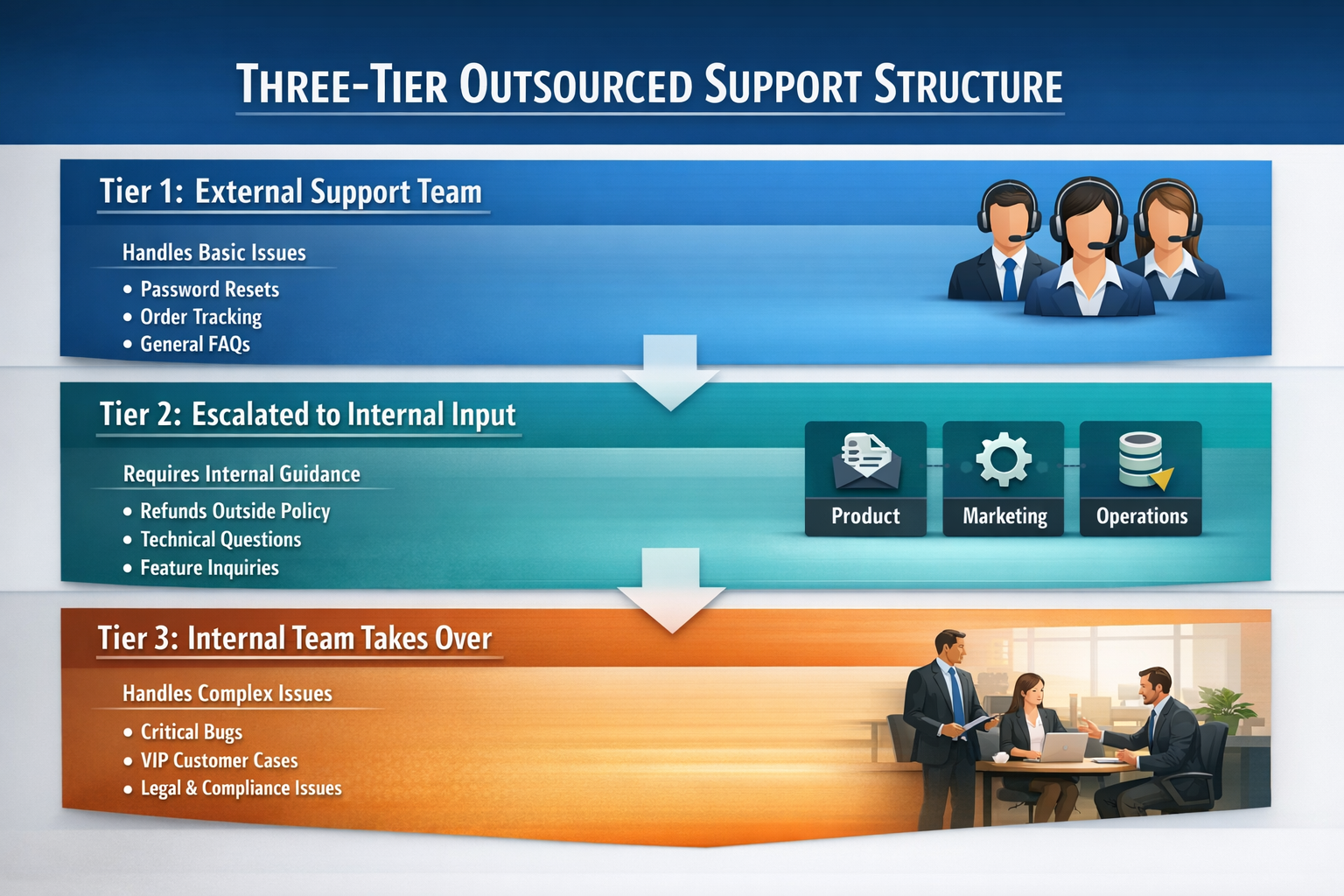
Tier 1: External Team Handles Completely
These are standard inquiries that your outsourced team can resolve without any internal involvement:
Password resets and account access
Order status and tracking updates
Basic product questions covered in documentation
Standard refund and return requests within policy
Billing inquiries with straightforward answers
General how-to questions
Your external team should own these end-to-end. They respond, resolve, and close the ticket. No internal touchpoint required.
Tier 2: External Team Handles with Internal Input
These issues require information or decisions from your internal team, but the external team remains the customer-facing communicator:
Refund requests outside standard policy
Technical questions requiring product knowledge
Complaints about specific team members or processes
Questions about upcoming features or roadmap
Partnership or collaboration inquiries
For these, your external team gathers context, escalates internally through a defined channel, receives direction, and then responds to the customer. They own the communication; your internal team owns the decision.
Tier 3: Internal Team Takes Over
Some issues genuinely require internal ownership of the entire interaction:
Complex technical bugs requiring investigation
VIP or enterprise customer issues
Legal or compliance concerns
Media or PR inquiries
Escalations after customer requests a manager
For these, your external team acknowledges receipt, lets the customer know they're routing to a specialist, and hands off completely. Your internal team takes over direct communication.
Mapping Responsibilities Across Product, Marketing, and Operations
Once you've categorized issue types, assign internal ownership for Tier 2 and Tier 3 items. Here's how responsibilities typically break down for small teams.
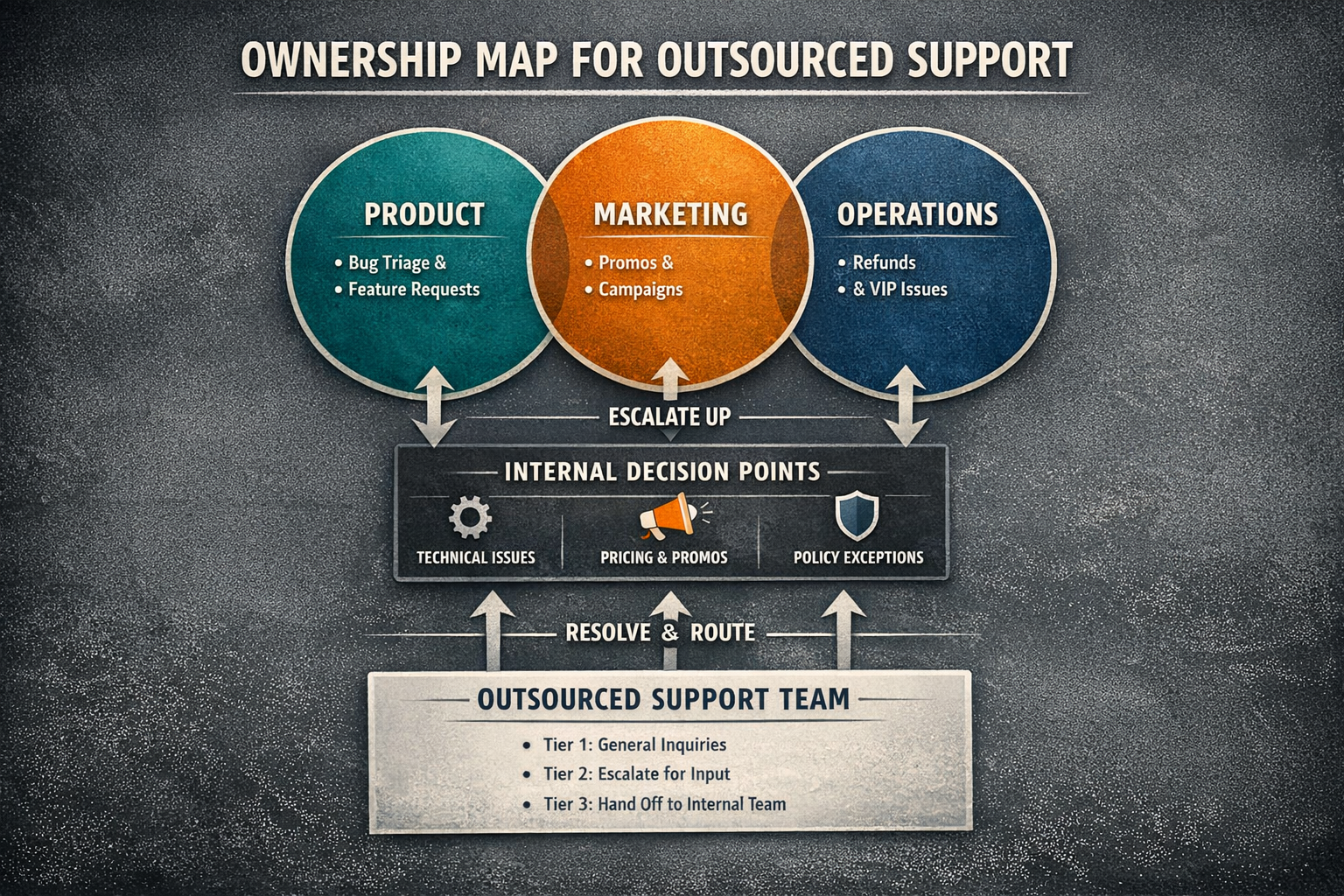
Product or Engineering
Owns:
Bug reports and technical investigations
Feature request aggregation and prioritization
Integration questions and troubleshooting
Product feedback synthesis
Escalation trigger: Any issue involving broken functionality, unexpected behavior, or requests for features that don't exist.
Response expectation: Acknowledge within 4 hours during business days. Provide status update or resolution within 24 hours for critical bugs, 72 hours for non-critical.
Marketing
Owns:
Questions about promotions, discounts, or campaigns
Brand partnership inquiries
Content-related feedback (blog posts, emails, social)
Affiliate and referral program questions
Escalation trigger: Any inquiry related to marketing campaigns, pricing promotions, or brand partnerships.
Response expectation: Acknowledge within 4 hours. Provide decision within 24 hours for time-sensitive promotional issues.
Operations or Founder
Owns:
Policy exceptions and high-value refund decisions
VIP and enterprise customer issues
Vendor and supplier escalations
Hiring and HR-related inquiries
Escalation trigger: Any issue requiring authority beyond documented policy, high-value accounts, or legal/compliance considerations.
Response expectation: Acknowledge within 2 hours for VIP issues. Provide decision within same business day.
Creating Your Escalation Protocol
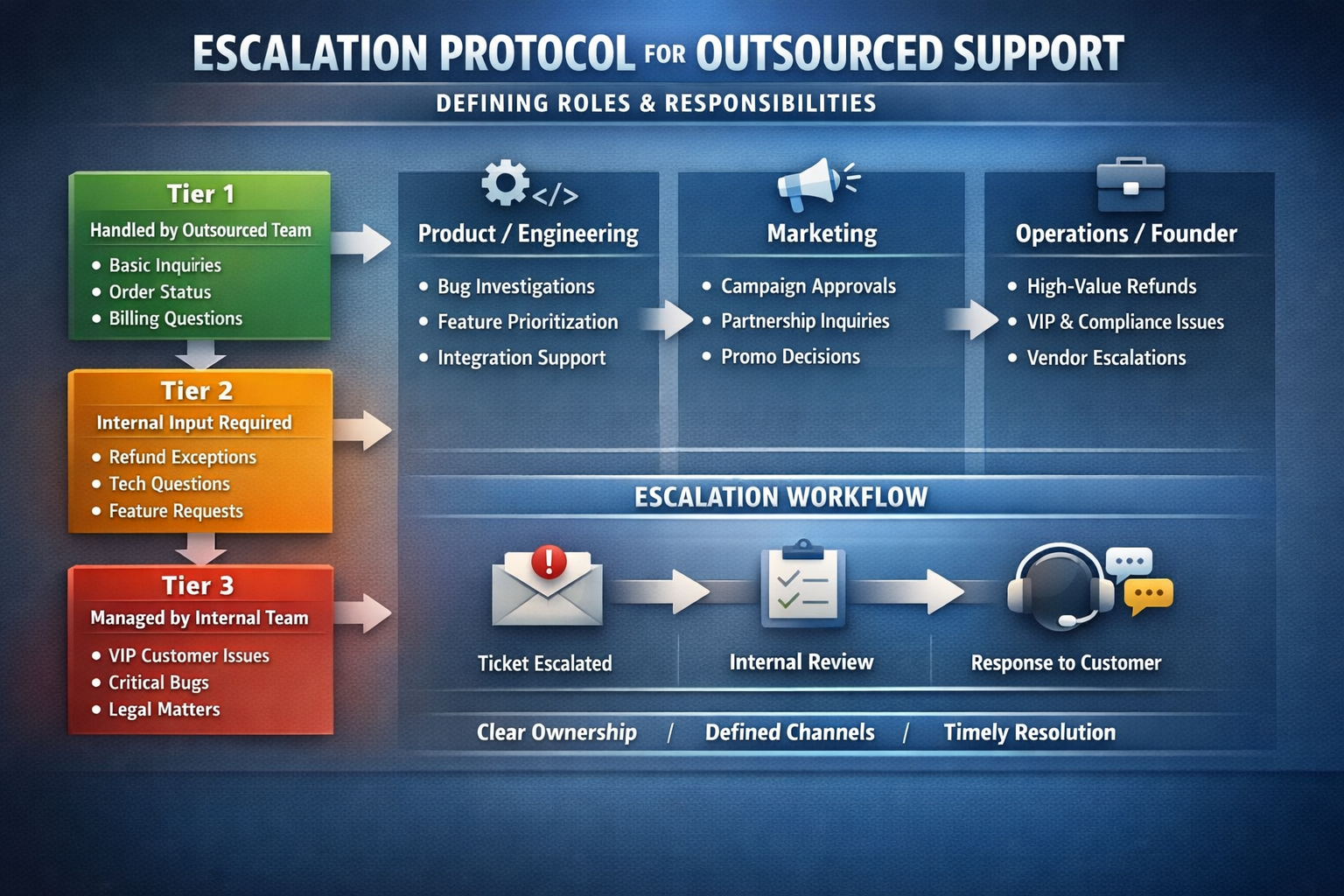
A clear escalation protocol answers three questions for every issue type: Who decides? How do they receive escalations? What's the expected turnaround?
Here's a practical framework you can adapt:
Bug Reports
External team action: Document the issue (steps to reproduce, screenshots, device/browser info). Tag as bug in helpdesk. Notify product lead via Slack with ticket link.
Internal owner: Product lead
Decision required: Severity assessment and timeline for fix
Customer communication: External team updates customer once internal owner provides timeline
Refund Requests Outside Policy
External team action: Document the request and customer history. Check account value and previous refunds. Present recommendation to ops owner via Slack.
Internal owner: Operations lead or founder
Decision required: Approve, deny, or offer alternative
Customer communication: External team delivers decision with empathy
Feature Requests
External team action: Log request in designated feature tracking system. Thank customer and set expectation that requests are reviewed monthly.
Internal owner: Product lead (for aggregation and review)
Decision required: None immediately. Monthly review determines roadmap impact.
Customer communication: External team closes ticket after acknowledgment. Product team may reach out directly for high-impact requests.
VIP Customer Issues
External team action: Immediate acknowledgment. Alert operations lead via priority Slack channel. Provide full ticket history and context.
Internal owner: Operations lead or founder
Decision required: Full ownership of resolution
Customer communication: Internal owner communicates directly. External team monitors for any follow-up needs.
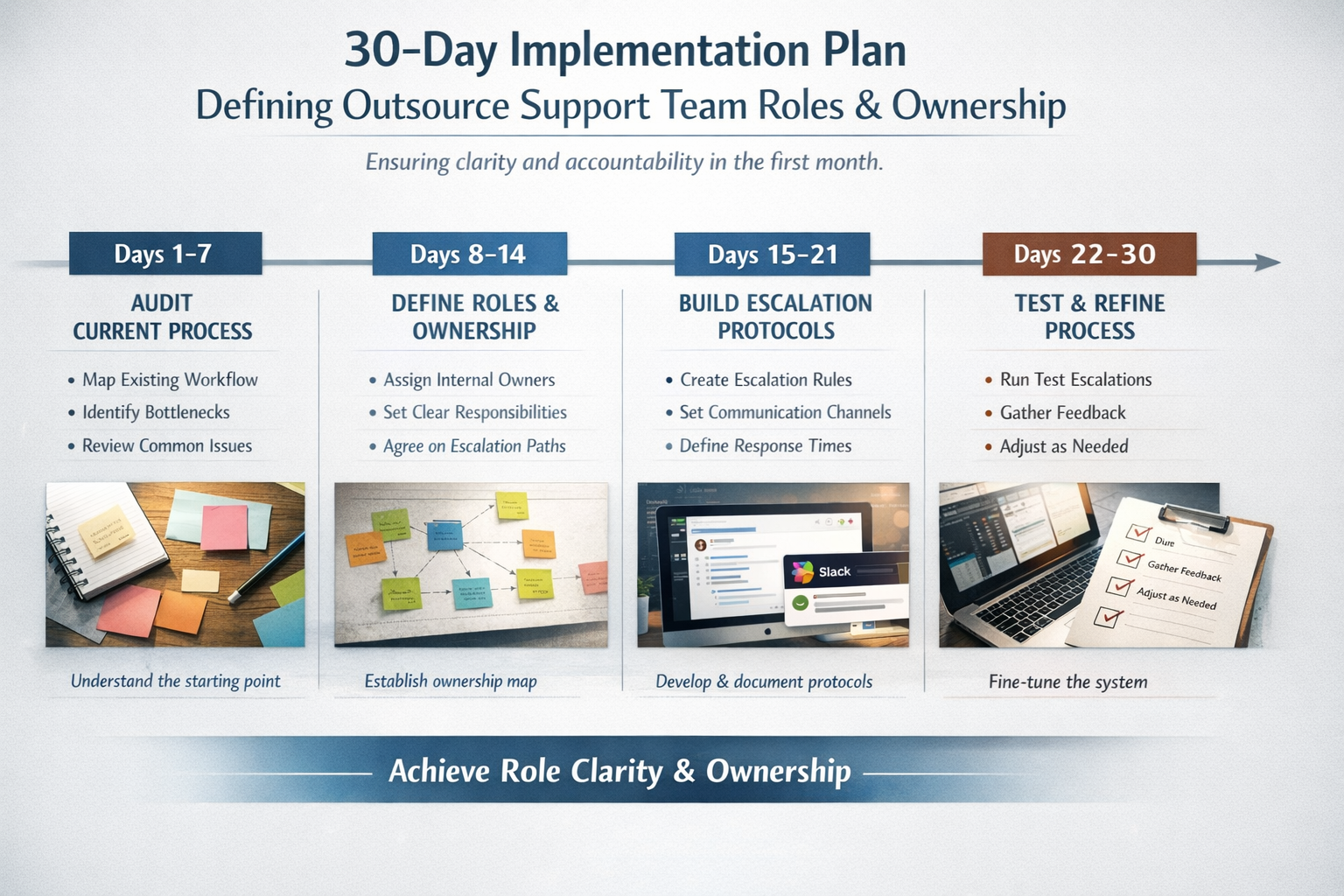
Implementing Role Clarity in the First 30 Days
The best time to establish clear ownership is during your outsourcing partner's onboarding period. Here's how to sequence it:
Days 1-7: Document current reality. Before defining new roles, map how issues currently flow. Which team members handle which types of questions? What decisions require founder approval? Where do things get stuck?
Days 8-14: Define your ownership map. Use the framework above to assign every issue category to a specific internal owner. Get explicit agreement from each person that they own their assigned categories.
Days 15-21: Build escalation protocols. For each Tier 2 and Tier 3 category, define exactly how escalations should work. Which Slack channel? Which email address? What information should the external team include? What's the expected response time?
Days 22-30: Test and refine. Run real escalations through the new system. Identify friction points. Adjust protocols where needed. Add new categories as they emerge.
The organizations that get this right treat the first month as a collaborative project with their outsourcing partner, not a one-way handoff.
Common Ownership Mistakes and How to Avoid Them
Mistake 1: Assigning too many categories to the founder.
When in doubt, founders often keep decision authority to themselves. This creates a bottleneck that defeats the purpose of outsourcing.
Fix: Establish clear policies that empower your external team and internal leads to make decisions within defined parameters. Save founder involvement for true exceptions.
Mistake 2: Skipping the documentation step.
Verbal agreements about who handles what fall apart when someone's sick, on vacation, or just forgets.
Fix: Create a simple shared document that maps issue types to owners. Review it monthly and update as your team evolves.
Mistake 3: Using email for escalations.
Email creates delay and loses context. By the time your product lead sees an escalated bug report in their inbox, the customer has waited hours.
Fix: Use Slack channels or your helpdesk's internal note system for escalations. Real-time visibility dramatically reduces resolution time.
Mistake 4: Forgetting to close the loop.
Your external team escalates an issue. Your internal team resolves it. But nobody tells the external team the outcome, so they can't update the customer or learn for next time.
Fix: Build "loop back to support team" into every escalation protocol. The internal owner's job isn't done until the support team knows the outcome.
The Pattern Recognition Advantage
Clear ownership doesn't just solve individual issues faster. It enables something more valuable: pattern recognition.
When your external team owns Tier 1 issues completely, they see patterns you can't see from the inside. The same question appearing repeatedly signals a documentation gap. A spike in refund requests after a specific marketing campaign suggests messaging misalignment. Technical questions clustering around a particular feature indicate a UX problem.
But these insights only surface if your external team knows exactly where to route them—and believes those insights will actually reach decision-makers.
Build a recurring review into your operations. Whether it's a weekly Slack summary or a monthly call, create a designated space for your support team to share what they're seeing. Then assign an internal owner to act on those insights.
Companies that treat support data as operational intelligence consistently outperform those that view support as a cost center to minimize [3]. Clear ownership makes that intelligence actionable.
What Success Looks Like
When role clarity works, the differences are measurable:
Escalation resolution time drops. Issues that used to take 3 days to resolve now close in hours because the routing is instant and the decision-maker is clear.
Ticket handoffs decrease. Customers stop experiencing the frustration of explaining their issue multiple times to different people.
Internal team satisfaction improves. Your product lead isn't fielding random refund questions. Your marketing person isn't troubleshooting bugs. Everyone works in their area of expertise.
Customer churn reduces. Research from Bain & Company suggests that a customer is four times more likely to buy from a competitor after a service-related problem than a price or product issue [4]. Fast, clear resolution prevents service failures from becoming churn events.
Your outsourced partnership strengthens. When your external team knows exactly what they own and what requires escalation, they operate with confidence. Ambiguity breeds hesitation; clarity enables speed.
Getting Started Today
You don't need a complex system. You need explicit answers to simple questions:
What issue types can your external team resolve without any internal involvement?
For issues requiring internal input, who specifically provides that input?
How should escalations reach internal owners, and what information should they include?
What's the expected response time for each type of escalation?
How will you review and refine this system over the first 90 days?
Write down your answers. Share them with your internal team and your support partner. Revisit them monthly.
The founders who get the most value from outsourcing aren't the ones who hand off support and walk away. They're the ones who use outsourcing as an opportunity to build operational clarity they never had when doing everything themselves.
Your external team can own the inbox. But you need to own the system that makes that partnership work.
Ready to outsource with clarity built in from day one? The best support partnerships include role mapping and escalation protocols as part of onboarding—not as an afterthought. Book a call with Evergreen Support to see how we help define ownership during your first 30 days, so your team reclaims their time without losing control.
Frequently Asked Questions
How long does it typically take to establish clear ownership after outsourcing support?
Most teams can define and document basic ownership within the first 30 days of an outsourcing partnership. However, expect refinement over the first 90 days as edge cases emerge and you discover gaps in your initial framework. Building ownership mapping into your onboarding process accelerates this timeline significantly.
What happens when an issue doesn't fit neatly into one ownership category?
Ambiguous issues are inevitable. Establish a default escalation path—typically to operations or the founder—for anything that doesn't fit existing categories. Track these exceptions and use them to refine your ownership map monthly. After three months, most recurring edge cases will have clear homes.
Should we use our helpdesk or Slack for internal escalations?
Both can work, but choose one primary channel and stick with it. Slack offers faster visibility for urgent issues; helpdesk internal notes keep context attached to the ticket. Many teams use Slack for immediate alerts and helpdesk notes for documentation, with a clear protocol for when to use each.
How do we handle escalations when the internal owner is unavailable?
Define backup owners for each category during your initial mapping. Document these backups explicitly and share with your external team. For true emergencies when all owners are unavailable, establish a protocol for the external team to make a best-judgment call and flag for review.
What metrics should we track to know if role clarity is working?
Focus on escalation resolution time (how long from escalation to decision), ticket handoff rate (how often issues move between multiple people), and internal team satisfaction (whether your product, marketing, and ops leads feel appropriately involved versus overwhelmed). Survey your internal team monthly during the first quarter.
About Evergreen Support
Evergreen Support is a US-based customer support agency built specifically for small SaaS and ecommerce businesses. Founded by Emma Fletcher and Ellis Annichine after experiencing the challenges of scaling support firsthand, the team specializes in helping founders reclaim their time without sacrificing the personal touch their customers love. With dedicated human agents, transparent month-to-month pricing, and a structured onboarding process that includes defining ownership and escalation protocols, Evergreen partners with businesses to build support operations that actually work.
Cited Works
Project Management Institute — "Pulse of the Profession 2023." https://www.pmi.org/learning/thought-leadership/pulse
Gallup — "State of the American Workplace Report." https://www.gallup.com/workplace/238085/state-american-workplace-report-2017.aspx
Harvard Business Review — "The Value of Customer Experience, Quantified." https://hbr.org/2014/08/the-value-of-customer-experience-quantified
Bain & Company — "Prescription for Cutting Costs." https://www.bain.com/insights/prescription-for-cutting-costs-bain-book/