
Your Shopify store is growing. Orders are up. Reviews are rolling in. And somewhere between packing shipments and planning your next product launch, you've realized something uncomfortable: customer emails are piling up faster than you can answer them.
You're not alone. Most Shopify store owners hit this wall around the same time—when support stops being a quick morning task and starts eating into everything else. The question isn't whether you need help. It's what "good" outsourced email support actually looks like for an e-commerce business like yours.
This guide breaks down the real numbers: what to expect from pricing, which SLAs actually matter, how to staff for your ticket volume, and the specific workflows any agency handling your Shopify inbox needs to master. No fluff. Just the practical details you need to make a smart decision.
What Does "Good" Customer Support Look Like for Shopify Stores?
Before you evaluate agencies or pricing tiers, you need to know what you're measuring against. E-commerce customer expectations have shifted dramatically—and what passed for acceptable support five years ago now reads as neglect.
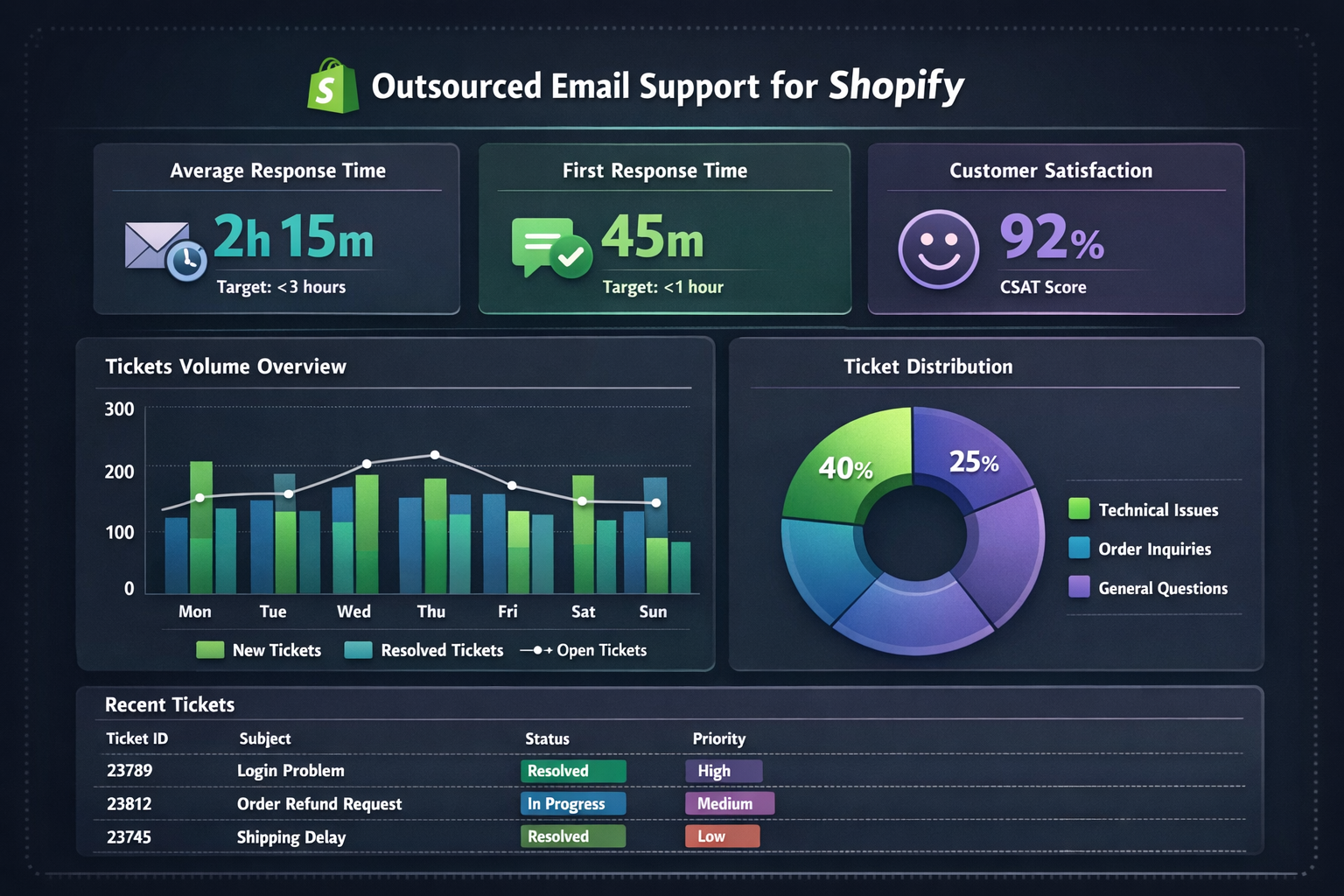
First Response Time: The Metric That Matters Most
For Shopify stores, first response time is the single most important metric. Research consistently shows that customers expect replies within hours, not days [1]. For e-commerce specifically, the window is even tighter.
Here's what "good" looks like:
Under 4 hours during business hours: This is the standard for competitive e-commerce brands. Customers shopping online expect near-immediate acknowledgment.
Under 24 hours as an absolute maximum: Anything beyond this and you're actively losing customers. Studies indicate that slow response times directly correlate with cart abandonment and lost repeat purchases [2].
Weekend coverage considerations: If you promise fast shipping, customers expect fast answers—even on Saturdays.
A solid outsourced support partner should guarantee response times in writing, not just mention them as "targets."
Resolution Time: Getting to "Done"
First response matters, but resolution time determines whether customers actually walk away satisfied. For typical Shopify support tickets—shipping questions, order modifications, return requests—resolution benchmarks look like this:
| Ticket Type | Target Resolution Time |
| Order status inquiries | Same day |
| Shipping address changes | Under 4 hours |
| Return/exchange requests | 24–48 hours |
| Product questions | Same day |
| Billing disputes | 24–48 hours |
Complex issues involving damaged items, lost packages, or disputes with carriers may take longer, but the initial response should always set clear expectations.
Customer Satisfaction Scores (CSAT)
CSAT measures how customers feel after interacting with support. For e-commerce, a CSAT score above 85% is generally considered good, with top-performing stores hitting 90% or higher [3].
What drives CSAT in e-commerce support:
Speed: Getting answers quickly
Accuracy: Correct information the first time
Tone: Friendly, human responses (not robotic scripts)
Resolution: Actually solving the problem, not just acknowledging it
When evaluating an outsourced partner, ask how they measure and report CSAT. If they don't track it, that's a red flag.
Refund and Exchange Processing Speed
For Shopify stores, refund speed directly impacts your reputation. Customers who request refunds are already disappointed—making them wait compounds the problem.
Good benchmarks:
Refund approval: Within 24 hours of request (for straightforward cases)
Refund processing: Initiated same day after approval
Exchange shipment: Within your standard fulfillment window
An outsourced team should have clear authority to process routine refunds up to a defined threshold without escalating every request to you.

How Much Does Outsourced Shopify Support Actually Cost?
Pricing for outsourced e-commerce support varies widely depending on the model, location, and scope. Here's what you're likely to encounter:
Common Pricing Models
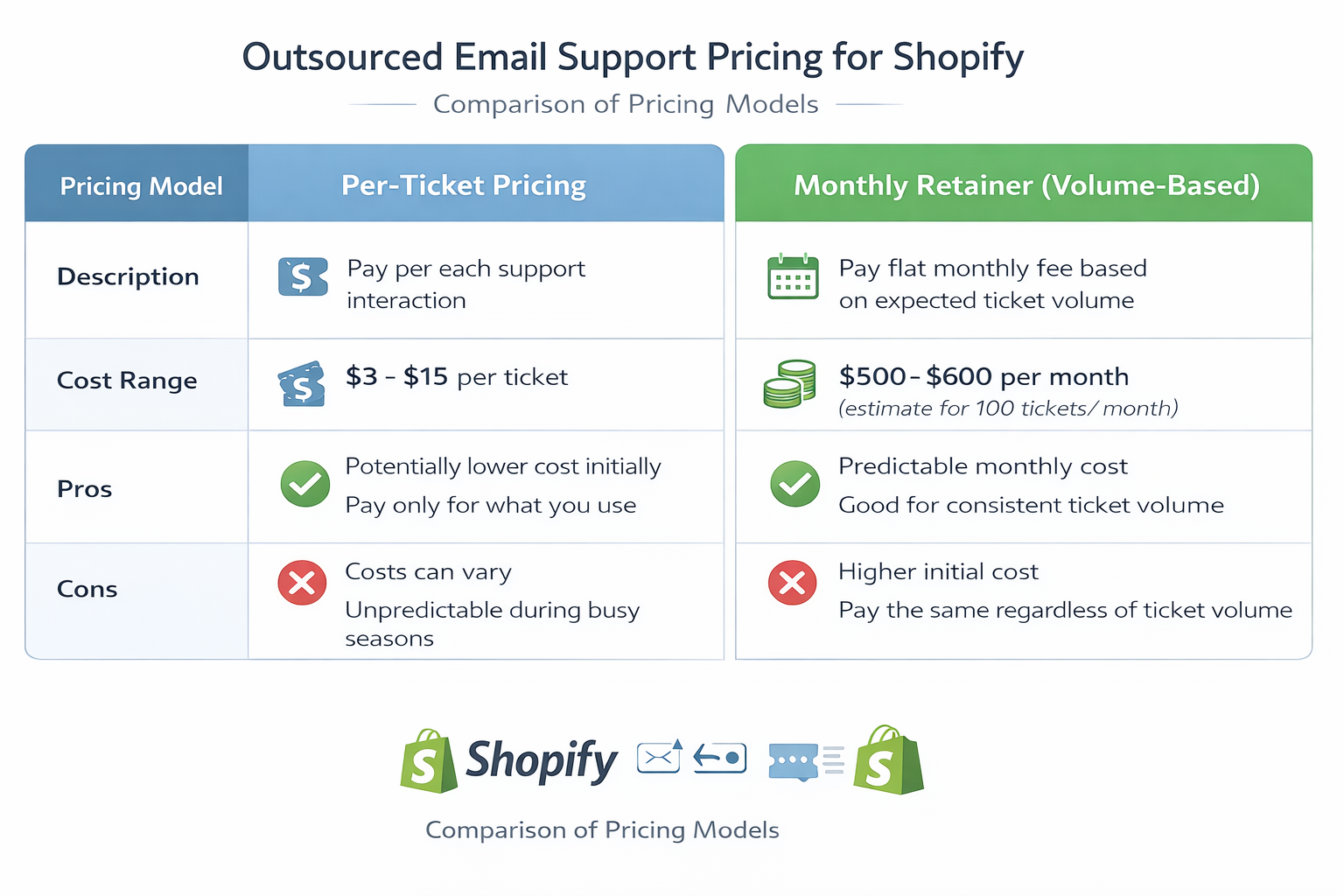
Per-ticket pricing: You pay for each support interaction. Rates typically range from $3–$15 per ticket depending on complexity and provider location. This model works well for low-volume stores but can become unpredictable during busy seasons.
Hourly pricing: Common with virtual assistants and some agencies. Rates range from $8–$50+ per hour depending on whether agents are offshore, nearshore, or US-based. The challenge: hours don't always correlate with outcomes.
Monthly retainer (volume-based): Many agencies charge a flat monthly fee based on expected ticket volume. This provides predictability. For example, supporting 100 tickets per month might cost around $600 for US-based service [4].
What Influences Price?
Several factors affect what you'll pay:
Agent location: US-based agents cost more than offshore alternatives, but often deliver better quality for English-speaking customers
Hours of coverage: Business hours only vs. extended or weekend coverage
Complexity: Technical products or high-touch customers require more training and expertise
Channel scope: Email only vs. email plus chat, social, or phone
The Hidden Costs of "Cheap"
The lowest-priced option rarely delivers the best value for Shopify stores. Common problems with budget providers include:
Language and cultural disconnects that frustrate customers
High agent turnover requiring constant retraining
Scripted responses that don't match your brand voice
Limited authority requiring frequent escalations
When comparing prices, factor in the cost of customer churn from poor support—not just the invoice amount.
Staffing Needs: Matching Support Capacity to Your Volume
One of the trickiest parts of outsourcing is knowing how much support you actually need. Under-staff and response times suffer. Over-staff and you're wasting money.
Estimating Your Ticket Volume
Start by tracking your current support volume. Most Shopify stores see a ratio of roughly 1–5 support tickets per 100 orders, depending on product complexity and customer expectations [5].
Quick estimation framework:
| Monthly Orders | Estimated Tickets | Suggested Coverage |
| 100–500 | 10–50 | Part-time or shared agent |
| 500–1,500 | 50–150 | Dedicated part-time support |
| 1,500–5,000 | 150–500 | Full-time dedicated support |
| 5,000+ | 500+ | Multiple agents or team |
These are rough guidelines. Your actual ratio depends on factors like product type, shipping reliability, and how clearly your site answers common questions.
Accounting for Seasonality
E-commerce support volume doesn't stay flat. Most Shopify stores see significant spikes around:
Black Friday/Cyber Monday: Often 3–5x normal volume
Holiday season (November–December): Sustained elevated volume
Major promotions or launches: Temporary spikes
Post-holiday returns: January surge in exchange/refund requests
A good outsourced partner should offer flexible scaling—the ability to ramp up for peak seasons without locking you into year-round capacity you don't need.
The Two-Agent Advantage
Single points of failure hurt support quality. When one person handles everything, vacation days and sick days mean coverage gaps. The better model: having at least two trained agents who can cover for each other [6].
This redundancy ensures:
Consistent coverage even when someone is out
Knowledge backup if an agent leaves
Faster response during volume spikes

Essential Shopify Workflows Your Support Partner Must Handle
E-commerce support isn't generic. Shopify stores have specific, recurring workflows that any outsourced team needs to master from day one.
Returns and Exchanges
The return/exchange process is where many support experiences fall apart. Your outsourced team should be able to:
Verify return eligibility against your policy
Generate return labels (through Shopify or your returns app)
Process exchanges including inventory checks and new order creation
Handle exceptions like damaged items or sizing issues
Communicate status at each step
They'll need access to your Shopify admin, any returns management apps (Loop, Returnly, etc.), and clear documentation of your policies.
Shipping Inquiries and Issues
Shipping questions typically make up the largest portion of e-commerce support tickets. Common scenarios:
"Where is my order?": Agents need access to tracking information and carrier portals
Address changes: Quick modifications before shipment, or redirect requests after
Lost packages: Filing carrier claims and determining refund/reship policy
Delayed shipments: Setting expectations and offering solutions
Your support partner should have playbooks for each scenario and authority to take action without escalating routine issues.
Order Modifications
Customers frequently need to change orders after placing them:
Adding or removing items
Applying discount codes retroactively
Changing shipping speed
Canceling unfulfilled orders
Speed matters here. The faster these requests are handled, the less likely they are to become complaints or chargebacks.
Product Questions and Pre-Sale Support
Not every email is a complaint. Pre-sale questions—sizing, compatibility, usage—represent potential conversions. Your support team should be knowledgeable enough to:
Answer common product questions accurately
Recommend appropriate products based on customer needs
Identify upsell or cross-sell opportunities (without being pushy)
Escalate genuinely technical questions appropriately
This requires real product training, not just access to your FAQ.
Billing and Payment Issues
Payment problems require careful handling:
Failed charges: Helping customers update payment methods
Duplicate charges: Investigating and resolving quickly
Chargeback responses: Gathering documentation to dispute fraudulent claims
Subscription issues: Managing recurring billing problems (if applicable)
Your support partner needs clear guidelines on refund authority and when to escalate to you.
What to Look for in an Outsourced Support Partner
Not all agencies are built for e-commerce. When evaluating options for your Shopify store, prioritize these factors:
E-Commerce Experience
General customer service experience doesn't automatically translate to e-commerce competence. Look for:
Familiarity with Shopify's admin interface and common apps
Understanding of e-commerce metrics and customer expectations
Experience with returns, exchanges, and shipping workflows
Knowledge of seasonal patterns and scaling needs
Brand Voice Alignment
Your support emails represent your brand. Cookie-cutter responses from an outsourced team can feel jarring to customers who chose your store for its personality.
A good partner should:
Learn your brand voice during onboarding
Draft sample responses for your approval before going live
Adapt tone and language to match your existing communication style
Sound like part of your team, not an external call center
Flexibility and Transparency
E-commerce needs change. Your support partner should offer:
Month-to-month agreements: Avoid long-term contracts that lock you in before you've validated fit
Transparent pricing: Clear understanding of what you're paying for
Easy scaling: Ability to ramp up or down as volume changes
Regular reporting: Visibility into metrics, trends, and team performance
Integration and Handoff
The onboarding process matters. Look for a partner who:
Takes time to learn your products, policies, and common issues
Documents processes and creates internal knowledge bases
Uses your existing tools (helpdesk, Shopify apps, etc.) rather than forcing new systems
Provides clear escalation paths for issues they can't resolve
The Bottom Line
Outsourcing email support for your Shopify store isn't about finding the cheapest option—it's about finding a partner who can represent your brand, handle your workflows, and scale with your growth.
Good outsourced support means:
First response times under 4 hours (ideally faster)
Resolution times measured in hours, not days
CSAT scores above 85%
Mastery of Shopify-specific workflows like returns, shipping, and order modifications
Flexible capacity that matches your seasonal patterns
Brand voice alignment that makes outsourced agents indistinguishable from in-house
The right partner frees you to focus on growing your business while ensuring every customer email gets the attention it deserves.
Ready to stop drowning in your inbox? Evergreen Support offers month-to-month coverage with US-based agents who specialize in e-commerce email support. Start onboarding for just $1 to see if it's the right fit—no long-term commitment required. Book a call to discuss your store's needs.
Frequently Asked Questions
How quickly should a Shopify store respond to customer emails?
For competitive e-commerce brands, the standard is under 4 hours during business hours, with 24 hours as the absolute maximum. Customers shopping online expect fast responses, and slow reply times correlate directly with lost sales and negative reviews. If you're consistently taking more than a day to respond, you're likely losing customers to competitors.
What's the typical cost for outsourced e-commerce support?
Costs vary based on agent location, coverage hours, and pricing model. US-based support for around 100 tickets per month typically runs approximately $600 monthly. Per-ticket pricing ranges from $3–$15 depending on complexity. The cheapest option often isn't the best value—factor in the cost of customer churn from poor-quality support.
How do I know if my Shopify store is ready to outsource support?
Most stores hit the outsourcing threshold when support takes more than 10–15 hours per week, response times start slipping beyond acceptable levels, or the founder/team can no longer focus on growth because they're stuck in the inbox. If you haven't taken a real day off in months because of email, you're probably past ready.
What Shopify apps does an outsourced team need access to?
At minimum, your support team needs access to Shopify admin for order management. Beyond that, common integrations include your helpdesk (Gorgias, Zendesk, Help Scout, etc.), returns apps (Loop, Returnly), shipping/tracking tools, and any subscription management platforms. A good partner works within your existing tools rather than requiring new systems.
Can outsourced agents really match my brand voice?
Yes, with proper onboarding. The best partners spend time learning your brand, reviewing past support interactions, and drafting sample responses for your approval before going live. The key is choosing a partner that prioritizes quality and training over volume—agencies that rush onboarding typically struggle with voice consistency.
About Evergreen Support
Evergreen Support is a US-based customer support agency specializing in email support for small online businesses, including SaaS companies and e-commerce stores. Founded by Emma Fletcher and Ellis Annichine, the team brings firsthand experience in startup operations and customer service. Every client receives two dedicated support agents who learn the business deeply—no AI bots, no offshore call centers, just real humans helping humans. With month-to-month pricing and a $1 onboarding trial, Evergreen makes it easy for growing Shopify stores to get professional support without long-term risk.
Works Cited
[1] HubSpot — "Customer Service Statistics." https://www.hubspot.com/service-statistics
[2] Evergreen Support — "How a Customer Service Agency Elevates E-Commerce CX with Email (and Boosts Sales)." https://www.evergreensupport.co/blog/customer-service-agency-ecommerce-email-support
[3] Zendesk — "Customer Experience Trends Report." https://www.zendesk.com/customer-experience-trends/
[4] Evergreen Support — "Customer Support Agency Pricing." https://www.evergreensupport.co/pricing
[5] Gorgias — "E-commerce Support Benchmarks." https://www.gorgias.com/blog/ecommerce-support-benchmarks
[6] Evergreen Support — "Fractional Customer Support Teams: A Startup's Complete Guide." https://www.evergreensupport.co/blog/fractional-customer-support-teams-startups-guide