

Key Takeaways
A small e-commerce founder reclaimed 10+ hours weekly by outsourcing email support to a specialized agency
The transition took approximately two weeks from onboarding to fully independent operation
Customer satisfaction remained stable while response times improved significantly
Outsourcing costs were roughly 70-80% less than hiring a full-time in-house employee
The founder reinvested reclaimed time into marketing, product development, and personal well-being
Running a growing e-commerce store should feel exciting. But for many founders, the reality looks different: late nights answering customer emails, weekends lost to shipping inquiries, and that gnawing feeling that the business is running you instead of the other way around.
This case study explores a real transformation. A small e-commerce founder went from drowning in support tickets to reclaiming more than 10 hours weekly—hours now spent on growth initiatives, product development, and yes, actual time off.
The path to that outcome? Outsourcing email support to a dedicated team that handled the inbox while preserving the personal touch customers loved.
Editor's note: This case study is based on a composite of real client experiences. Details have been adjusted to protect privacy while preserving the core lessons and outcomes.
Signs Your E-Commerce Business Needs to Outsource Customer Support
Our founder—let's call her Sarah—built a thriving direct-to-consumer brand selling handcrafted home goods. Three years in, her Shopify store was generating consistent revenue. Customer reviews praised the personal service. Everything looked healthy on paper.
Behind the scenes, reality told a different story.
Sarah spent four to five hours daily managing customer emails. Order status questions. Shipping delays. Returns processing. Product inquiries that required detailed responses. Each message demanded her attention because nobody else understood the business well enough to reply.
The inbox had become a second job. And it was blocking progress on everything else.
"I couldn't focus on marketing campaigns or supplier negotiations because I was constantly checking email," Sarah explained. "If I ignored the inbox for half a day, I'd have 40 messages waiting. Customers expected fast replies, and I couldn't let them down."
This pattern is remarkably common among small e-commerce operators. Research from Salesforce indicates that 83% of customers expect to interact with someone immediately when contacting a company [1]. Meeting that expectation as a solo founder means sacrificing time that should go toward strategic work.
Sarah had reached the classic inflection point: the business needed professional support infrastructure, but hiring a full-time employee felt premature and expensive.

Why DIY and Budget Solutions Often Fail
Before exploring outsourcing, Sarah tried several alternatives. Understanding why they failed helps explain what ultimately worked.
The Virtual Assistant Experiment
Sarah hired a general virtual assistant through an online marketplace. The VA handled administrative tasks reasonably well but struggled with customer support. Without deep product knowledge, responses often required Sarah's review before sending. Messages that should have taken two minutes to answer were taking ten—with Sarah still involved in every exchange.
The VA also worked inconsistent hours. Some days, emails sat unanswered for hours. Customers noticed.
The Chatbot Detour
Next came automation. Sarah implemented a chatbot promising to handle "80% of inquiries automatically." In practice, the bot frustrated customers with irrelevant responses and created more work. People would exhaust the chatbot's limited capabilities, then send angry emails demanding human assistance.
Customer satisfaction scores dropped. Sarah disabled the bot after six weeks.
The Part-Time Hire Challenge
Finally, Sarah considered a part-time customer service hire. The math was discouraging. Even at 20 hours weekly, factoring in wages, payroll taxes, training time, and management overhead, costs approached what she'd pay for a full-time employee. And one person meant zero coverage during sick days or vacations.
None of these approaches addressed the core problem: Sarah needed reliable, high-quality email support without the overhead of building an internal team.
How to Choose the Right Customer Support Outsourcing Partner
Sarah discovered specialized customer support agencies designed specifically for small e-commerce businesses. Unlike general BPO firms handling thousands of clients across industries, these boutique agencies focus on understanding each client's brand voice, products, and customer expectations.
The evaluation criteria that mattered most to Sarah:
Human agents, not AI-assisted responses. After the chatbot disaster, Sarah wanted real people handling every customer interaction. Her buyers valued the personal touch that distinguished her brand from Amazon sellers.
Brand voice alignment. Generic canned responses would damage the relationships Sarah had spent years building. Any partner needed to write emails that sounded like they came from her team.
Predictable costs without long-term contracts. Cash flow in e-commerce fluctuates seasonally. Sarah needed pricing flexibility, not a 12-month commitment she might regret during slow months.
US-based support. Her customers were predominantly American and expected culturally fluent communication. Overseas time zones and potential language barriers weren't acceptable risks.
Dedicated agents who learned the business. Sarah wanted consistency—the same people handling her inbox daily, building knowledge over time rather than rotating through anonymous call center staff.
After evaluating several options, Sarah chose an agency offering all these characteristics. The onboarding process began with a detailed discovery call to understand her products, common customer questions, brand voice preferences, and escalation procedures.
The Onboarding Process: Tools, Security, and Knowledge Transfer
Effective outsourcing requires upfront investment in knowledge transfer. Sarah spent approximately five hours during the first week documenting everything the support team needed to know.
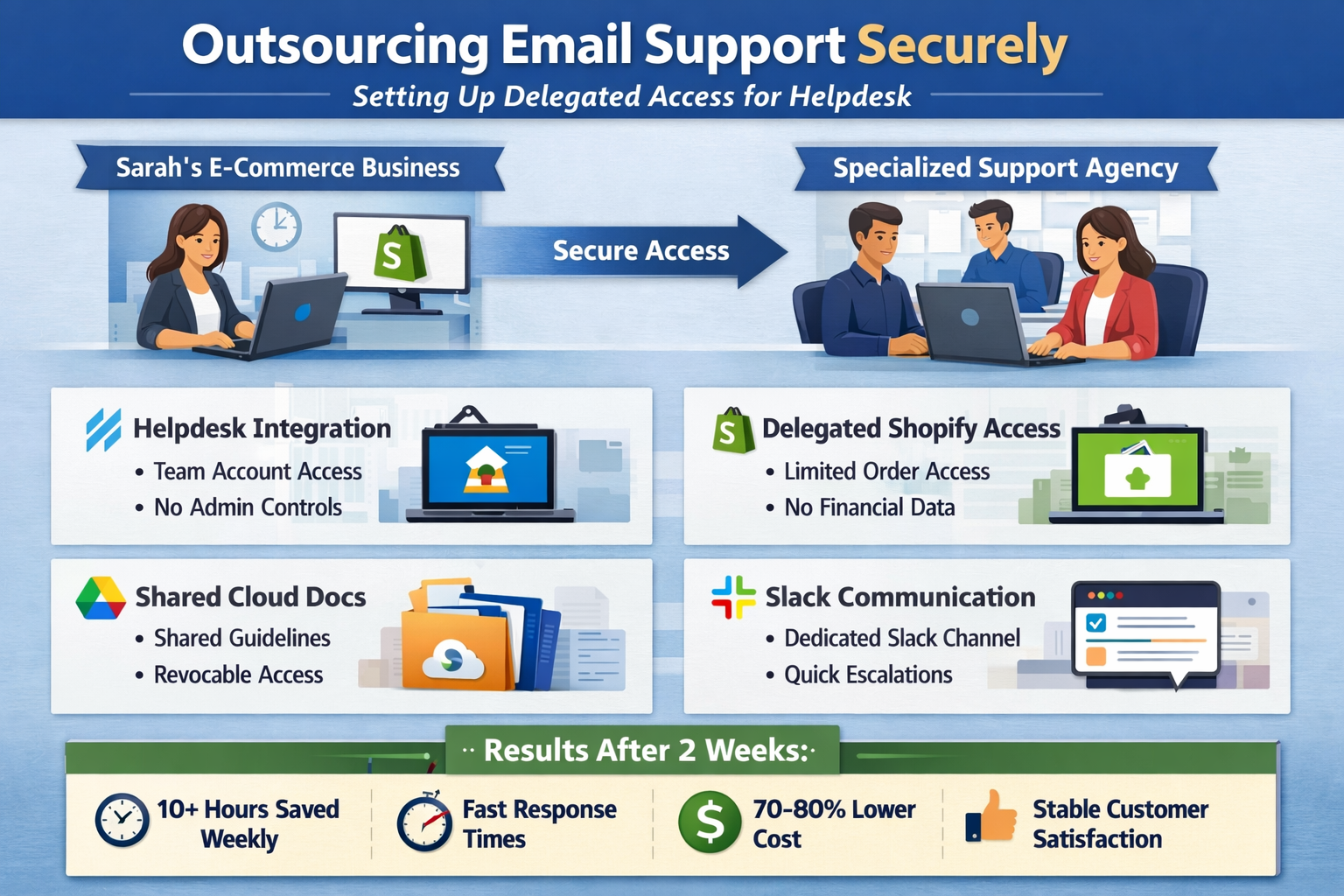
Setting Up Secure Access
Before any customer data changed hands, Sarah needed to address a common founder concern: security. The agency explained their access protocols clearly:
Helpdesk integration. Sarah used Help Scout for her support inbox. Rather than sharing her personal login credentials, she created a dedicated team account with appropriate permissions. The agency could view and respond to tickets without accessing billing information or admin settings.
Delegated access for Shopify. Sarah granted limited staff permissions to her Shopify store, allowing agents to look up order status and tracking information without exposing sensitive business data like revenue reports or supplier costs.
Shared documentation via cloud folders. Product information, policies, and brand guidelines lived in a shared Google Drive folder. Sarah maintained ownership and could revoke access instantly if needed.
Communication through a dedicated Slack channel. Quick questions, escalations, and daily updates flowed through Slack rather than personal email or text messages. This created a clear audit trail and kept work communication separate from personal channels.
This approach meant Sarah never had to share passwords directly. If the relationship ended, revoking access took minutes rather than requiring password changes across multiple systems.
Building the Knowledge Foundation
With access established, documentation became the focus:
Product details and FAQs. Common questions about materials, care instructions, sizing, and customization options. The agency compiled this information into a living knowledge base updated as new questions emerged.
Shipping and returns policies. Clear guidelines for handling delays, lost packages, return requests, and refund exceptions. Having documented policies meant agents could resolve most issues without escalation.
Brand voice guidelines. Examples of on-brand email responses showing the warm, personal tone Sarah used. The agency drafted sample replies for Sarah's approval before going live, ensuring alignment from day one.
Escalation criteria. Which issues required Sarah's direct involvement? Complex product questions, wholesale inquiries, and anything involving potential legal concerns got flagged for her attention. Everything else, the team handled independently.
The agency also reviewed Sarah's past support tickets to identify patterns. They discovered that 60% of inquiries fell into just eight categories—order status, shipping times, returns, product care, sizing questions, customization requests, wholesale inquiries, and technical website issues. Creating templated responses for these common scenarios dramatically improved efficiency.
By day seven, the support team began handling live customer emails. Sarah reviewed early responses and provided feedback. Within two weeks, she was only seeing escalated issues and weekly summary reports.
Time Savings and Customer Service Improvements: The Results
The impact became apparent within the first month.
Quantifiable Time Savings
Sarah tracked her support-related hours before and after the transition:
| Metric | Before Outsourcing | After Outsourcing |
| Daily inbox time | 4-5 hours | 30 minutes |
| Weekend support hours | 3-4 hours | 0 hours |
| Weekly total | 25-30 hours | 3-4 hours |
The math was striking. Sarah gained back roughly 10-12 hours weekly—time previously consumed by routine customer inquiries now handled by trained specialists.
Improved Response Times
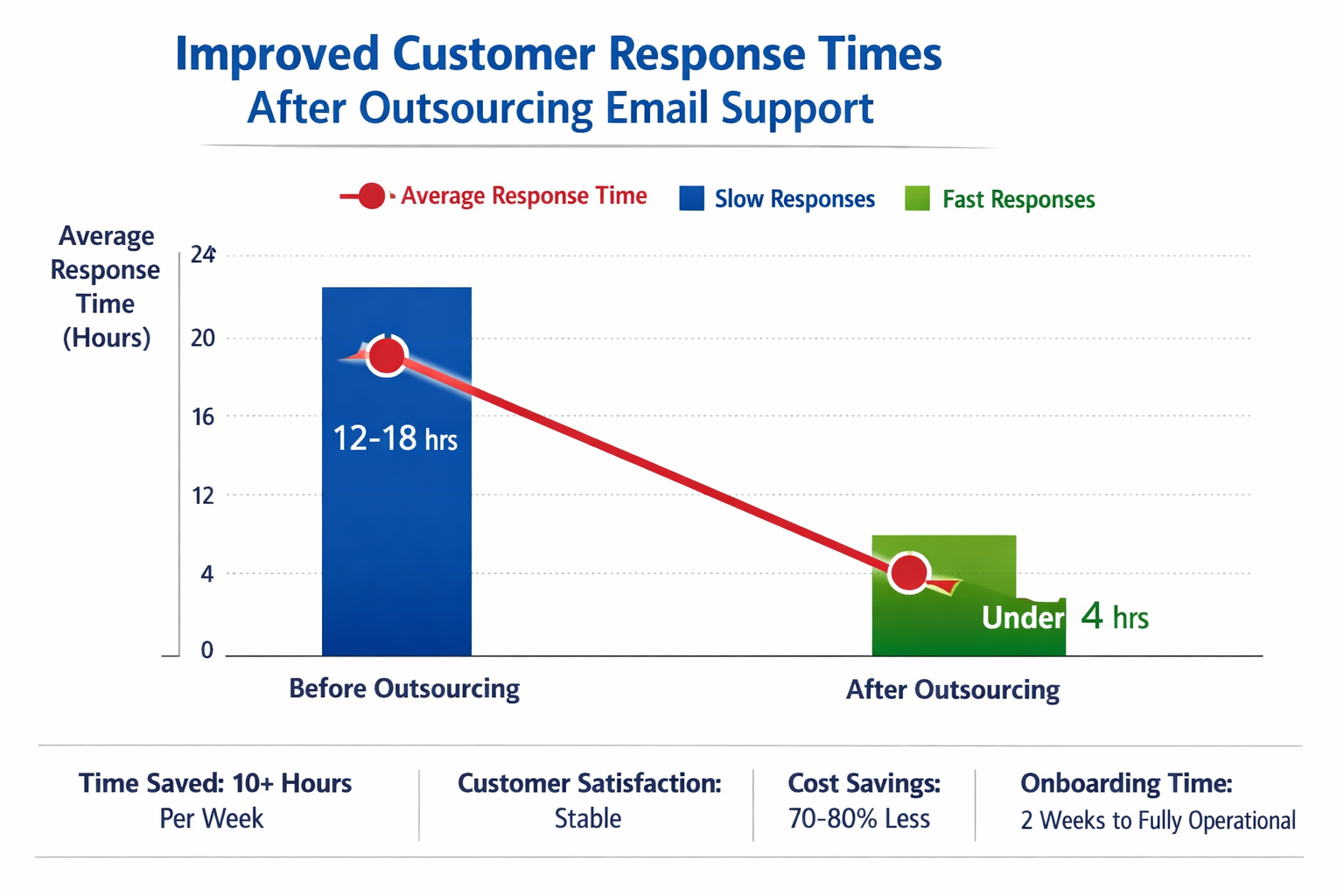
Before outsourcing, Sarah's average response time ranged from 8-24 hours depending on how overwhelmed she felt. Some messages slipped through cracks entirely.
The outsourced team maintained response times under four hours during business days. Customers received consistent, timely replies regardless of Sarah's schedule.
Research from HubSpot suggests that 90% of customers rate an "immediate" response as important when they have a customer service question, with "immediate" defined as 10 minutes or less for many consumers [2]. While same-day email response doesn't hit that bar, it dramatically outperforms the delays Sarah experienced when managing support alone.
Customer Satisfaction Maintained
Sarah's biggest fear was quality degradation. Would customers notice the change? Would they feel abandoned?
The opposite happened. Customer satisfaction scores remained stable, and some repeat buyers commented positively on faster response times. The personal touch Sarah worried about losing was preserved through careful brand voice alignment and dedicated agents who became genuinely knowledgeable about her products.
One customer emailed specifically to praise the support experience: "I always get such helpful, thoughtful replies from your team. It's refreshing compared to other online stores."
That customer never knew she was communicating with an outsourced specialist rather than Sarah herself.
What Sarah Did With Her Reclaimed Hours
Time savings only matter if they translate into meaningful outcomes. Here's how Sarah reinvested those 10+ weekly hours:
Strategic Marketing Initiatives
Sarah had postponed launching an email marketing sequence for over a year. "There was never time," she admitted. With support handled, she finally built a welcome series that increased repeat purchase rates by 15% within three months.
She also explored influencer partnerships—something impossible when she was constantly tethered to the inbox.
Product Development
Customer support had ironically prevented Sarah from acting on customer feedback. She had notebooks full of product improvement ideas gathered from emails but no bandwidth to implement them.
Post-transition, Sarah developed two new product variations based on frequently requested features. Both became top sellers within their first quarter.
Actual Time Off
Perhaps most importantly, Sarah took her first real vacation in three years. A ten-day trip where she checked email once daily—just the escalated issues—rather than spending hours managing the inbox from hotel rooms.
"I didn't realize how much mental energy customer support consumed until I stopped doing it," Sarah reflected. "Even when I wasn't actively answering emails, I was thinking about them. That constant background noise finally went quiet."
Cost Comparison: In-House vs. Outsourced Customer Support
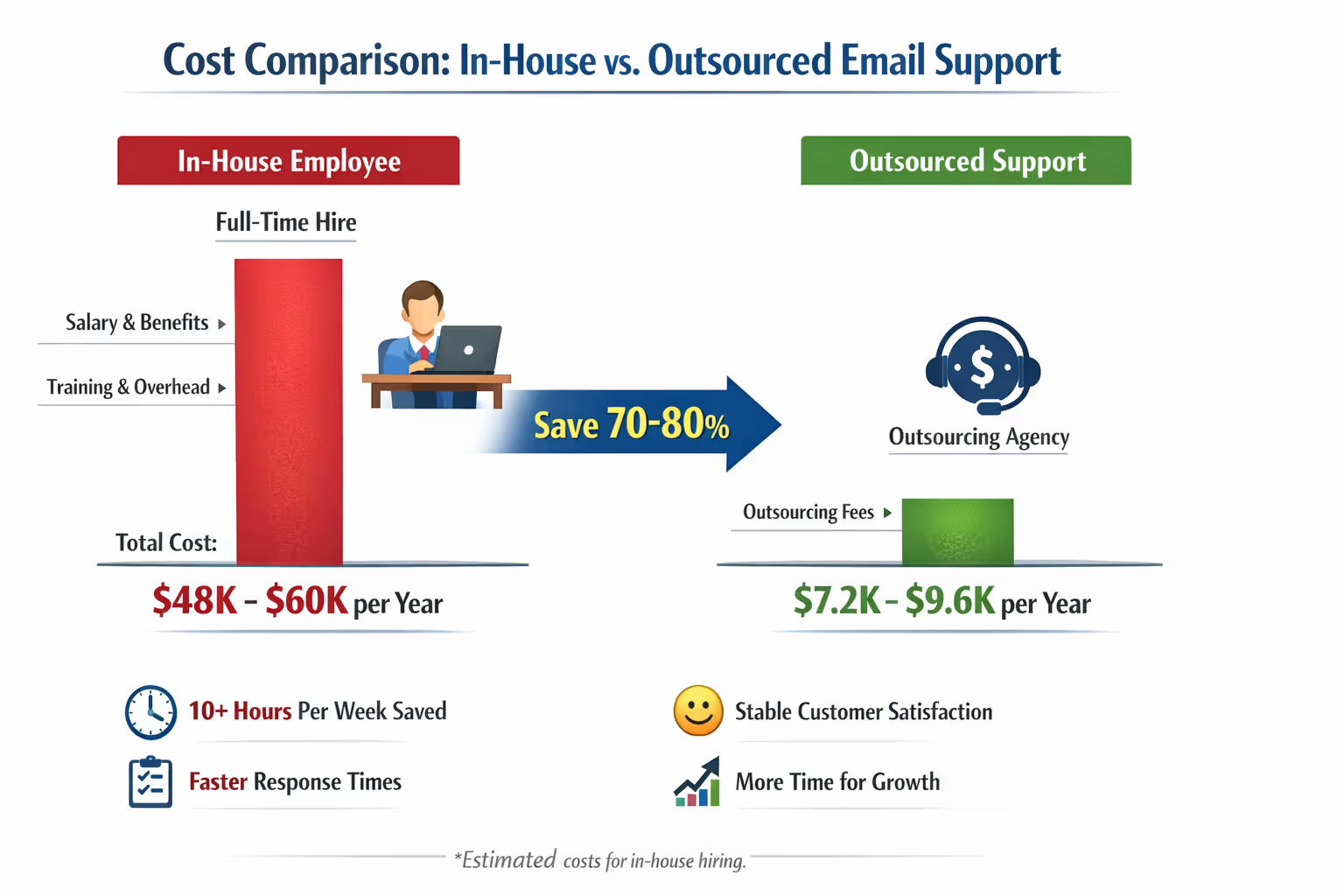
Cost concerns often prevent founders from exploring outsourcing. Sarah's experience illustrates why the comparison requires looking beyond hourly rates.
Full-Time Employee Costs
Hiring an in-house customer service representative would have cost Sarah approximately:
Base salary: $35,000-$45,000 annually for an entry-level hire
Payroll taxes and benefits: Additional 20-30% of salary
Training and onboarding: 40+ hours of Sarah's time initially, plus ongoing management
Coverage gaps: Sick days, vacations, and turnover create service interruptions
Total annual cost: $45,000-$60,000, plus Sarah's continued time investment in management and training.
Part-Time Employee Costs
A 20-hour weekly part-timer seemed more affordable on paper. Reality was messier:
Hourly wages plus employer taxes
Training investment for someone working limited hours
Single point of failure with no backup coverage
Management overhead that doesn't scale down proportionally
Sarah estimated part-time support would cost $15,000-$20,000 annually while still requiring significant personal involvement.
Outsourced Support Costs
Sarah's agency charged based on monthly ticket volume, with no long-term contract. Her typical month ran around $600-$800 depending on seasonal fluctuations—approximately $7,200-$9,600 annually.
Important clarification: This pricing reflects a shared team model where trained agents handle multiple client accounts. The agents assigned to Sarah's account knew her business intimately and worked on her tickets daily, but they weren't exclusively dedicated to her store alone. This structure is how boutique agencies deliver high-quality, US-based support at accessible price points for small businesses.
The agency provided:
Two primary agents who knew her business and covered each other's absences
Coverage during agent sick days or vacations (no gaps in service)
Quality oversight and process documentation
Flexibility to scale up during peak seasons like Black Friday
The cost difference was significant. More importantly, outsourcing eliminated the management burden entirely. Sarah's weekly involvement dropped to reviewing reports and handling occasional escalations—perhaps three hours total compared to the 25+ hours she'd spent before.
What Made This Transition Successful: Key Lessons
Not every outsourcing experiment ends well. Sarah's success stemmed from several factors worth noting:
Clear Documentation Before Launch
The upfront time investment in knowledge transfer paid dividends. Agents had answers to common questions from day one rather than constantly pinging Sarah for clarification.
Realistic Expectations About the Transition Period
The first two weeks required more of Sarah's attention as she reviewed responses and provided feedback. She planned for this rather than expecting immediate hands-off operation.
Choosing a Specialized Partner
General virtual assistants and overseas call centers might work for some businesses. For Sarah's brand-sensitive e-commerce operation, specialists who understood small online businesses made the difference.
Trusting the Process
Sarah's instinct was to micromanage every response. Letting go felt uncomfortable initially. But the agency's track record and the quality of their draft responses built confidence quickly.
Maintaining Strategic Oversight
Outsourcing support didn't mean ignoring it entirely. Sarah reviewed weekly reports to spot trends, identify product issues customers mentioned frequently, and ensure quality remained high. She stayed connected without getting buried.
Is Outsourcing Email Support Right for Your E-Commerce Business?
Sarah's transformation won't apply universally. Outsourcing makes sense when certain conditions exist:
You're spending significant time on repetitive support tasks. If most inquiries follow predictable patterns, trained specialists can handle them efficiently. If every email requires founder-level product expertise, outsourcing becomes harder.
Your customer volume justifies the investment. Very early-stage stores with minimal support volume might not need external help yet. Once you're consistently spending 10+ hours weekly on support, the math changes.
You value quality over rock-bottom pricing. Cheap overseas support often creates more problems than it solves. Boutique agencies cost more than offshore alternatives but deliver dramatically better outcomes for brand-conscious businesses.
You're willing to invest in proper onboarding. Throwing support tickets at an external team without documentation leads to frustration. Success requires upfront effort to transfer knowledge effectively.
Your support is primarily written communication. Agencies specializing in email and ticket support excel at asynchronous channels. If your business requires extensive phone or live chat support, different solutions may apply.
Frequently Asked Questions
How long does it take to fully transition email support to an outsourced team?
Most small e-commerce businesses can achieve full transition within two to three weeks. The first week focuses on knowledge transfer and documentation. The second week involves supervised handling with feedback loops. By week three, most founders only review escalated issues and periodic reports.
Will customers notice they're not communicating with the founder?
When done well, customers won't detect the change—and that's the point. Effective outsourcing partners learn your brand voice, product details, and communication style so thoroughly that responses feel native to your brand. Sarah's customers praised the support experience without ever realizing the shift.
What happens during peak seasons like Black Friday?
Reputable support agencies build flexibility into their service models. Volume-based pricing means you pay more during busy periods but get proportionally more help. The alternative—scrambling to hire and train temporary staff yourself—creates far more disruption.
How do outsourced teams handle complex or unusual customer situations?
Clear escalation procedures define which issues go directly to the business owner. Typically, this includes potential legal matters, significant financial decisions, complex technical questions requiring deep product expertise, and any situation where the customer specifically requests to speak with ownership. Everything else gets resolved by the support team.
What if I'm not satisfied with the quality of responses?
Quality concerns should emerge during the supervised onboarding period when you're reviewing responses before they go live. Address issues immediately through direct feedback. Reputable agencies welcome this input because it helps them serve you better. If quality remains problematic despite feedback, month-to-month arrangements allow you to exit without penalty.
The Bottom Line
Sarah's story illustrates what becomes possible when e-commerce founders stop trying to do everything themselves. Ten hours weekly returned to strategic work. Consistent customer response times. Mental energy freed from inbox anxiety. And ultimately, a more sustainable business that doesn't depend on one person's constant availability.
Outsourcing email support isn't abandoning your customers. Done right, it's ensuring they receive reliable, high-quality service while you focus on building the business they love.
The inbox doesn't have to run your life. With the right partner, it becomes someone else's job—handled with the same care you'd bring, but without consuming your every waking hour.
Ready to explore what inbox delegation could look like for your e-commerce business? Book a consultation to discuss your support volume, customer expectations, and whether outsourced email support might be the right fit. No pressure, no commitment—just an honest conversation about whether this approach makes sense for your situation.
Why This Perspective Matters
The insights in this case study come from working directly with small e-commerce and SaaS founders navigating the exact challenges described. Evergreen Support specializes in helping online businesses maintain the personal touch their customers love while freeing founders to focus on growth. Every recommendation reflects real experience helping businesses like Sarah's make this transition successfully.
Cited Works
[1] Salesforce — "State of the Connected Customer Report." https://www.salesforce.com/resources/research-reports/state-of-the-connected-customer/
[2] HubSpot — "The Hard Truth About Acquisition Costs (and How Your Customers Can Save You)." https://blog.hubspot.com/service/customer-acquisition-study