
You built your SaaS from Berlin, Amsterdam, or Dublin. Your product is solid. Your customers love it. And increasingly, those customers are American.
That's exciting—until you realize what it actually means for your inbox.
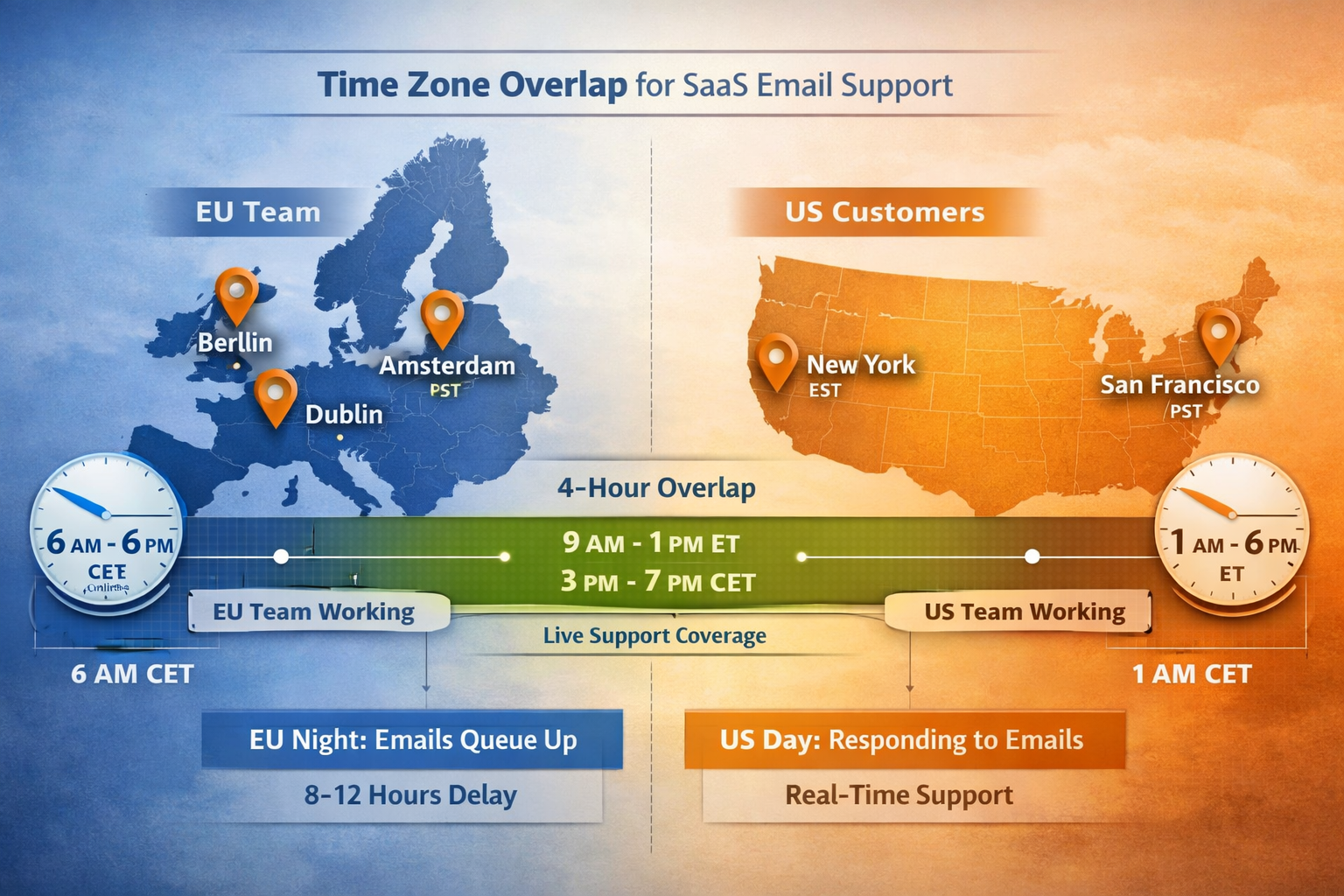
When a US customer sends a support email at 2 PM Eastern, it's already 8 PM in Central Europe. By the time your team logs on the next morning, that customer has been waiting twelve hours. For enterprise clients who expect prompt, professional responses during their business day, that delay can erode trust fast.
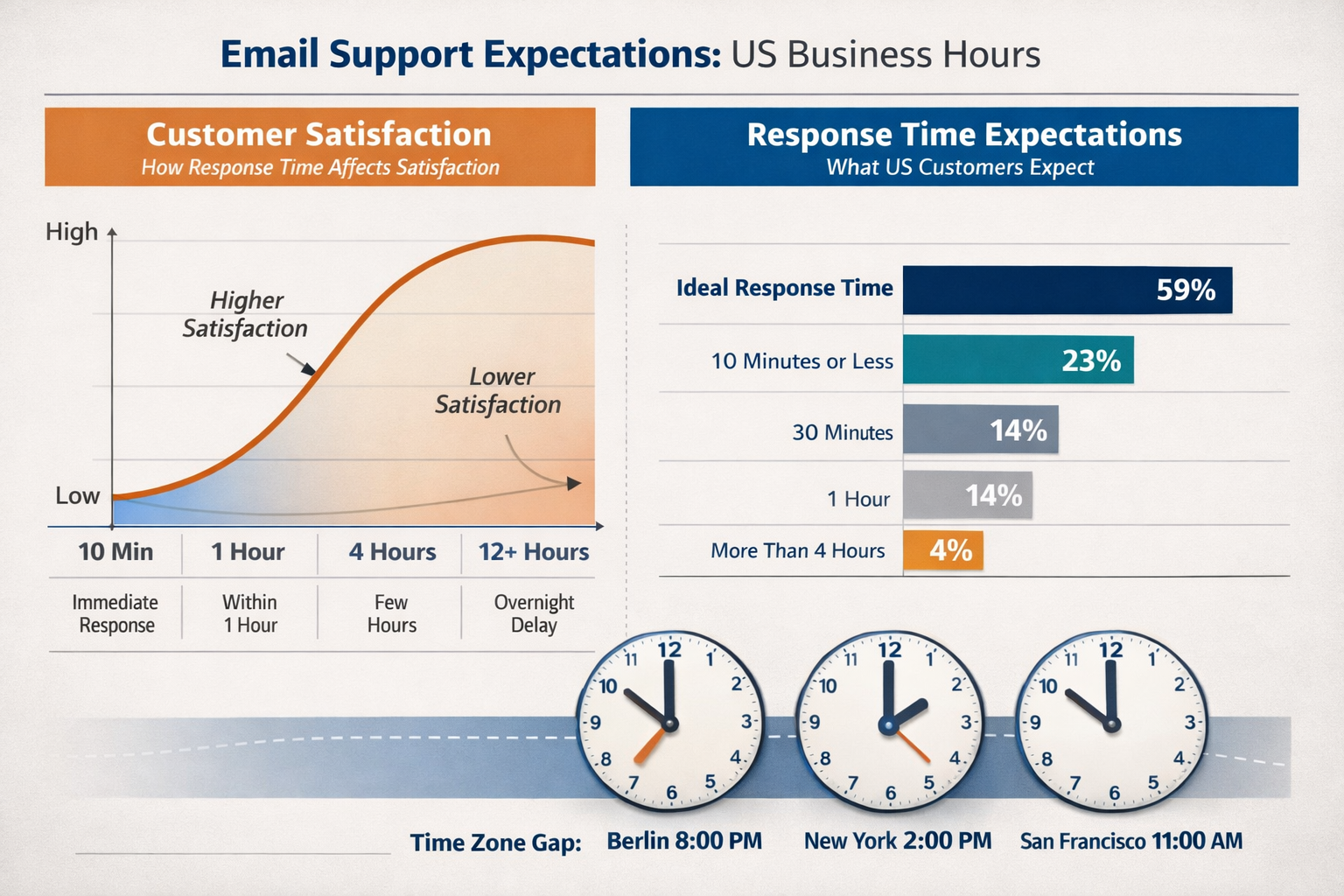
This isn't a hypothetical problem. Research from HubSpot shows that 90% of customers rate an "immediate" response as important when they have a support question—and most define immediate as ten minutes or less [1]. Even if your product is exceptional, slow support creates friction that compounds over time.
The good news? You don't need to hire a night shift or relocate your team. There's a simpler path: partnering with US-based support specialists who handle your American customers' emails during US business hours while your EU team sleeps.
The Time Zone Math That Keeps EU Founders Up at Night
Let's get specific about the challenge.
If you're based in Germany (CET/CEST), your standard 9-to-6 workday overlaps with US Eastern time for roughly four hours—and only in the morning for your American customers. By 1 PM in New York, your team is wrapping up for the day.
For Pacific time customers? The overlap shrinks to almost nothing. When a customer in San Francisco starts their workday at 9 AM, it's already 6 PM in Berlin.
This creates a predictable pattern:
US customers send emails throughout their business day
Those emails sit untouched for 8-16 hours
Your team wakes up to a backlog
Responses arrive when the US customer is asleep or off work
Back-and-forth stretches across days instead of hours
For consumer-facing products with casual users, this might be tolerable. But for B2B SaaS—especially when you're landing larger US accounts—those enterprise buyers expect responsiveness that matches their domestic vendors.
One COO of a small SaaS company with primarily US enterprise clients described the bind perfectly: her team was based in Europe, but her biggest customers expected white-glove support during American hours. She couldn't afford to hire a US-based employee, and she couldn't keep waking up at 3 AM to answer tickets.
What US-Hours Coverage Actually Looks Like
Here's the practical reality of outsourcing US-hours email support.
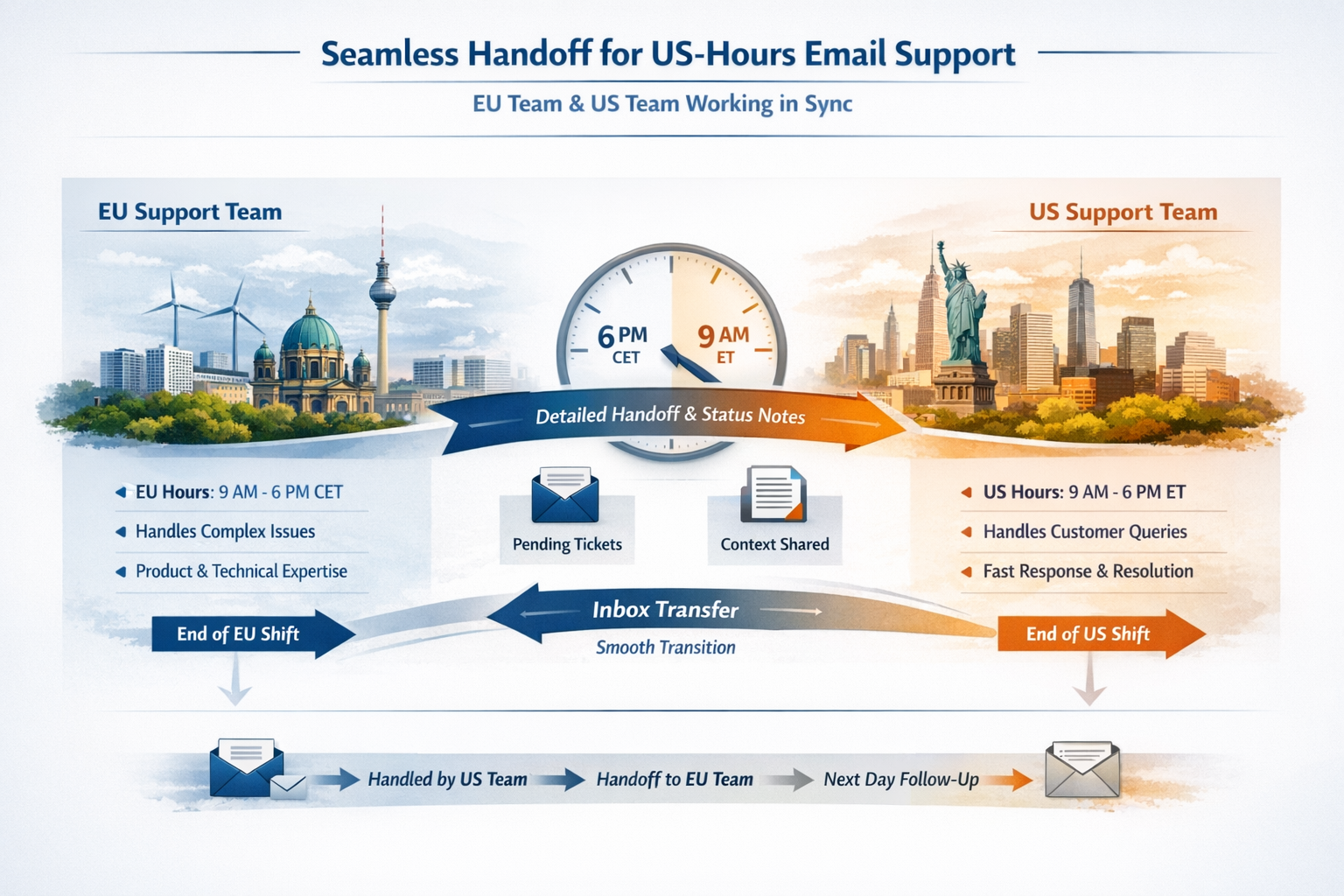
A US-based support partner handles your inbox during American business hours—typically 9 AM to 6 PM Eastern, Monday through Friday. They answer customer emails within hours (often much faster), following your brand voice and escalation guidelines.
When they wrap up for the day, your EU team picks up. Any tickets that need deeper technical expertise or product decisions get handed off cleanly with context.
Think of it as a relay race, not a replacement.
What the US team handles (Tier 1):
Account and billing questions
Basic troubleshooting with documented solutions
Onboarding guidance and how-to requests
Status updates and acknowledgment of more complex issues
Feature requests (logged and forwarded)
What stays with your EU team (Tier 2+):
Deep technical debugging requiring codebase access
Product decisions and roadmap discussions
High-stakes escalations with strategic accounts
Anything requiring founder-level judgment
The US partner becomes an extension of your team—not a barrier between you and your customers.
Making Handoffs Seamless
The mechanics of cross-Atlantic coordination matter more than you might expect. A sloppy handoff creates confusion and makes your support feel disjointed.
Here's what works:
Shared helpdesk with internal notes. Every ticket should have context visible to both teams. When your US partner acknowledges an issue and begins investigating, they document what they've tried and what they've learned. When your EU team logs on, they can see exactly where things stand.
Clear escalation triggers. Define upfront which situations get escalated immediately versus handled independently. For example: billing disputes under €500 get resolved by the US team using your refund policy. Feature requests from enterprise accounts get flagged for your product team. Anything mentioning legal or security concerns goes straight to you.
Autoresponders that set expectations. While your US partner handles the heavy lifting during American hours, autoresponders during your EU hours can acknowledge receipt and provide realistic response timeframes. Something simple like: "Thanks for reaching out. Our team is reviewing your request and will respond within 24 hours" prevents anxiety and buys you time without making promises you can't keep.
A shared Slack channel. Real-time communication between your team and your support partner catches edge cases before they become problems. If an unusual request comes in, a quick question in Slack gets answered in minutes rather than sitting until the next shift.
Weekly syncs (at least initially). A 30-minute call to review trends, discuss tricky tickets, and refine processes keeps everyone aligned. Over time, these can become less frequent as the partnership matures.
Why This Matters More for Enterprise Accounts
Consumer SaaS can often get away with next-day responses. Enterprise can't.
When you're charging thousands of dollars per month—or per year—customers expect premium support. They're evaluating you not just on your product's features but on what it's like to work with your company.
Slow support signals understaffing, disorganization, or worse: that you don't prioritize their success. For a procurement team deciding between you and a US-based competitor, that perception matters.
American business culture also tends toward directness about service expectations. A US enterprise customer who waits 16 hours for a response won't silently fume—they'll tell you. And if it keeps happening, they'll evaluate alternatives.
Studies consistently show the relationship between support quality and retention. According to PwC research, 32% of customers will walk away from a brand they love after just one bad experience [2]. For B2B relationships where switching costs are higher, tolerance may be slightly greater—but frustration still accumulates.
Fast, knowledgeable responses during US business hours signal that you take American customers seriously, even if your headquarters is 5,000 miles away.
The Case for Human Support (Not Bots)
You might wonder: why not just deploy a chatbot or AI assistant to handle US-hours coverage?
It's a reasonable question. AI support tools have improved dramatically. But for the EU-SaaS-serving-US-enterprise use case, human support has distinct advantages.
Enterprise customers often hate chatbots. Many have been burned by clunky implementations that waste their time. When they reach out to a SaaS vendor, they're expecting to talk to someone who understands their situation—not navigate a decision tree.
Complex B2B issues rarely fit templates. A consumer product might get the same ten questions repeatedly. B2B SaaS support often involves integrations, custom configurations, and workflows unique to each customer. Humans adapt. Bots struggle.
Brand voice is harder for AI. If your company's tone is warm and slightly witty, maintaining that consistently through AI-generated responses is genuinely difficult. Human support specialists can be trained on your voice and actually embody it.
Trust matters more at higher price points. When customers are paying enterprise prices, they want to know there are real humans behind the product who care about their success. That perception has value beyond any individual ticket.
None of this means AI has no role. Automated acknowledgments, smart routing, and suggested response templates all help human agents work faster. But for the actual customer-facing interaction, humans still win—especially in high-stakes B2B contexts.
Implementation: What to Expect
If you're considering US-hours support coverage, here's a realistic timeline and process.
Week 1: Discovery and setup
Kick-off call to understand your product, customers, and pain points
Access to your helpdesk system and internal documentation
Review of historical tickets to identify common issues
Week 2: Documentation and training
Your support partner builds or refines an internal knowledge base
They draft responses to frequent questions in your brand voice
You review and approve (or tweak) those drafts
Week 3: Shadowed support
The support team begins handling tickets with your oversight
You review responses before they go out (or shortly after)
Feedback loop refines accuracy and tone
Week 4+: Live support
Full coverage during US business hours
Ongoing refinement based on new issues and edge cases
Regular check-ins to review metrics and discuss improvements
The best support partners treat onboarding as an investment, not a formality. They should be asking questions, learning your product deeply, and genuinely caring about representing your brand well.
What It Costs (and What You're Comparing It To)
Let's talk numbers.
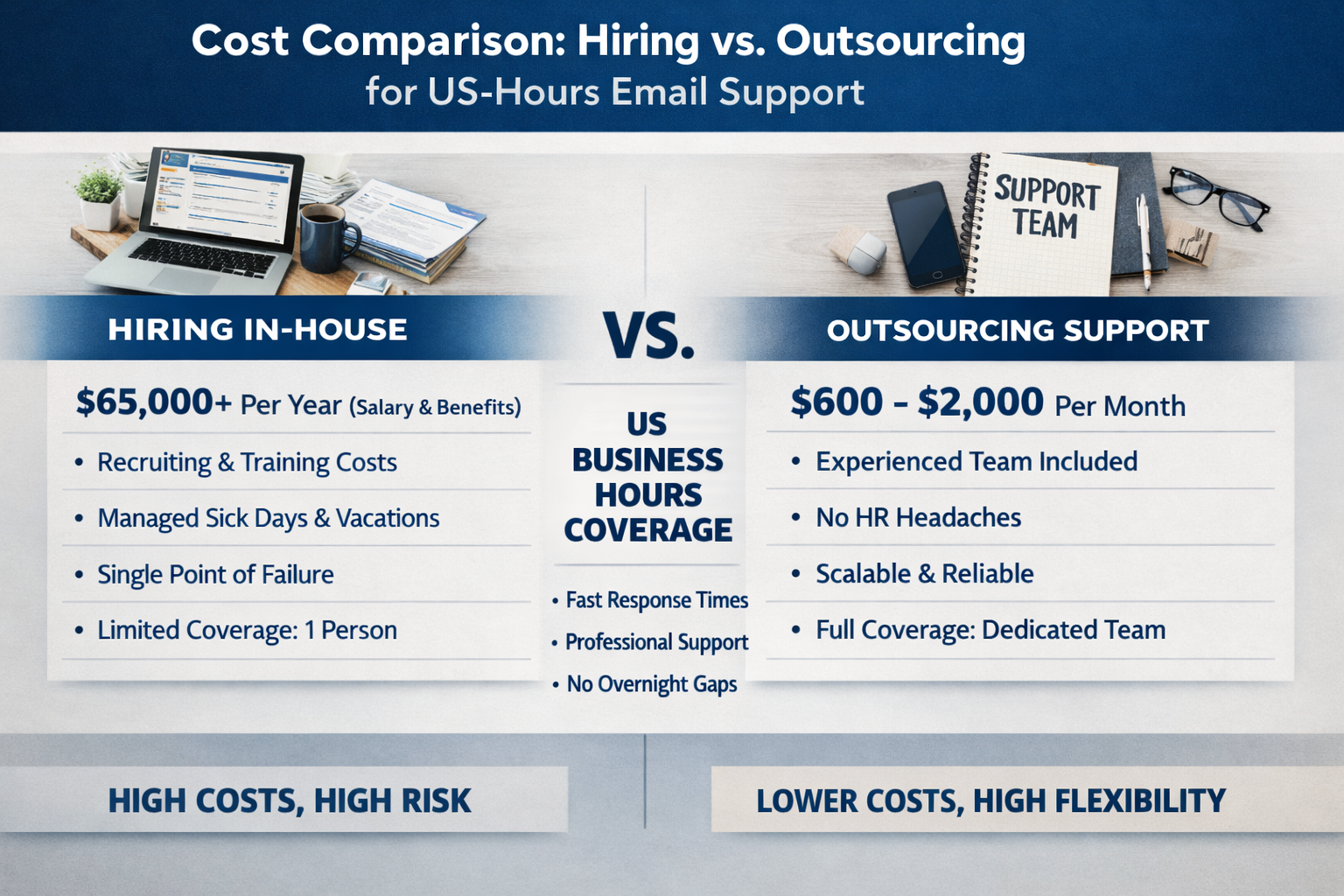
Hiring a US-based support employee costs, at minimum, $45,000-$60,000 in annual salary for an entry-level role—plus benefits, payroll taxes, equipment, and management overhead. The Bureau of Labor Statistics estimates that employer costs add roughly 30% beyond base wages [3]. So that $50K hire actually costs $65K+, before you account for recruiting, training, and turnover risk.
And that's one person. If they get sick, go on vacation, or quit, you're back to no US coverage.
Outsourced support typically runs $600-$2,000+ per month depending on volume—a fraction of hiring. You get coverage that doesn't disappear when someone calls in sick, because there's a team behind the service.
For an EU-based SaaS with 50-200 US support tickets monthly, outsourcing often makes more economic sense than hiring—while delivering more reliable coverage.
The real question isn't just cost. It's cost relative to the value of keeping enterprise accounts happy. If faster support helps you retain even one $20K/year customer who might otherwise churn, the ROI is clear.
Who This Works Best For
This model isn't for everyone. It works particularly well when:
Your US customer base is growing but not huge. Enough volume to justify coverage, not enough to justify a US office.
You serve B2B or enterprise customers. Higher stakes per account, greater expectations for responsiveness.
Your support is primarily email/ticket-based. This approach doesn't cover phone or real-time chat.
You have documentation (or are willing to build it). Support partners need knowledge to work from.
You want to stay lean. You'd rather not add headcount you can't easily reverse.
It works less well if you need 24/7 instant coverage, phone support, or deep technical debugging that only your engineers can do. Those use cases require different solutions.
Your Next Step
If you're an EU-based SaaS team struggling to serve US customers during their business day, you have options beyond hiring or suffering through time zone pain.
A US-based support partner can extend your coverage without extending your team—handling your American inbox while you sleep, responding within hours instead of half a day, and representing your brand as if they were sitting in your office.
The fastest way to see if it's a fit? Book a call to talk through your specific situation, or start with a low-risk trial to experience how it works in practice.
Your US customers don't need to know your team is in Europe. They just need to know someone's there when they reach out.
Frequently Asked Questions
Will customers know they're talking to an outsourced team?
Not unless you want them to. Support agents can use your company email domain and respond in your brand voice. The goal is seamless coverage, not obvious outsourcing. Most customers simply notice that they're getting faster responses.
What happens with technically complex issues my team needs to handle?
Those get escalated with full context. Your US support partner acknowledges the issue, gathers relevant information, and hands it off cleanly so your EU team can resolve it when they come online. The customer gets a fast acknowledgment; you get a prepared ticket.
How do you maintain our brand voice across different teams?
Through deliberate onboarding. Before going live, support partners should draft sample responses for your approval, learning your tone and terminology. Ongoing feedback refines this over time. The best partners genuinely internalize your voice rather than just following scripts.
Can this work if we only have a few US customers right now?
Yes, though the economics depend on volume. Even a handful of high-value enterprise accounts can justify coverage if responsiveness affects retention. Many outsourced support models are volume-based, so costs scale with your actual needs.
What if we want to bring support in-house later?
Good partners create documentation that stays with you. The knowledge base, response templates, and process docs built during the engagement belong to your company. If you eventually hire a US team, you'll have a foundation to hand them—not a black box.
About Evergreen Support
Evergreen Support provides US-based email support for small SaaS and ecommerce businesses—including EU-based teams serving American customers. Founded by Emma Fletcher and Ellis Annichine, our team handles your inbox with the same care you would, using real humans (never AI chatbots) who learn your product and voice. We offer flexible month-to-month plans with no long-term contracts, transparent pricing based on ticket volume, and a $1 trial onboarding so you can experience the service before fully committing.
Works Cited
[1] HubSpot — "The Hard Truth About Acquisition Costs (and How Your Customers Can Save You)." https://blog.hubspot.com/service/customer-acquisition-study
[2] PwC — "Experience is Everything: Here's How to Get It Right." https://www.pwc.com/us/en/services/consulting/library/consumer-intelligence-series/future-of-customer-experience.html
[3] U.S. Bureau of Labor Statistics — "Employer Costs for Employee Compensation." https://www.bls.gov/news.release/ecec.nr0.htm