
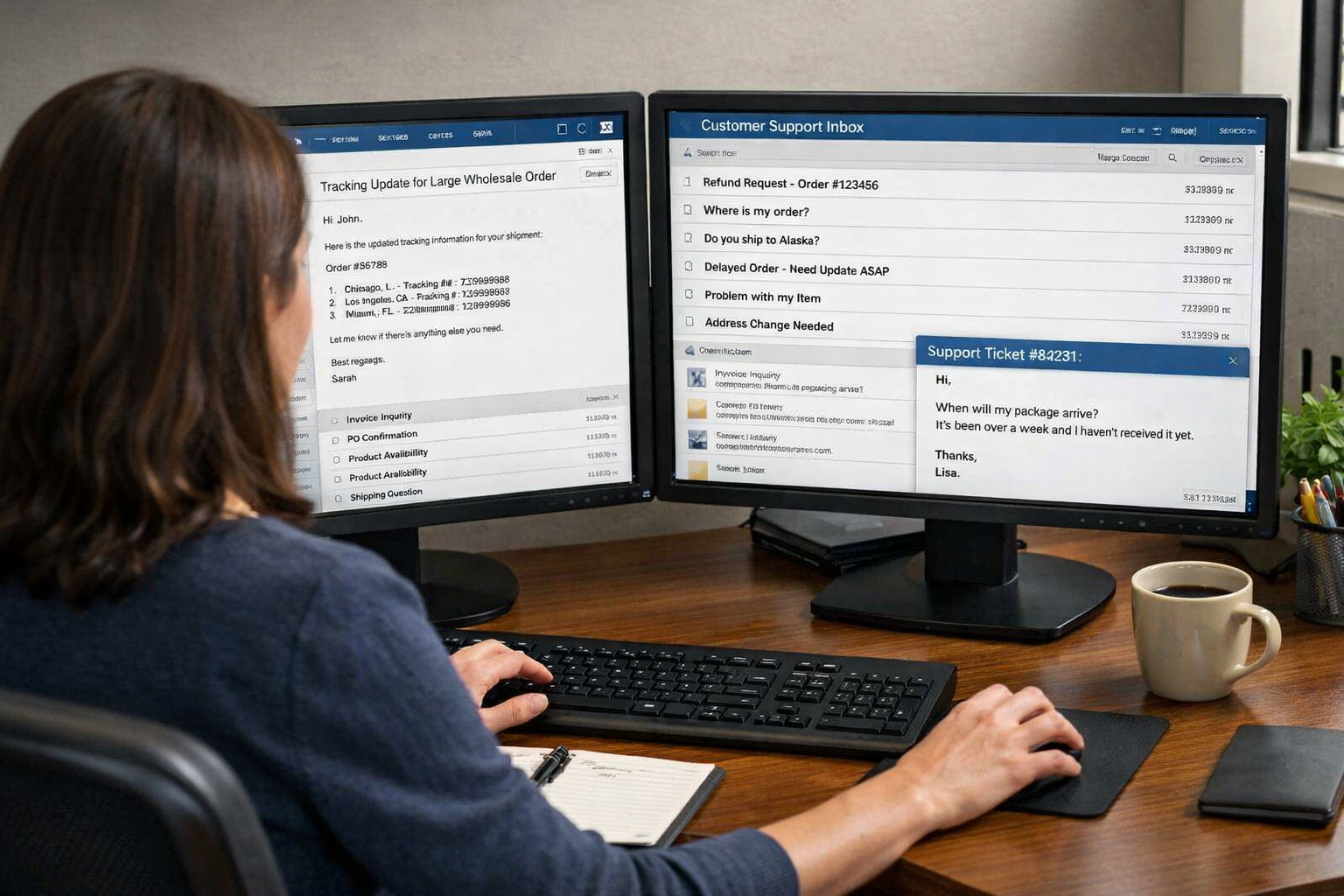
Your inbox just pinged again. A wholesale buyer needs updated tracking for a 500-unit order shipping to three different locations. Meanwhile, 47 consumer tickets sit unanswered—refund requests, "where's my order" messages, and someone asking if you ship to Alaska.
Welcome to the dual-queue problem that hits every growing DTC brand the moment they land their first big wholesale accounts.
Running email support for wholesale and direct-to-consumer customers from the same inbox sounds efficient. In practice, it creates a triage nightmare. The wholesale buyer expects white-glove treatment and fast answers. The consumer expects quick resolution too. And whoever handles both—usually you, the founder, or a marketing lead who never signed up for this—ends up disappointing everyone while burning out in the process.
Here's the thing: structuring your email support for hybrid DTC and B2B operations isn't complicated. It just requires intentional design. This guide walks you through the exact frameworks, escalation paths, and workflow decisions that keep wholesale relationships protected while your consumer queue stays under control.
The Real Cost of One Person Managing Both Queues
Before diving into solutions, let's talk about what actually happens when your marketing lead, ops person, or founder handles both DTC and wholesale support.
The Drowning Pattern
It starts manageable. A few consumer tickets a day, maybe one or two wholesale emails a week. You can handle it between other work.
Then wholesale accounts grow. You land that regional chain. Orders get bigger, questions get more complex. Meanwhile, consumer volume creeps up with every marketing campaign.
Now you're spending two hours a day in the inbox minimum. Wholesale emails sit for 6-8 hours because you're buried in consumer tickets. You start making mistakes—sending a consumer response to a wholesale buyer, missing a deadline, forgetting to follow up on an open issue.
The person handling support can't focus on their actual job. The work that grows your business—marketing campaigns, operations improvements, product development—gets squeezed into whatever time remains.
The Opportunity Cost
This is the part most founders undercount. Every hour spent triaging tickets is an hour not spent on work that compounds. A marketing lead buried in support isn't running campaigns. A founder answering refund requests isn't closing wholesale accounts or improving the product.
Research suggests founders can reclaim 10-20 hours weekly by delegating support responsibilities [1]. That's not just time—it's capacity for the work that actually scales your business.
The Relationship Risk
Here's the real danger: when support quality drops, you don't always hear about it directly. Wholesale buyers don't usually complain. They just don't reorder. By the time you notice the revenue dip, the relationship damage is done.
Consumer customers are more forgiving of slow responses. Wholesale buyers aren't. They have alternatives, and they'll use them.
Why Wholesale Email Support Demands Different Treatment
A wholesale account isn't just a bigger customer. It's a fundamentally different relationship with different expectations, timelines, and stakes.
When a consumer has a bad experience, you might lose a $60 order. When a wholesale buyer has a bad experience, you could lose a $15,000 monthly account—plus the retail exposure that comes with it.
The Expectation Gap
Direct-to-consumer customers generally expect helpful service within a reasonable window. Research from Forrester indicates that customer expectations for response times have compressed significantly in recent years, with most consumers expecting acknowledgment within 24 hours at minimum [2].
Wholesale buyers operate differently. They're running businesses too. When they email about a shipment delay or invoice discrepancy, the answer affects their operations, their retail partners, and potentially their own customer relationships. They expect:
Faster response times. Many wholesale agreements include informal or formal SLAs around communication.
Proactive updates. They don't want to chase you for tracking information or order confirmations.
Direct access to someone who can actually solve problems. Getting bounced around or receiving canned responses erodes trust fast.
Documentation. Everything in writing, organized, and easy to reference.
The Volume Problem
Here's where hybrid brands get stuck. Your DTC queue generates steady volume—predictable, manageable, and often repetitive. Your wholesale queue generates lower volume but higher complexity per ticket.
When both land in the same inbox, the sheer number of consumer tickets tends to bury wholesale requests. Your wholesale buyer's urgent question about a split shipment sits below 30 "did my order ship yet" messages. By the time you surface it, the relationship has already taken a hit.
Building Separate Queues (Without Separate Teams)
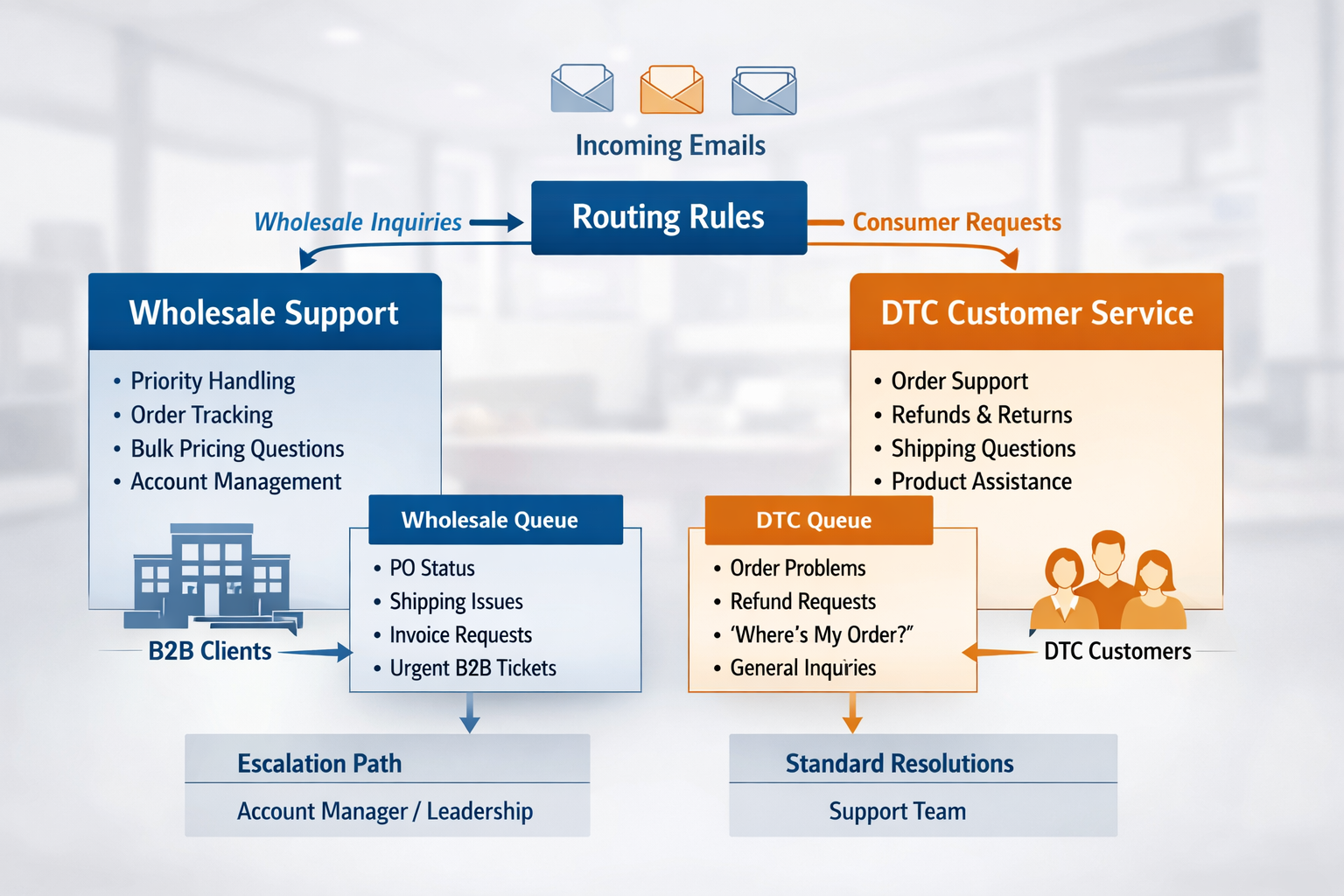
You don't need two full support teams to treat these channels differently. You need clear separation at the intake level and smart routing rules.
Option 1: Dedicated Email Addresses
The simplest approach: create distinct addresses for each channel.
support@yourbrand.com for consumer inquiries
wholesale@yourbrand.com or accounts@yourbrand.com for B2B customers
This works even if the same person monitors both. The visual separation alone changes behavior. You can prioritize the wholesale inbox, set different notification rules, and track response times separately.
Most helpdesk tools (Help Scout, Zendesk, Freshdesk, Gorgias, etc.) let you route these addresses into separate inboxes or apply automatic tags. That gives you visibility into each queue's health without constant manual sorting.
Technical setup in common tools:
Help Scout: Create separate mailboxes for each address, then use workflows to auto-assign or tag.
Gorgias: Use Rules to auto-tag incoming emails based on the receiving address, then filter views by tag.
Zendesk: Set up separate email channels and use Triggers to route tickets to distinct groups or views.
Option 2: Contact Form Routing
If you want to keep a single customer-facing email address, use your helpdesk's intake forms to separate traffic. Add a simple dropdown: "Are you a wholesale partner?" Route those submissions to a priority queue automatically.
The downside: wholesale buyers often email directly rather than using forms. Old habits persist. But combined with training your accounts to use specific addresses, this catches most traffic.
Option 3: Domain-Based Tagging
Some helpdesks can auto-tag based on sender domain. If your wholesale accounts email from company domains (versus gmail.com or yahoo.com), you can flag those tickets automatically for priority handling.
This isn't foolproof—plenty of small retailers use personal email—but it catches a meaningful percentage of B2B traffic without any manual effort.
How to set this up in Gorgias or Zendesk:Create a rule that checks if the sender's email domain matches a list of known wholesale account domains. When it matches, apply a "Wholesale" tag and route to your priority queue.
Setting Wholesale SLAs That Protect the Relationship
Consumer support benefits from fast responses, but wholesale support requires them. The difference matters.
What "Fast" Actually Means for B2B
For most wholesale relationships, a 24-hour response time on email is the baseline expectation—not the goal. Many buyers expect same-business-day acknowledgment, even if full resolution takes longer.
Here's a framework that works for most hybrid brands:
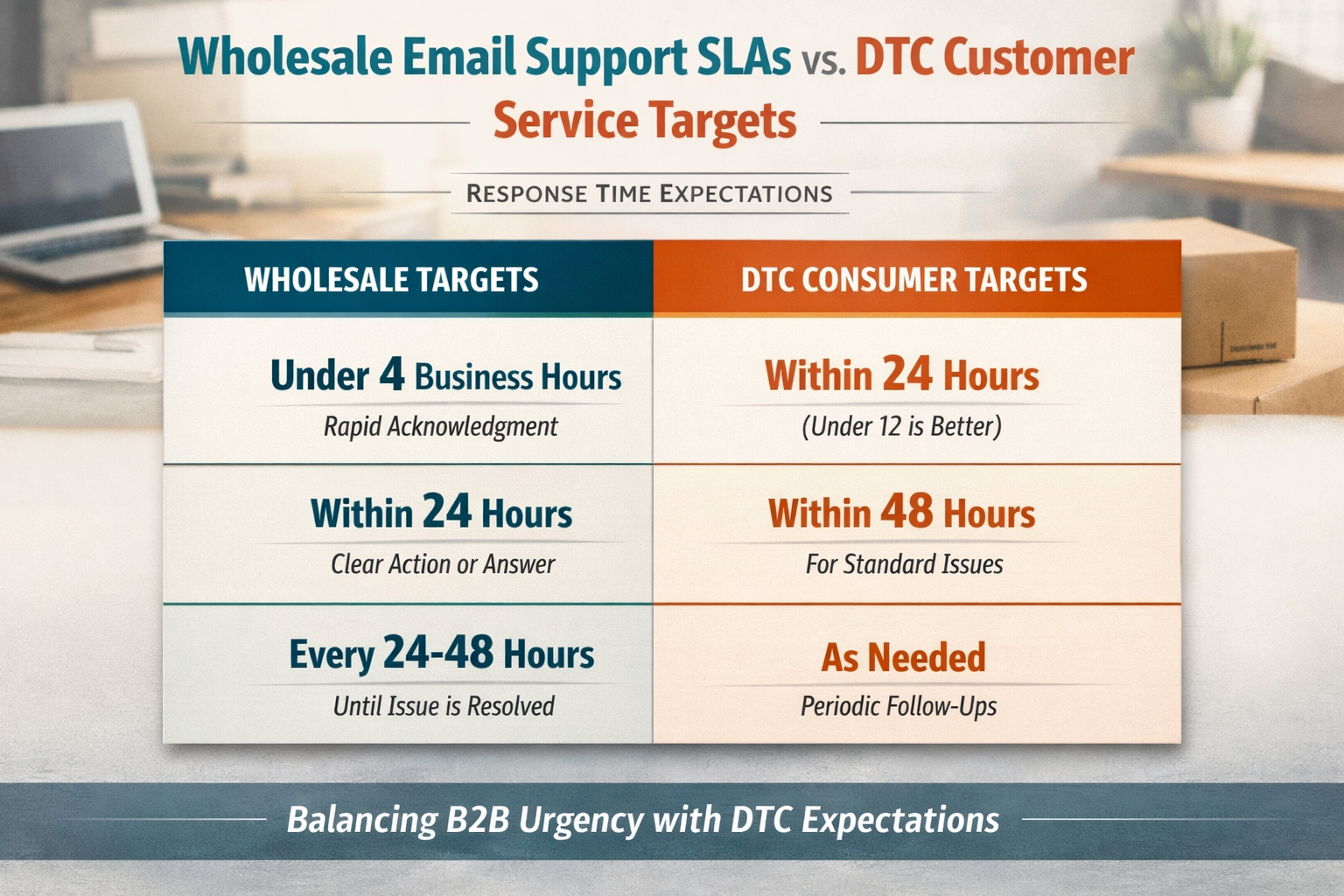
| Metric | Wholesale Target | Consumer Target |
| First response | Under 4 business hours | Within 24 hours (under 12 is better) |
| Resolution or clear next step | Within 24 hours | Within 48 hours for standard issues |
| Proactive updates on open issues | Every 24-48 hours until resolved | As needed |
The gap between these targets is intentional. It creates breathing room to protect wholesale relationships during busy periods without abandoning your consumer queue.
Communicating SLAs Without Over-Promising
You don't need to publish these targets publicly. In fact, it's often smarter not to—consumer expectations inflate quickly when you advertise fast response times.
For wholesale accounts, communicate expectations during onboarding. Something simple: "You can expect a response from our team within a few hours on business days. For urgent issues, here's a direct line."
That "direct line" doesn't have to be a phone number. It could be a specific email address, a Slack channel for your largest accounts, or clear escalation instructions.
3PL Coordination: The Hidden Support Burden
If you're shipping wholesale orders through a third-party logistics provider (3PL), you've added a layer of complexity that most support workflows ignore.
The Coordination Problem
Consumer order issues are usually straightforward: check tracking, issue refund, send replacement. You can often resolve them without leaving your helpdesk.
Wholesale order issues require coordination. A shipment arrives damaged? You need to contact the 3PL, file a claim, arrange replacement inventory, and keep the buyer informed throughout. A split shipment goes to the wrong locations? Same dance.
The support person handling these tickets needs:
Access to your 3PL's portal or direct contact with their support team
Authority to make decisions about replacements and credits
Clear documentation of wholesale order details (PO numbers, ship-to addresses, special instructions)
Time. These tickets take 3-5x longer than consumer tickets.
Building 3PL Coordination Into Your Workflow
Create a 3PL contact playbook. Document exactly how to reach your logistics partner for different issue types—missing shipments, damaged goods, address corrections, inventory discrepancies. Include contact names, emails, phone numbers, and typical response times. Keep this in your helpdesk's internal knowledge base where support agents can access it instantly.
Establish escalation thresholds. Not every 3PL issue needs founder involvement. Define clear boundaries: "For credits under $500, support can authorize independently. Over $500 requires approval." This speeds resolution and protects wholesale relationships.
Track 3PL-related tickets separately. Tag these tickets in your helpdesk so you can identify patterns. If your 3PL consistently causes issues with a specific retailer's shipments, you need to know that before it costs you the account.
Escalation Paths: When Wholesale Issues Need Leadership Attention
Even with great support processes, some wholesale issues require escalation. The key is defining when clearly, so nothing falls through cracks and leadership isn't pulled into every minor question.
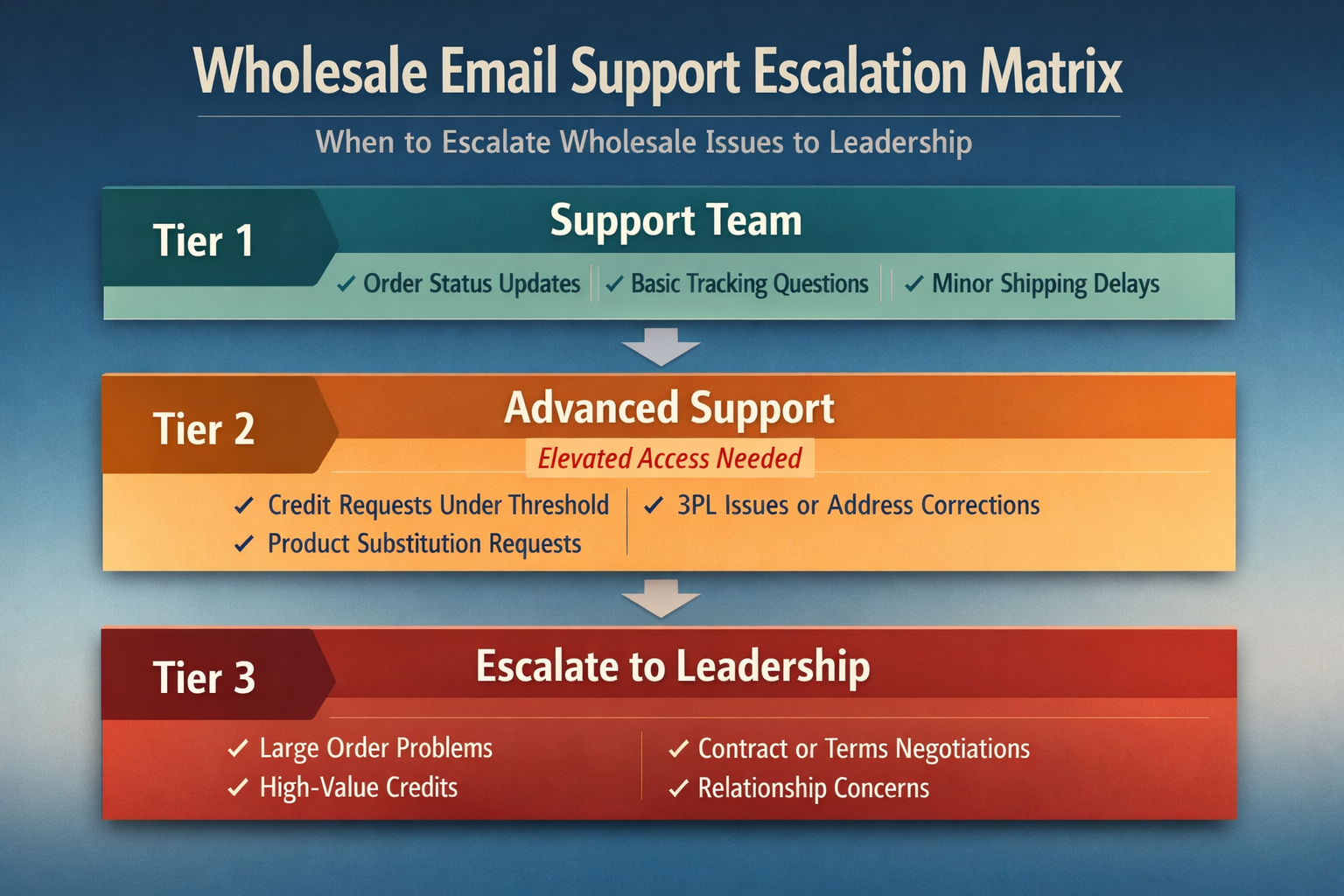
Escalation Matrix
| Tier | Who Handles | Issue Types |
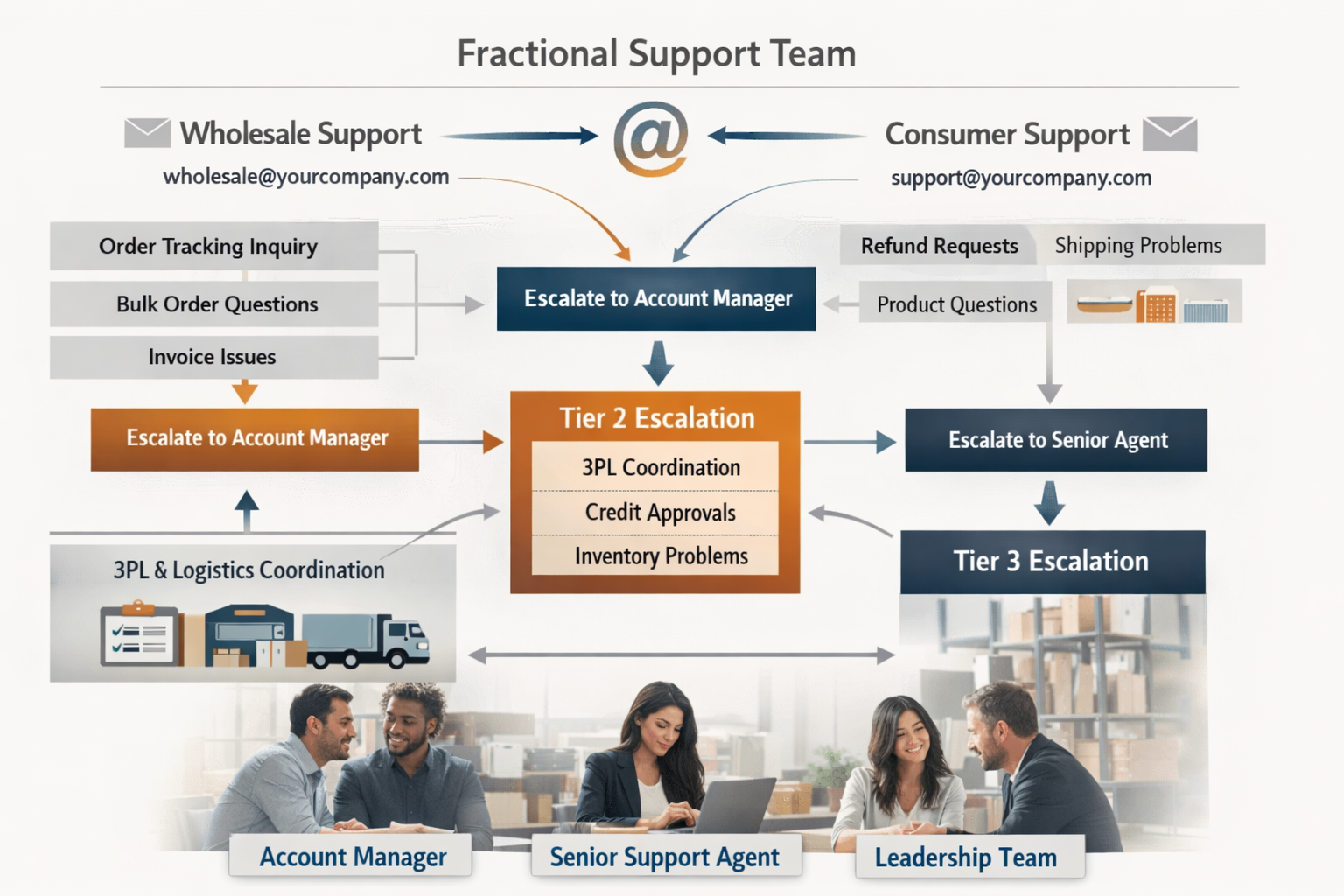
| Tier 1 | Support handles independently | Order status inquiries, basic tracking questions, standard invoice copies or documentation requests, routine reorders and catalog questions, minor shipping delays (under 48 hours) |
| Tier 2 | Support handles with elevated access | Credit requests under your defined threshold, 3PL coordination for damaged or missing items, address corrections requiring re-routing, product substitution requests, questions about upcoming orders or inventory availability |
| Tier 3 | Escalate to account manager or leadership | Credit requests over threshold, relationship concerns (buyer expressing frustration or dissatisfaction), large order complications (anything affecting 50+ units or multiple ship-to locations), contract or terms discussions, new wholesale account setup, requests outside standard policies |
Document this escalation matrix somewhere your support team can reference quickly. A shared doc works. A pinned message in your team Slack works. Whatever format ensures it actually gets used.
The Warm Handoff Principle
When tickets escalate, information should travel with them. Nothing damages wholesale relationships faster than making a buyer repeat themselves to multiple people.
Your escalation process should include:
A summary of the issue and any troubleshooting already completed
Relevant order details (PO number, order date, ship-to, tracking)
The buyer's stated concern and desired outcome
Any context about the account (size, history, relationship health)
Whether you handle this through helpdesk internal notes, a quick Slack summary, or a templated escalation form, consistency matters more than format.
The Fractional Team Alternative
One option worth considering: a fractional support team that handles first-line email for both queues, with clear escalation paths back to your team for complex issues.
This isn't about replacing your involvement in wholesale relationships. It's about protecting your bandwidth for the strategic work—relationship management, problem-solving, and growing the business—while someone else handles the routine volume.
How It Works in Practice
A fractional support partner handles incoming tickets across both DTC and wholesale queues. They learn your products, your brand voice, and your policies. They resolve routine issues independently and escalate anything requiring deeper involvement.
For wholesale support specifically, this means:
Faster first responses. Someone is monitoring the inbox during business hours, not checking between other tasks.
Consistent coverage. Vacations, sick days, and busy seasons don't create gaps.
Protected bandwidth. Your team handles escalations and relationship management, not password resets and tracking questions.
The key is the escalation process. A good fractional team knows exactly when to involve your leadership and provides complete context when they do.
When This Makes Sense
The fractional model works well when:
Support volume is too high for current staff but too low to justify a full-time hire
You have established processes and documentation (or a partner willing to build them)
Your wholesale accounts require faster response times than you can consistently deliver
The person currently handling support has higher-value work they should be doing
It's less ideal when:
Your product requires deep technical expertise that takes months to develop
You're still figuring out your support processes and policies
Volume is genuinely low (under 50 tickets monthly across both channels)
Building Your Hybrid Support Playbook
Whether you manage support internally, use a fractional team, or some combination, you need documented processes. Here's what to include:
Queue-Specific Response Templates
Create separate template libraries for DTC and wholesale. The tone and content differ.
Consumer templates tend to be warmer, more casual, and focused on individual satisfaction.
Wholesale templates are more professional, detail-oriented, and assume business context. They should reference PO numbers, account details, and next steps clearly.
Account Context Documentation
For wholesale accounts, maintain basic documentation:
Primary contact name and email
Order history and typical order size
Any special terms, pricing, or shipping requirements
Notes on relationship health and communication preferences
3PL or fulfillment specifics for their orders
This lives in your helpdesk as contact notes, in a CRM, or even a shared spreadsheet. Format matters less than accessibility—can your support team find this information in under 30 seconds?
The Weekly Queue Review
Spend 15 minutes weekly reviewing both queues:
Consumer queue: Average response time, common issues, any tickets over 48 hours old
Wholesale queue: Response times, open issues, any accounts requiring follow-up, pattern analysis
This lightweight review catches problems before they escalate. A wholesale ticket that's been open for five days is a relationship at risk.
Protecting Wholesale Relationships While Scaling DTC
The tension between these queues doesn't disappear as you grow. It just shifts. The practices that work at 50 orders a week need adjustment at 500.
Principles That Scale
Separation at intake. However you route tickets, keep wholesale and consumer streams visually and operationally distinct.
Wholesale gets priority. Not because consumer customers don't matter—they do. But the asymmetric stakes justify asymmetric treatment.
Documentation compounds. Every process you document, every template you create, every escalation path you define makes the next hire, the next partner, the next growth phase easier.
Response time is relationship currency. For wholesale buyers especially, fast responses signal that you value the relationship. Slow responses signal the opposite, regardless of intent.
Your Next Step
Take 20 minutes this week to audit your current setup:
How are wholesale and consumer tickets separated (or not)?
What's your actual response time for each queue over the past month?
Who handles support, and what else should they be doing instead?
Do you have documented escalation paths, or does everything require judgment calls?
If you're finding gaps—and most hybrid brands do—start with the highest-impact fix. Usually that's queue separation or escalation documentation.
And if the honest answer is "we can't consistently deliver the response times our wholesale accounts deserve," consider whether a fractional support team could protect those relationships while you focus on growing the business.
Ready to stop choosing between your DTC customers and your wholesale accounts? Book a call with Evergreen Support to explore how a fractional team can handle first-line email while you focus on the relationships and work that scale your brand.
Frequently Asked Questions
What's the ideal response time for wholesale customer support emails?
Most wholesale buyers expect same-business-day acknowledgment, with resolution or clear next steps within 24 hours. A practical target is first response within 4 business hours during your coverage window. This is faster than typical consumer SLAs because the stakes are higher—wholesale accounts represent larger revenue and longer-term relationships. Even if you can't fully resolve an issue immediately, acknowledging the inquiry and providing a timeline builds trust.
How do I handle 3PL issues that affect wholesale shipments?
Build a coordination playbook that documents exactly how to reach your 3PL for different issue types—damaged shipments, missing inventory, address corrections. Include contact names, response time expectations, and the information your 3PL needs to investigate. For wholesale tickets involving 3PL coordination, update the buyer proactively every 24-48 hours until resolution. These tickets take longer than standard consumer issues, so factor that into your workload planning.
Should wholesale and DTC support use separate email addresses?
Separate addresses are the simplest way to route tickets correctly and track performance by queue. Even if the same person monitors both, the visual separation changes behavior and makes prioritization easier. Use something like wholesale@yourbrand.com or accounts@yourbrand.com for B2B inquiries. Most helpdesk tools can route these into separate inboxes automatically, giving you clear visibility into each queue's health.
When should I escalate a wholesale support issue to leadership?
Define escalation thresholds in advance based on three factors: financial impact (credits over a set dollar amount), relationship risk (buyer expressing dissatisfaction), and scope (issues affecting large orders or multiple shipments). Tier 1 issues like order status and basic documentation can be handled by support independently. Tier 2 issues requiring elevated access—like mid-size credits or 3PL coordination—stay with support but may need special permissions. Tier 3 issues involving relationship concerns, large credits, or contract discussions should escalate to account managers or leadership with full context.
Can a fractional support team handle wholesale accounts effectively?
Yes, with proper onboarding and clear escalation paths. A fractional team can handle first-line wholesale inquiries—order status, tracking, routine documentation requests, and initial triage of more complex issues. The key is ensuring they understand your wholesale SLAs, have access to account context, and know exactly when to escalate. This protects your bandwidth for relationship management and complex problem-solving while ensuring wholesale buyers get the fast, professional responses they expect.
About Evergreen Support
Evergreen Support is a US-based customer support agency built specifically for small online businesses—SaaS companies and ecommerce brands—who need reliable, human-powered email support without the overhead of building an internal team. Founded by Emma Fletcher and Ellis Annichine, two former startup operators who understand the challenges of scaling support while protecting customer relationships. Every client works with dedicated support specialists who learn your brand voice, your products, and your wholesale and consumer workflows. No AI chatbots, no offshore call centers—just experienced humans helping humans, so you can focus on growing your business.
Works Cited
[1] Evergreen Support — "5 Benefits of Using a Fractional Customer Support Team." https://www.evergreensupport.co/blog
[2] Forrester Research — "The State of Customer Service." https://www.forrester.com/research/customer-service/