Last Tuesday, a founder messaged me at 11:47 PM. "Just closed a $2K deal. Can't celebrate—got 23 support tickets from today."
That's the SaaS founder paradox. You're winning. Users love your product enough to pay for it. But every new customer adds weight to an inbox you're already drowning in.
Most founders wait too long to get help. They think outsourcing support is something you do "later"—after you've raised a Series A, hired a team, proven the model. Reality check: by then, you've already lost users to slow responses. You've already burned weekends answering password reset emails instead of shipping features.
Working with a customer support agency isn't a luxury move. For early SaaS startups, it's a retention strategy that protects growth while keeping you sane.
The Hidden Tax of Founder-Led Support
Support eats your day in ways spreadsheets never capture.
You're not just answering tickets. You're context-switching between coding, customer calls, investor emails, and "Where's my invoice?" questions. Research by Dr. Gloria Mark at UC Irvine found that interruptions cost an average of 23 minutes to regain full focus on the original task. Five support interruptions daily? That's nearly two hours of pure productivity loss just from mental gear-shifting.
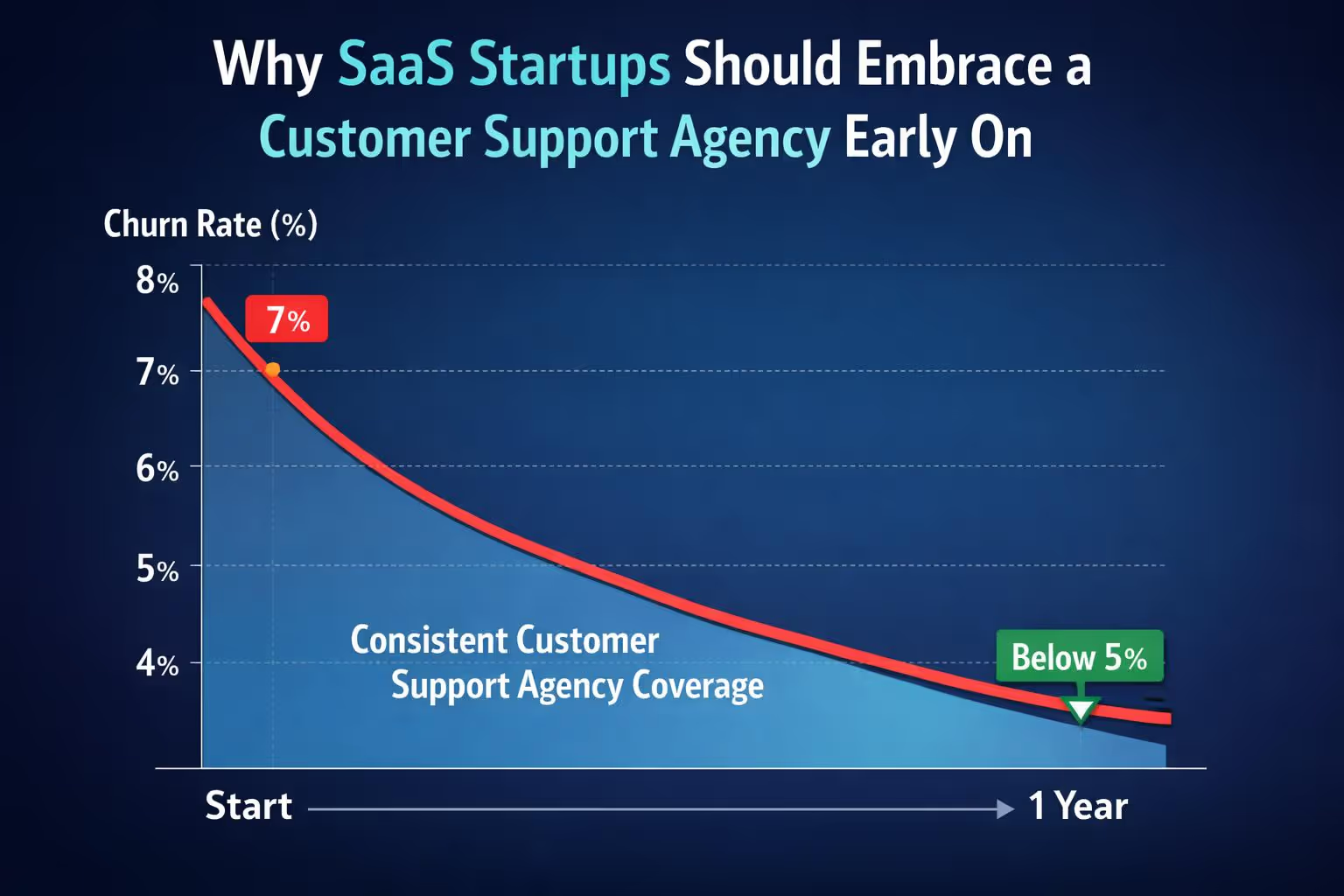
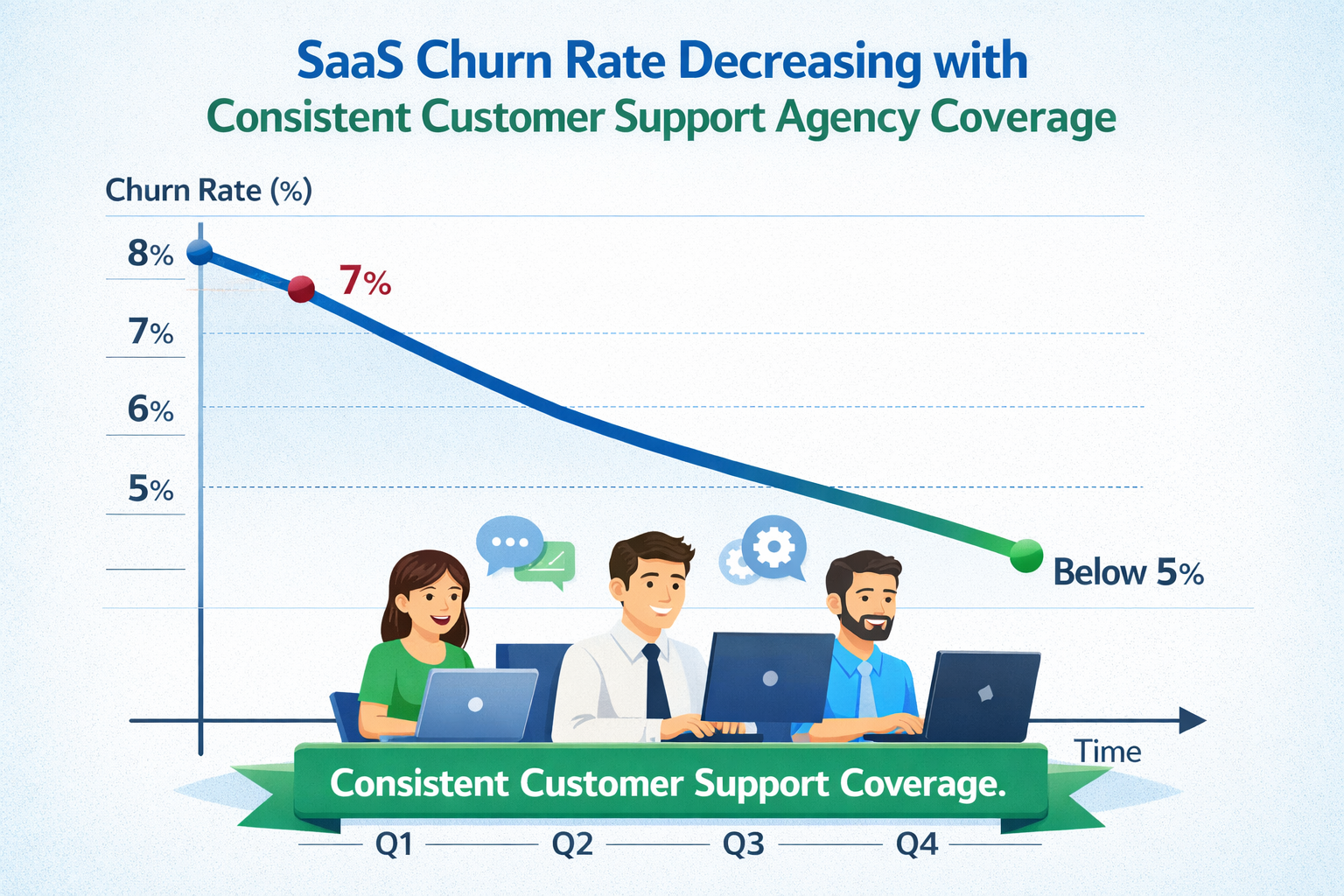
The churn numbers tell a brutal story. B2B SaaS companies experience annual churn rates between 3.5% and 4.9%, with anything below 5% considered strong performance. Early-stage startups often face steeper climbs—monthly churn can hit 7-8% as teams refine product-market fit and learn which customer segments actually stick.
Here's the part that stings: only one out of 26 unhappy customers actually complains. The other 25? They silently cancel. When your response times slip past 24 hours because you're buried in product work, users leave without telling you why.
Customer expectations haven't gotten more reasonable. Ninety percent rate immediate responses as important or very important. Not "fast." Immediate. And 96% of customers who experience high-effort support become disloyal—they're gone.
Calculate what your time actually costs. Your hourly value as founder might range from $150-400 depending on your skillset, market, and what you're building. But let's use a conservative $200 estimate. If you're spending 10-15 hours weekly on support, that's $2,000-3,000 weekly in opportunity cost. Annually? Six figures of value you're burning on work that doesn't compound.
How Agencies Turn Response Time Into Competitive Advantage
Speed isn't about heroics. It's infrastructure.
Customer support agencies hit response targets you can't match solo: acknowledgment within one hour, full resolution within four hours for standard issues. Every single day. Including the days you're in all-day investor meetings or finally taking that weekend off.
The Retention Economics
Increasing customer retention by just 5% can boost profitability by 25% to 95%, according to research from Bain & Company. The variation depends on your business model, customer acquisition costs, and lifetime value calculations—but the direction is always up. When users get consistent, fast responses whether it's Monday morning or Saturday evening, they stick around. They tolerate bugs. They wait for features. Because someone clearly cares.
Four Structural Advantages
Agencies bring capabilities founder-led support simply can't replicate:
Coverage without interruption. They handle tickets during your focus blocks. No more breaking flow to check if that urgent tag is actually urgent.
Professional support writers. Not generalists figuring it out. Specialists trained in the specific skill of balancing empathy with efficiency—turning frustrated users into advocates through written communication alone.
Consistent quality. Tuesday's support quality matches Saturday's. That predictability builds trust faster than occasional heroic all-nighters.
Smart escalation systems. You see complex bugs, feature discussions, and high-value accounts. They handle the repetitive stuff that doesn't need founder brain cycles.
The best agencies document everything. They follow your style guide, use your knowledge base, sound like your team. Because they work from your playbook, not a generic script factory.
Email-First Support: The Right Channel for Early SaaS
Most early SaaS companies don't need phone support or 24/7 live chat.
They need responsive, helpful email support that unblocks users and keeps them moving forward. Period.
Why Email Works for Startups
Email fits early-stage constraints perfectly:
Users understand asynchronous communication—they're not expecting instant replies like chat
You get time to craft complete, accurate answers instead of real-time improvisation
Written responses create documentation automatically
One agent can handle 20-40 tickets daily versus 5-8 concurrent chats
No expensive phone infrastructure or chat software licensing
The Economics Make Sense
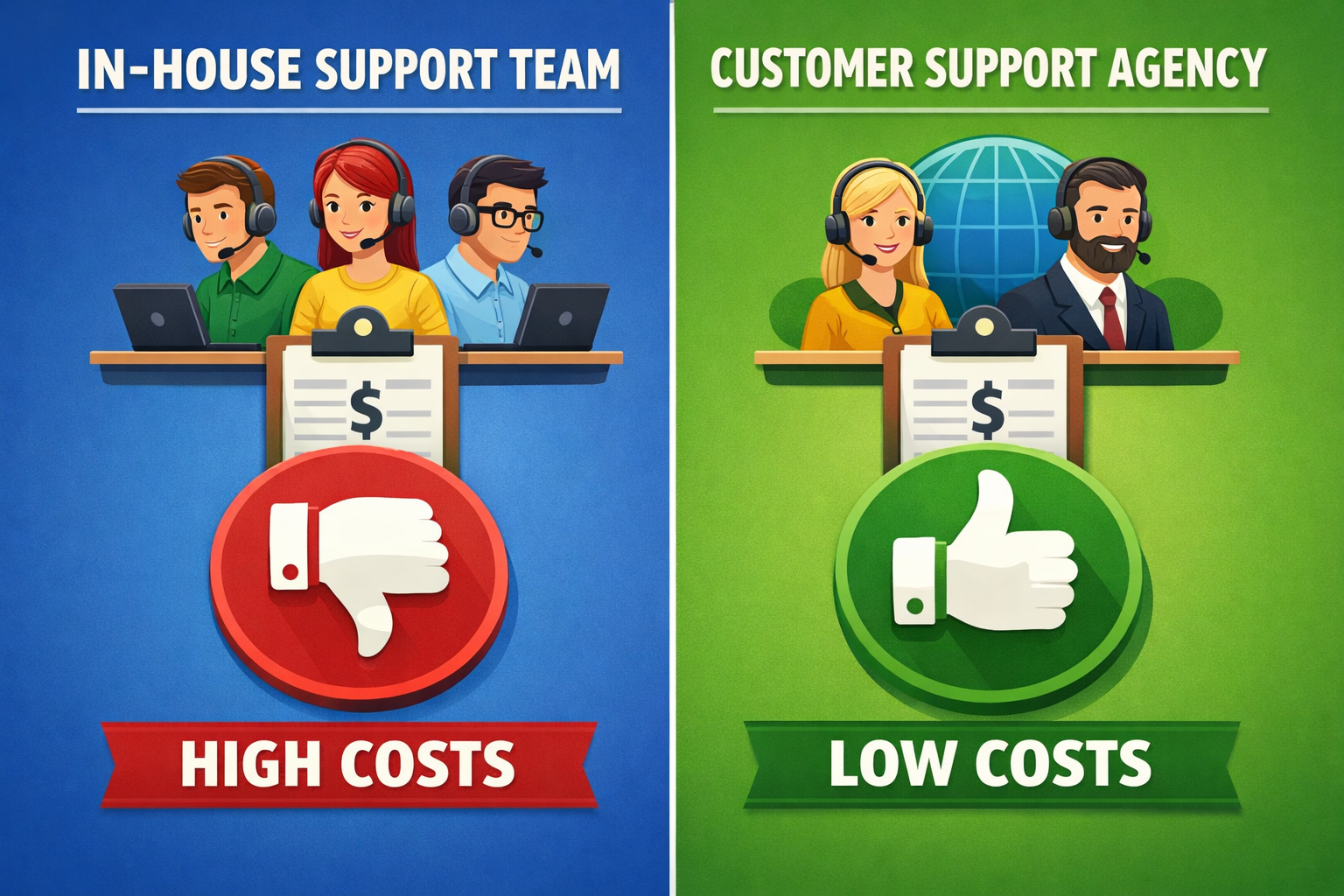
This channel choice changes your math entirely. Instead of hiring a full-time support person at roughly $45,000-55,000 annually (the typical range for entry-level support roles according to PayScale and Glassdoor data), plus 20-30% for benefits, training, and management overhead, you pay for coverage you actually need.
Most agencies specializing in SaaS startups charge $2,000-3,500 monthly for fractional email support—typically 15-25 hours weekly. That's 30-60% cost reduction compared to internal teams when you factor in recruiting, training, management, tools, and infrastructure. Some analyses show savings up to 83% for email-specific support.
But the real win is flexibility. Product launch next week? Scale up coverage. Slow month after the holidays? Scale back. Try doing that with a full-time employee without layoffs or wasted payroll.
Implementation: Starting Small and Scaling Smart
Biggest founder mistake? Thinking you need perfect documentation and processes before bringing in help.
Wrong.
Good agencies start by handling your FAQ tickets—password resets, billing questions, "how do I do X" basics. These repetitive questions consume hours but don't require deep product expertise. As they learn your product and voice over 2-4 weeks, they gradually take more complex issues.
Week 1-2: Foundation
Agency reviews your existing documentation, FAQ, and past tickets
You provide 10-15 example responses showing your brand voice
They handle tier-1 support only (account access, billing basics, simple how-to)
Daily check-ins to calibrate tone and catch gaps
Week 3-4: Expansion
Confidence builds, they take tier-2 issues (feature questions, workflow troubleshooting)
You're reviewing fewer tickets, just spot-checking quality
Knowledge base grows based on common questions they're fielding
Escalation paths clarify naturally through practice
Month 2+: Autonomy
They're handling 80-90% of inbound independently
You see summaries of trends, not individual tickets
Complex bugs, strategic feature requests, VIP accounts still route to you
The system runs without your constant attention
This keeps you close to customer feedback without drowning in it. You stay informed through weekly summaries highlighting patterns, common pain points, and emerging issues. The day-to-day grind happens without you.
What Professional Email Support Actually Looks Like
Quality standards matter more than speed alone.
Fast Acknowledgment (Within 1 Business Hour)
"Hey Sarah, got your message about the export timing out. Looking into this now—I'll have a solution for you within 3 hours. If this is blocking urgent work, you can also call us at [number]."
Clear, Contextual Responses (Within 4 Hours for Standard Issues)
Not templates. Answers that reference the user's specific situation, explain solutions step-by-step with screenshots where helpful, and confirm understanding. "Based on what you described about the CSV having 50,000 rows, here's why the timeout is happening..."
Brand Voice Consistency
The tone matches your company—casual and friendly or professional and precise. Users can't tell who's responding. They just know they're getting help.
Proper Escalation
Complex technical bugs, feature requests from power users, accounts paying $500+ monthly—these get flagged for founder attention within an hour. Everything else resolves at the agency level.
Documentation Improvement
As patterns emerge ("Five people asked about Zapier integration this week"), they suggest FAQ additions and help article updates to reduce future volume.
Companies working with specialized email support agencies see measurable improvements: median response times drop from 8-12 hours to under 2 hours, CSAT scores rise 15-25 points, and early-stage churn improves as users feel consistently supported.
The ROI That Never Shows Up in Spreadsheets
Founder mental bandwidth.
Think of it this way: your brain is a single-threaded processor pretending to multitask. Support tickets are like rogue processes constantly interrupting your main program. When you're not constantly checking support email—during meetings, before bed, first thing morning—you can run uninterrupted. You can spend 3 hours on architecture without context switches. Take investor meetings without anxiety about the ticket queue. Actually take a day off without compulsively checking your phone.
This isn't about working less. It's about working on things only you can do.
Customer support matters intensely—but 90% of tickets don't require founder involvement. Agencies handle that 90% so you can focus on the 10% where you're irreplaceable: complex technical decisions, strategic feature discussions, key customer relationships.
Several founders I've worked with describe this as "getting their company back." They're building again instead of managing an inbox.

When to Actually Make This Move
Probably sooner than you think.
Watch for these signals:
You're regularly answering support emails nights and weekends (voluntarily or not)
Response times routinely hit 24+ hours during busy weeks
You've declined opportunities because you're "catching up on support"
You have 10+ recurring questions you answer weekly
Your active user count crossed 50 and support volume is climbing
You just raised funding and need to execute fast
Don't wait until you're drowning. Get ahead of growth.
Starting small is fine. Most agencies serving SaaS startups offer fractional arrangements—you pay for hours you need, typically 15-20 hours weekly initially. Monthly investment of $2,000-3,500 covers that, with coverage scaling as your user base grows.
This early investment protects two things that matter most: your users' experience and your productive time. Users get responsive support that keeps them engaged. You get freedom to build the product that attracted them in the first place.
Choosing Your Support Partner
Not all agencies understand early-stage SaaS.
SaaS Email Support Specialization
They should understand subscription models, common SaaS workflows, how to write technical content that's clear without being condescending. Ask to see example responses from similar clients.
Startup Experience
Agencies primarily serving enterprise often have rigid processes built for scale. You need flexibility—comfortable with rapid iteration, growing knowledge bases, evolving processes as your product matures.
Transparent Pricing
Avoid complex per-ticket charges that spike unpredictably. Hourly or monthly retainer models work best because they're predictable and easy to budget.
Partnership Mindset
The best agencies surface insights from support conversations, suggest process improvements, genuinely care about your users' success. They're an extension of your team, not a vendor.
Tool Integration Capabilities
Ask which platforms they work with. Most professional agencies integrate seamlessly with popular helpdesk tools like Zendesk, Intercom, Help Scout, Front, and Gorgias. They should be comfortable working inside your existing stack rather than forcing you to switch platforms.
Strong Onboarding Process
Ask about their first 30 days. Good agencies invest 10-15 hours learning your product, voice, and workflows before handling tickets solo.
Red flags: agencies that promise instant starts (they're winging it), refuse to share example work, or push phone/chat when you explicitly need email-only.
Measuring What Actually Matters
Track these four metrics to know if the partnership is working:
First Response Time (FRT)
Target under 2 hours during business hours. Agencies hitting 1 hour consistently are excellent.
Resolution Time
Standard issues should resolve within 4-6 hours. Complex issues within 24 hours or get escalated.
Customer Satisfaction (CSAT)
Post-ticket surveys should run 85%+ positive. Below 80% means quality issues.
Ticket Volume Trends
If the same questions keep coming up, your documentation needs work. Good agencies surface these patterns proactively.
The metric you shouldn't track: cost per ticket. This optimizes for the wrong thing—minimal effort per interaction—when you actually want thorough resolutions that prevent follow-ups.
What Not to Outsource (At Least Not Yet)
Boundaries matter.

Keep In-House
Strategic customer conversations about roadmap and positioning
Complex technical debugging requiring architecture knowledge
High-value accounts (enterprise deals, strategic partnerships)
Feature request prioritization discussions
Customer development interviews for product direction
Can Be Outsourced Early
Password resets, account access, billing basics
Standard how-to questions covered in docs
Bug reports (they gather info, then escalate with details)
Feature questions about existing functionality
Onboarding help and general troubleshooting
The line blurs over time. As agencies gain product knowledge and your documentation improves, they can handle increasingly complex questions. But early on, draw clear escalation criteria so nothing important slips through.
Security and Compliance Considerations
Something most articles skip: data access and security.
What to Ask About
Data handling policies. How does the agency store customer information? What happens to tickets after resolution?
Access controls. Can you limit which team members see sensitive data? Do they use two-factor authentication?
Compliance requirements. If you're in healthcare (HIPAA), finance, or serving EU customers (GDPR), the agency needs specific compliance capabilities. Not all have them.
NDAs and data ownership. Your customer conversations are your intellectual property. Contract should make this explicit.
Most reputable agencies have standard security protocols, but verify rather than assume—especially if you handle sensitive customer data.
Contract Terms Worth Negotiating
Don't just sign standard agreements.
Key Terms to Address
Month-to-month vs. annual commitment. For your first agency partnership, push for monthly terms. Trust must be earned.
Response time SLAs. Get specific targets in writing: "90% of tickets acknowledged within 1 business hour" not vague "fast response."
Exit provisions. What happens if you need to transition back in-house or to another agency? How long is the offboarding period?
Data ownership and deletion. When the contract ends, do they delete all customer data? How long does that take?
Performance metrics and review cadence. Built-in monthly reviews keep quality high and catch issues early.
Reasonable agencies welcome these discussions. If they push back on reasonable terms, that's your red flag.
Common Objections (And Reality Checks)
"But I need to stay close to customers."
You will. Just not through repetitive support tickets. Stay close through scheduled customer development calls, strategic account check-ins, analyzing support trends the agency surfaces. Quality matters more than quantity.
"Our product is too technical/complex."
So is everyone's. Good agencies have onboarded into everything from developer tools to healthcare SaaS to e-commerce platforms. Technical products just need better documentation and clearer escalation paths.
"What if they give wrong answers?"
That's what the first 2-4 weeks of close oversight is for. You're training them, catching gaps, building the knowledge base. After that, quality checks are weekly spot reviews, not real-time monitoring. Plus, wrong answers happen with internal teams too—the solution is better documentation, not avoiding help entirely.
"Customers will notice they're talking to an agency."
Not if you choose the right partner. Professional agencies spend serious effort on voice matching. They study your previous responses, follow style guides, use your terminology. Done right, users just experience consistent, helpful support.
A Contrarian Take: Outsourcing Too Early Beats Too Late
Conventional wisdom says "build in-house first, outsource when you're mature."
That's backwards.
Early is actually the perfect time to outsource because:
Your support volume is still manageable (easier to onboard when it's 20 tickets weekly, not 200) You haven't built bad habits or messy processes yet The agency helps you build scalable documentation from day one Your time is worth MORE now—you're establishing product-market fit, not optimizing mature operations
Waiting until you "really need it" means waiting until you're already drowning. Then you're trying to onboard an agency while buried in backlog, making mistakes, and losing customers to slow responses.
Counter-intuitive but true: the best time to get support help is before you desperately need it.
The Bottom Line on Early Agency Partnerships
Support isn't a cost center. It's a retention mechanism that directly impacts revenue.
Every interaction is a chance to convert confused users into power users. Every fast response prevents churn. Every helpful answer increases lifetime value. When you hand this to a customer support agency executing consistently, you're not just saving time—you're protecting and growing revenue.
Early days are crucial. You're proving product-market fit, building initial traction, showing your idea works. You can't afford to lose users because support fell through cracks. You also can't afford to stop shipping features because you're buried in tickets.
Smart founders recognize which battles need personal attention and which need delegation to specialists. Support is a battle worth delegating early—especially for email-centric SaaS products where written communication scales well.
Your users deserve responsive support. Your product deserves focused attention. A customer support agency partnership makes both possible from day one.
Ready to reclaim your time while keeping users supported? Check out Evergreen Support's pricing to see how fractional email support fits early-stage budgets.
Frequently Asked Questions
When should a SaaS startup first consider outsourcing customer support?
Watch for specific signals rather than arbitrary revenue milestones. If you're spending more than 10 hours weekly on support, if response times regularly exceed 24 hours, or if you're turning down growth opportunities because support demands too much time—it's time. Most SaaS startups benefit from fractional support once they have 50+ active users generating consistent support volume. Counter-intuitively, starting early (before you desperately need it) is often smarter than waiting until you're drowning in tickets. The investment pays for itself in retained customers and recovered founder productivity.
What does email support from a customer support agency cost for early-stage SaaS companies?
Fractional email support typically runs $2,000-3,500 monthly for 15-25 hours of weekly coverage, depending on complexity and response time requirements. This represents 30-60% savings compared to hiring a full-time support person when factoring in salary (typically $45,000-55,000 annually for entry-level), benefits (20-30% additional), training, management overhead, and tools. Most agencies offer flexible month-to-month arrangements, allowing you to scale coverage up or down as your user base grows. For very early stage startups (under 30 active users), some agencies offer lighter packages starting around $1,500 monthly for basic coverage.
How do you maintain customer relationships when support is outsourced?
Outsourcing routine support actually strengthens strategic customer relationships by freeing you for high-value conversations. You stay connected through regular ticket reviews, handling all escalations personally, and conducting scheduled customer development calls and strategic account check-ins. The agency surfaces important feedback, feature requests, and emerging trends in weekly summaries. You're not losing touch—you're delegating repetitive interactions so you can focus on customer conversations that truly impact product direction and growth. The difference between answering "How do I reset my password?" versus "Here's how we're using your product to solve X" is massive for both your time and relationship quality.
Can a support agency learn a technical SaaS product well enough to provide accurate answers?
Yes, with proper onboarding and documentation. Agencies specializing in SaaS support have experience learning technical products quickly—they've onboarded into everything from developer tools to healthcare platforms. Start by having them handle straightforward tickets (account questions, billing, basic how-to), then gradually expand as product knowledge deepens over 2-4 weeks. Complex technical debugging, architecture questions, and strategic feature discussions get escalated to your team per agreed criteria. The key is maintaining a strong knowledge base and clear escalation paths. Over time, agencies can handle surprisingly complex questions as documentation improves and their expertise grows. The typical timeline: basic competency in 2 weeks, solid capability in 4-6 weeks.
What security and compliance considerations matter when outsourcing support?
Start with data handling and access controls. Ask how the agency stores customer information, what happens to tickets after resolution, and whether they use two-factor authentication. If you're in regulated industries—healthcare (HIPAA), finance, or serving EU customers (GDPR)—the agency needs specific compliance capabilities that not all possess. Your contract should address NDAs, data ownership (your customer conversations are your intellectual property), and data deletion procedures when the partnership ends. Reputable agencies have standard security protocols, but verify rather than assume, especially if you handle sensitive customer data. Request their security documentation and compliance certifications during evaluation.
E-E-A-T Section
This guide draws from documented implementation patterns across email-centric SaaS businesses serving 50-500 active users, combined with published industry research on customer retention, support economics, and startup operations. The strategic framework reflects approaches validated through customer success metrics including response time improvements, churn reduction, and founder time recovery across bootstrapped software companies prioritizing capital efficiency.
Cited Works
[1] Mark, Gloria — "The Cost of Interrupted Work: More Speed and Stress." University of California, Irvine. https://www.ics.uci.edu/~gmark/chi08-mark.pdf
[2] Vitally — "B2B SaaS Churn Rate Benchmarks: What's a Healthy Churn Rate in 2025?" https://www.vitally.io/post/saas-churn-benchmarks
[3] Fullview — "Average Churn Rate For SaaS Companies (2025 Update)." https://www.fullview.io/blog/average-churn-rate-for-saas-companies
[4] Bain & Company — "Retaining Customers Is the Real Challenge." https://www.bain.com/insights/retaining-customers-is-the-real-challenge/
[5] Fullview — "100+ Customer Support Statistics & Trends for 2025." https://www.fullview.io/blog/support-stats
[6] PayScale — "Customer Service Representative Salary." https://www.payscale.com/research/US/Job=Customer_Service_Representative/Salary
[7] Prialto — "2025 Outsourcing Statistics and Trends." https://www.prialto.com/blog/outsourcing-statistics-trends
[8] Working Solutions — "Cost of Outsourcing Customer Service: Pricing Models & Savings Guide." https://workingsolutions.com/blog/how-much-does-it-cost-to-outsource-customer-service/
[9] SupportYourApp — "How Much Will Customer Service Outsourcing Cost Me in 2025?" https://supportyourapp.com/blog/how-much-customer-service-outsourcing-cost/
[10] ChartMogul — "SaaS Metrics Benchmarks Report 2025." https://chartmogul.com/resources/saas-benchmarks/